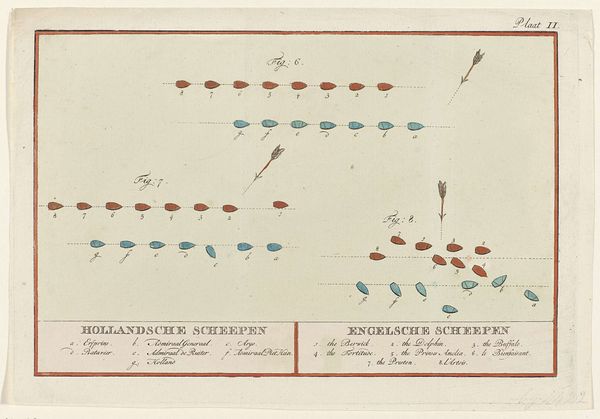
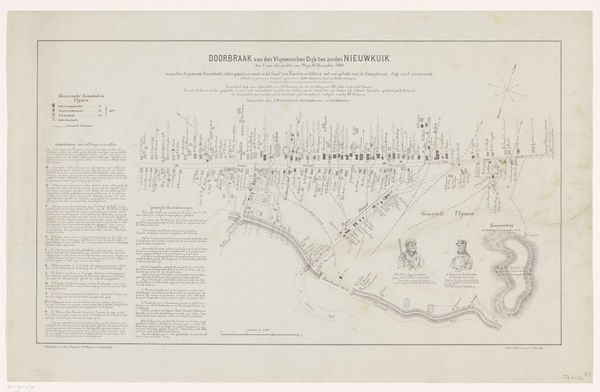
Posities van de Nederlandse en Engelse schepen bij de zeeslag bij Doggersbank, 1781 (plaat I) 1781 - 1783
0:00
0:00

Dimensions: height 196 mm, width 274 mm
Copyright: Rijks Museum: Open Domain
This diagram illustrates the positions of Dutch and English ships at the Battle of Dogger Bank in 1781. The anonymous draughtsman uses a formal, almost abstract style to chart naval movements. Notice the composition is neatly divided; on either side, we see rows of stylized ships rendered in red and blue. These colors aren't merely decorative, they function as coded indicators within a semiotic structure. The legend tells us how to read the symbols. Arrows show wind direction while ship types and naval ranks are systematically labelled. The image presents a rational, ordered view of naval engagement, distilling complex dynamics into comprehensible signs. Observe the visual language and the formal arrangement of shapes. The composition doesn't seek to represent the chaos of battle, but rather to codify and control it through visual syntax. The ordered lines and emblematic ships reduce naval conflict to a set of legible elements. This reflects an Enlightenment sensibility—an impulse to analyze and categorize all phenomena through empirical observation and rational design.
Comments
No comments
Be the first to comment and join the conversation on the ultimate creative platform.
 Collect
 React
React Comment
More like this