#
architectural sketch
#
aged paper
#
old engraving style
#
personal sketchbook
#
botanical drawing
#
architectural section drawing
#
architectural drawing
#
architecture drawing
#
storyboard and sketchbook work
#
botanical art
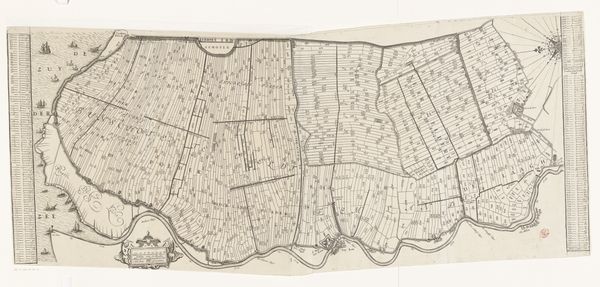
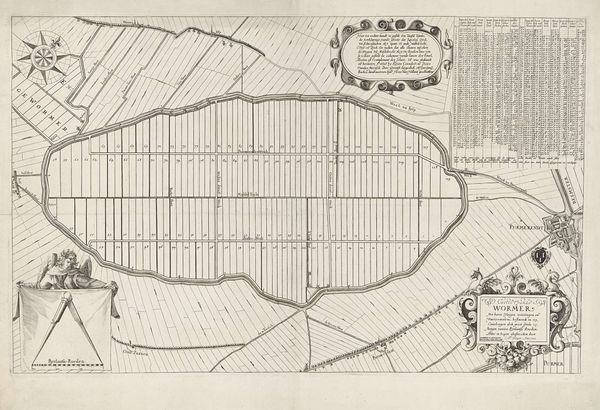
Dimensions: height 458 mm, width 740 mm
Copyright: Rijks Museum: Open Domain
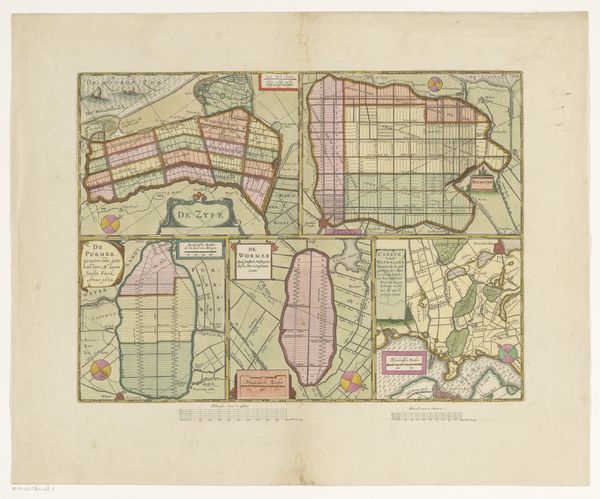
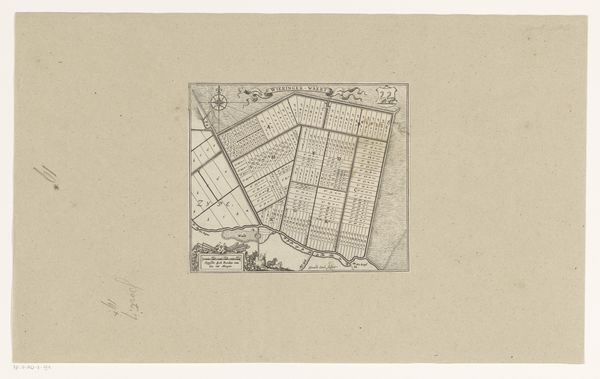
Editor: Here we have "Kaart met de kavels van de Wormer," a map dating sometime between 1627 and 1668 by Laurens van Teylingen. It has an intriguing layout, very geometric, with these long rectangular shapes laid out inside this defined perimeter. What jumps out at you? Curator: What fascinates me immediately is the interplay between precision and abstraction. Notice the exacting detail in the delineation of plots, juxtaposed with the overall stylized rendering. Consider, too, the symbolic weight of the empty cartouche at the bottom left. It establishes a visual tension with the other ornamented sections. What is its semiotic value? Editor: Are you suggesting the blank cartouche asks the viewer to insert meaning? How does that tie into the piece as a whole? Curator: Precisely. It encourages reflection on the nature of mapping itself—as both a representational and an imaginative act. Note how the ordered segments yield a formal, almost meditative visual rhythm that belies the implied political control. Can we therefore observe an intersection of social architecture and pure form? Editor: So, even in a seemingly straightforward map, there's an inherent subjectivity communicated through visual choices? That's a lot to consider. Curator: Indeed. It's in these structural nuances that the piece achieves its resonance. A deceptively straightforward image yielding intricate aesthetic codes!
Comments
No comments
Be the first to comment and join the conversation on the ultimate creative platform.
 Collect
 React
React Comment
More like this