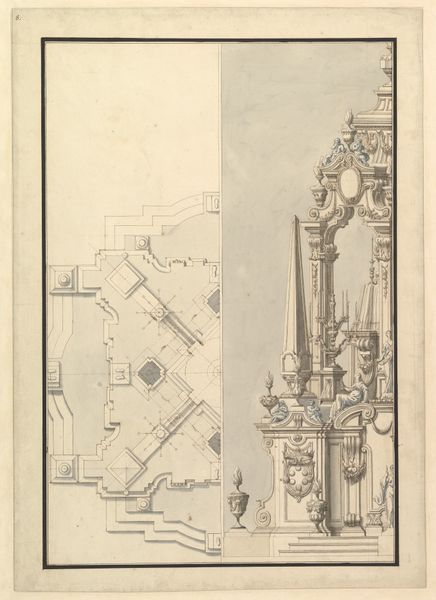
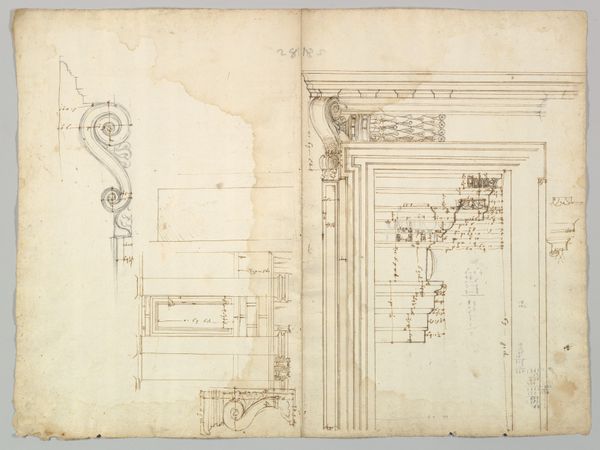
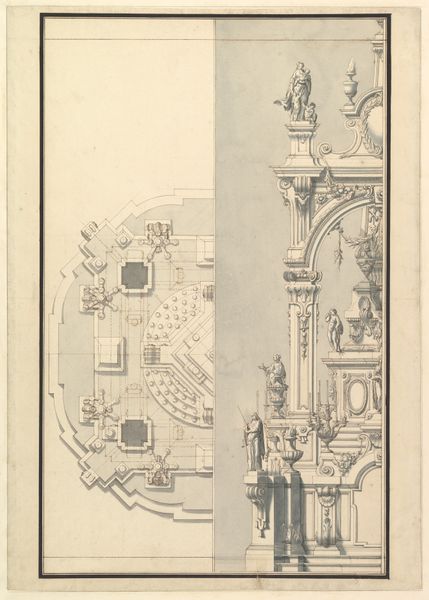
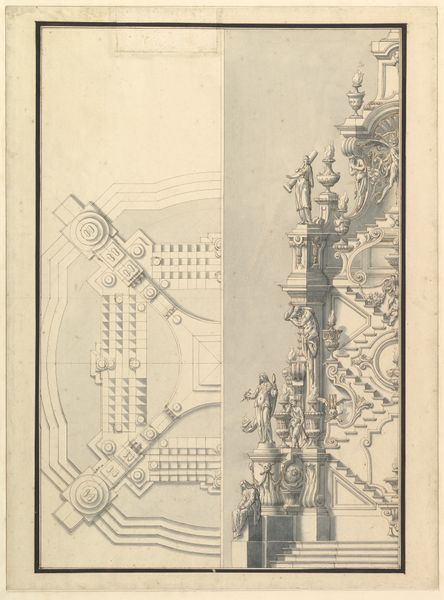
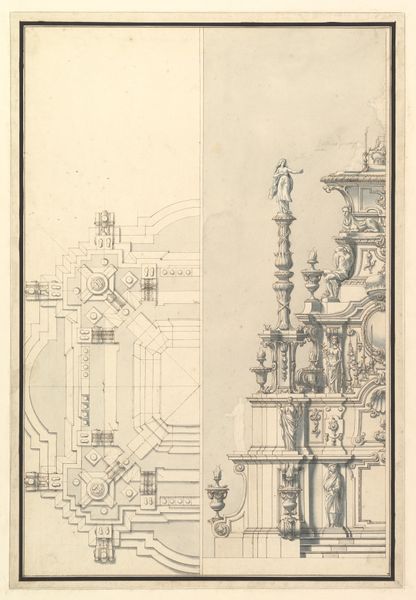
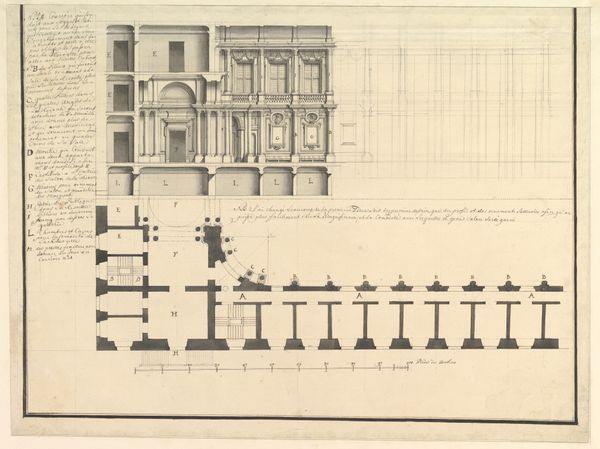
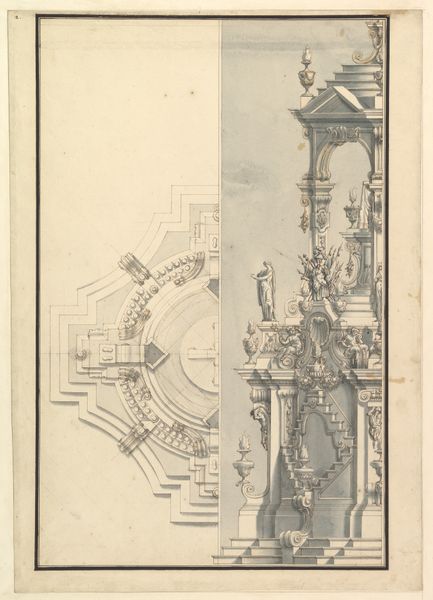
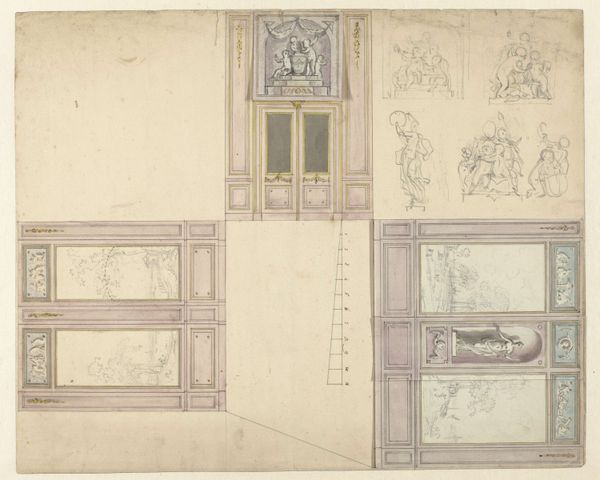
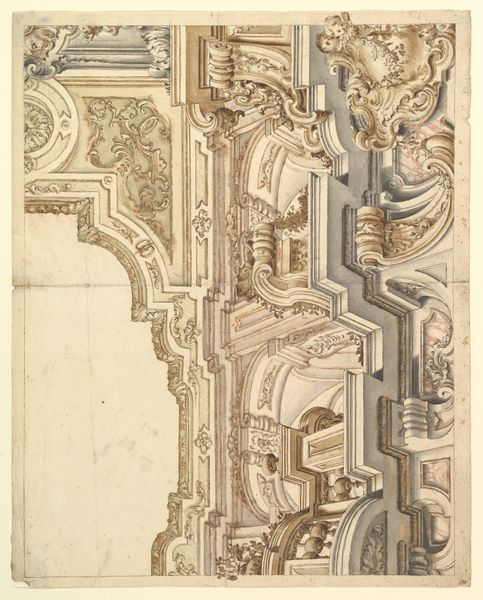
Designs for the Theater at Nancy: View of Half the Proscenium and a Half a Section of It; End of the Ceiling; and Ground Plan 1659 - 1739
0:00
0:00


drawing, print, architecture
#
drawing
#
baroque
# print
#
architecture
Dimensions: 16-7/16 x 20-5/8 in. (41.8 x 52.4 cm)
Copyright: Public Domain
Editor: So this is "Designs for the Theater at Nancy," by Francesco Galli Bibiena, sometime between 1659 and 1739. It's a drawing, almost a blueprint really. I'm immediately struck by how ornate it is, even for just a design. How do you interpret the sheer abundance of detail here? Curator: The detail speaks volumes about power, doesn’t it? Consider the social function of theatre during that period. The baroque style, exemplified here, wasn't merely decorative. It was a visual language of authority, intended to impress and to convey the might of the patron, most likely royalty or aristocracy. This theatre design is essentially a stage for power itself, mirroring the hierarchies of society. Editor: A stage for power, that's interesting. So, the audience wasn’t just watching a play; they were also participating in a display of social order? Curator: Precisely! The architecture becomes a form of social control. Notice how the design emphasizes perspective and grandeur, physically placing the audience in a position of spectatorship, reinforcing their roles within that social hierarchy. What does the architectural rendering itself evoke in you? Editor: It feels… distant, somehow. Like I'm looking at a world I can't access, frozen in time, which now, thinking about it, mirrors how people can experience elitist theatre and the performing arts nowadays. So, this design reflects and reinforces societal power structures? Curator: Exactly. It encourages us to question how spaces shape our understanding of social dynamics and access. Architecture, even in its design phase, is rarely neutral. Editor: That's a great way to put it. I'll definitely look at design and spaces with fresh eyes from now on! Curator: Likewise, it’s so important to bring contemporary ideas to older forms so we might continually reshape our understanding of art and its impact on culture.
Comments
No comments
Be the first to comment and join the conversation on the ultimate creative platform.
 Collect
 React
React Comment
More like this