print, engraving
#
baroque
# print
#
old engraving style
#
classical-realism
#
history-painting
#
engraving
Dimensions: height 220 mm, width 299 mm
Copyright: Rijks Museum: Open Domain
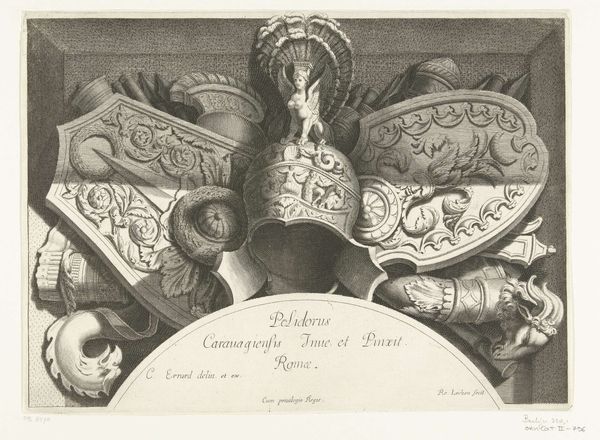
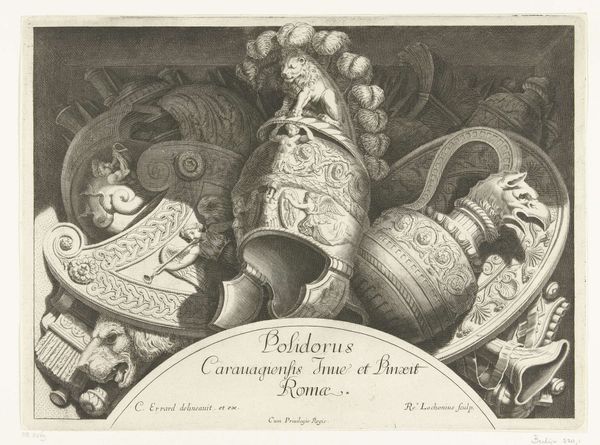
Editor: This is "Helm waarop Nike zit," or "Helmet with Nike Sitting on It," an engraving from 1651 by René Lochon after a design by Charles Errard. I’m really struck by the density of the composition. The level of detail is astonishing. What’s your take on this image? Curator: The composition displays a complex interplay of forms, doesn’t it? Note how the central helmet serves as the focal point, around which various other elements, such as shields and figural representations, are arranged. Are you noticing how the lines and textures contribute to a sense of depth, despite being a two-dimensional medium? Editor: Yes, I see what you mean. There's an almost tactile quality to the rendering of the textures. All the hatching gives it that rough yet precise feel. It is pretty cool, that’s for sure. I was reading how semiotics play a part. What’s that angle here? Curator: Semiotics would examine the signs and symbols used. The helmet itself functions as a signifier of warfare and power. And Nike, the goddess of victory, is atop, adding a layer of symbolic complexity. So, how does her placement modify the meaning of the helmet itself? Editor: It kind of elevates it, gives it this idea of divine approval, I suppose. Curator: Precisely. And beyond that, consider the composition as a structural system, in which each element affects and is affected by all the others. It brings a unity. Editor: It definitely presents more than just a helmet! Seeing it as a system of signs has totally changed my view of this piece. I’ll be pondering how to interpret visual culture more analytically now, considering how symbols interrelate, using semiotics as the structural framework to explore art’s layered significance.
Comments
No comments
Be the first to comment and join the conversation on the ultimate creative platform.
 Collect
 React
React Comment
More like this