print, metal, etching, engraving
#
baroque
# print
#
metal
#
pen illustration
#
etching
#
old engraving style
#
form
#
geometric
#
pen-ink sketch
#
limited contrast and shading
#
line
#
pen work
#
engraving
Dimensions: height 223 mm, width 303 mm
Copyright: Rijks Museum: Open Domain
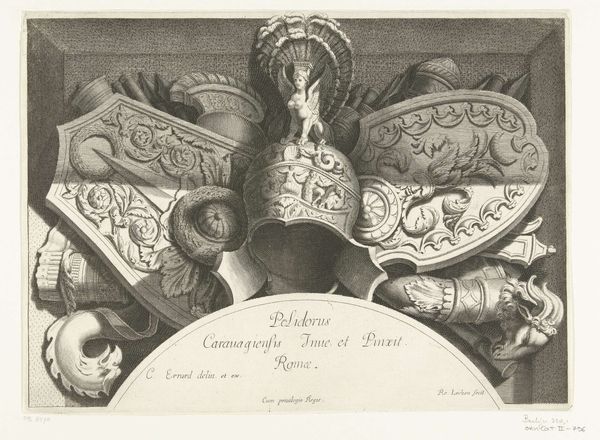
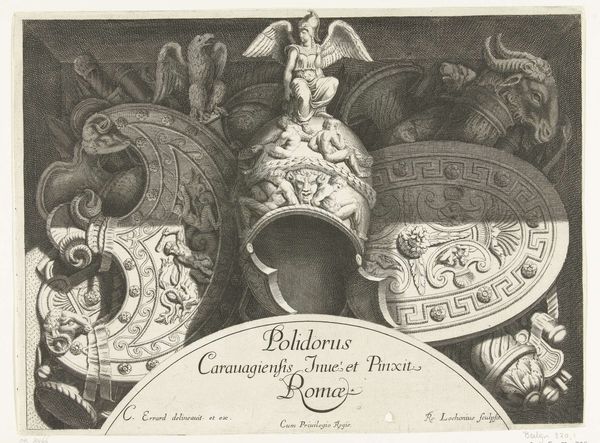
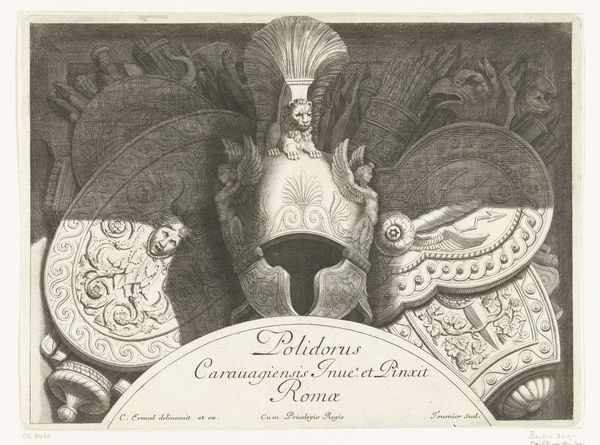
Editor: This engraving, "Helm bekroond met zittende leeuw," or "Helmet crowned with seated lion" was created in 1651 by René Lochon after drawings by Charles Errard. It is currently housed in the Rijksmuseum. There is a clear Baroque theatricality, a powerful sense of display, and the lion looks almost cartoonish in its regal stance atop the elaborate helmet. How do we unpack this combination of power and performance? Curator: The helmet becomes a stage! Let’s consider what armour represented in the 17th century, beyond simple protection. The aristocracy’s self-fashioning often utilized classical and heroic symbols. Here, the etching almost deconstructs the idea of invincibility by showcasing these accoutrements in a static, decorative way, devoid of a body. What does it mean to evoke power when that power isn't actively being used, but merely *represented*? It pushes us to question whose power it represents and what the actual impact is, beyond symbolic grandeur. Editor: I hadn't thought of it as deconstructing power, but more of a celebration, and the fact that it is simply a symbol. Is there something to the abundance of geometric forms in the composition? Curator: Absolutely. The geometric precision, typical of Baroque design, also mirrors a desire for order and control—qualities often associated with dominant power structures. Consider this through a critical lens: Whose order is being imposed? What are the social costs of such rigid control? What I also see are the erasures of individuals, which is an important note to make because the piece emphasizes these ideas around heroism without the mention of who can actually perform that heroism, which likely eliminates marginalized populations from that equation. Editor: So the form and content are intricately linked, both contributing to this message about constructed power? Curator: Exactly! And thinking about who was meant to view this, within what social hierarchies, enriches our interpretation of its lasting social impact. Editor: This makes me view the image in a whole new light! Seeing it as a reflection on the *performance* of power and how that resonates with identity is something I never would have considered. Curator: Precisely! This is what I find so fascinating; how the historical can illuminate the contemporary and vice versa!
Comments
No comments
Be the first to comment and join the conversation on the ultimate creative platform.
 Collect
 React
React Comment
More like this