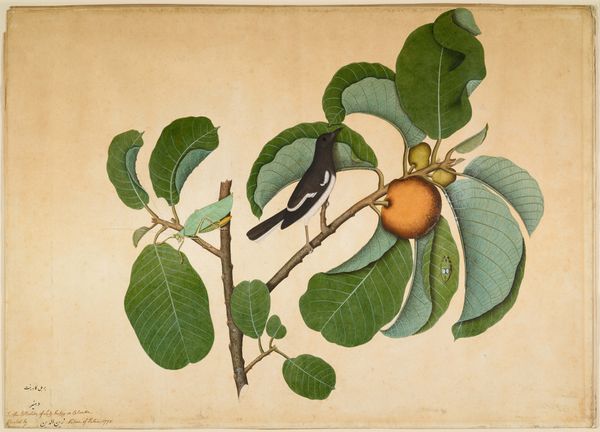
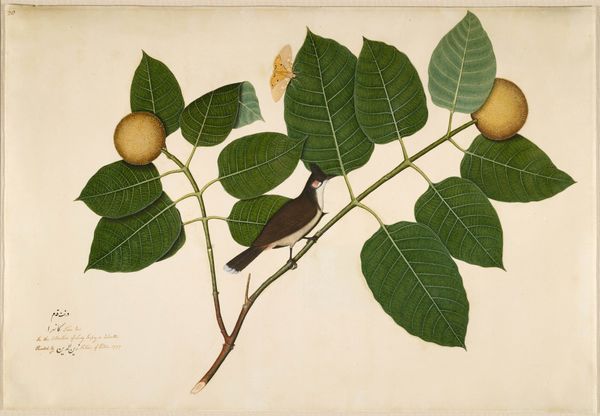
Black-hooded Oriole and Insect on Jackfruit Stump 1778
0:00
0:00


painting, watercolor
#
portrait
#
painting
#
asian-art
#
oil painting
#
watercolor
#
watercolour illustration
#
botanical art
#
miniature
#
watercolor
#
realism
Dimensions: 30 × 38 × 1 in. (76.2 × 96.52 × 2.54 cm) (outer frame)
Copyright: Public Domain
Editor: Here we have Sheikh Zain al-Din’s "Black-hooded Oriole and Insect on Jackfruit Stump" from 1778. It's a watercolor painting, and the detail is just amazing! What jumps out to you when you look at it? Curator: Consider the materiality here. Watercolor allows for incredibly precise depiction, and this detail speaks to the context of its creation. It's not just about representing the oriole or the jackfruit, it's about possessing that knowledge through the act of detailed rendering. Do you see the almost scientific precision in the leaves' veins, or the textures conveyed using watercolour that simulate the bird's feather pattern? Editor: Absolutely, it’s like a botanical or zoological illustration. So, what does this emphasis on the material tell us about its purpose? Curator: The medium enables a meticulous record, and its miniature scale also suggests an elite commission, intended perhaps for a collector or patron who prizes this kind of detail. It moves beyond just being "art" and shows a system where nature and science become extensions of materialist ways of thinking. It challenges assumptions and dissolves boundaries as an act of knowledge-production through a specific artistic labour. The labour produces more than just an image. Editor: So, it's about knowledge production rather than just aesthetic appreciation. It really puts the work into a new context, especially understanding it as a form of material knowledge in its time. Curator: Precisely. Paying close attention to the materials and process reveals so much more than what is at first perceived as simple aesthetics! It demonstrates how we think about and organize the natural world.
Comments

minneapolisinstituteofart over 2 years ago
⋮
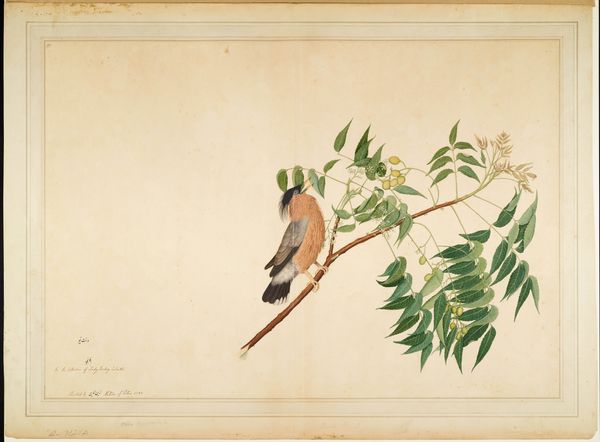
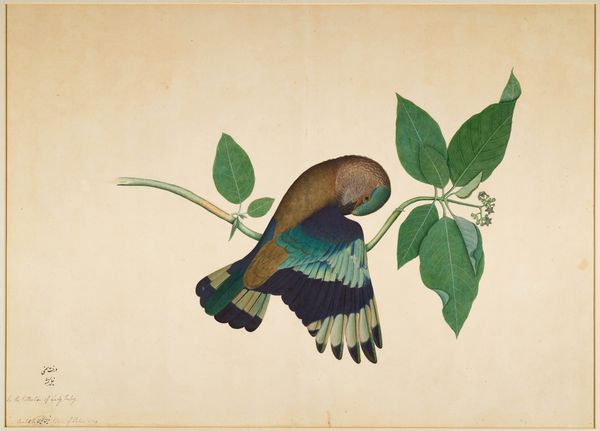
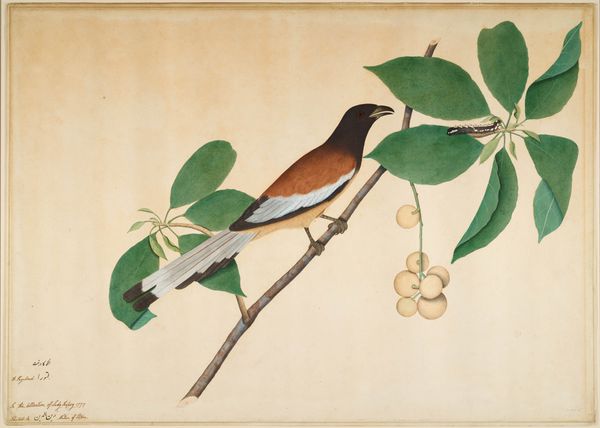
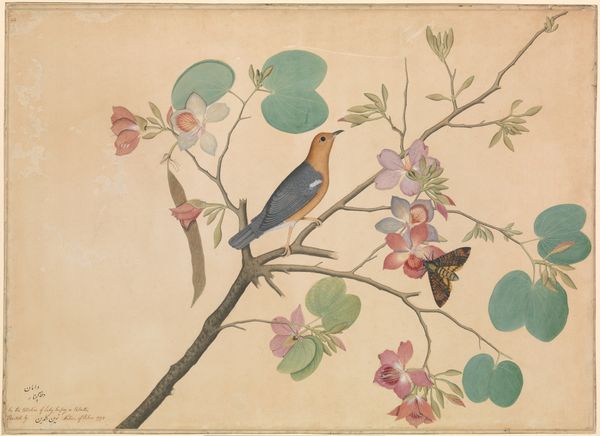
The famed ‘Impey Album,’ to which these 11 natural history studies originally belonged, marks the beginning of a new school in the canon of Indian Painting: that is “Company Painting’’—so called after the British East India Company, which by 1757 had taken effective rule over the sub-continent—spanning from c. 1760-1880 and distinguished by native painters adapting to the needs of Colonial tastes. The result was an emergence of a distinctive Anglo-Indian aesthetic, which we see in the remarkable paintings here. Between 1777-1783, Lady Mary Impey, wife of the recently appointed Chief Justice of Bengal, Sir Elijah Impey, commissioned three artists: a Muslim, Shaik Zain ud-Din, and two Hindus, Bhawani Das and Ram Das (all of whom trained in a Provincial Mughal atelier in the neighboring city of Patna) to record the newfound wonders of her Calcutta aviary and menagerie.


Join the conversation
Join millions of artists and users on Artera today and experience the ultimate creative platform.
 Collect
More like this