painting, paper, watercolor, ink
portrait
water colours
painting
asian-art
indigenism
paper
watercolor
ink
watercolour illustration
miniature
watercolor
realism
Dimensions: 30 × 38 × 1 in. (76.2 × 96.52 × 2.54 cm) (outer frame)
Copyright: Public Domain
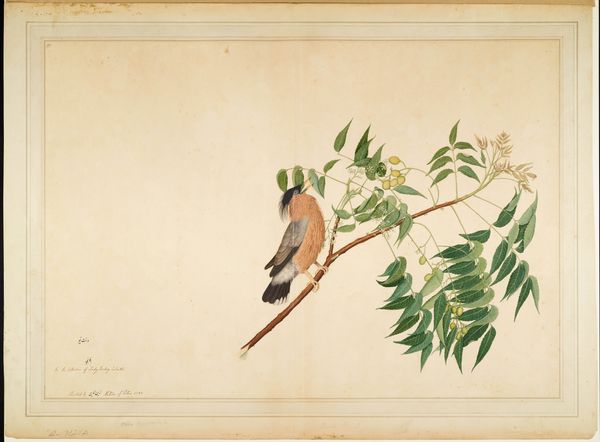
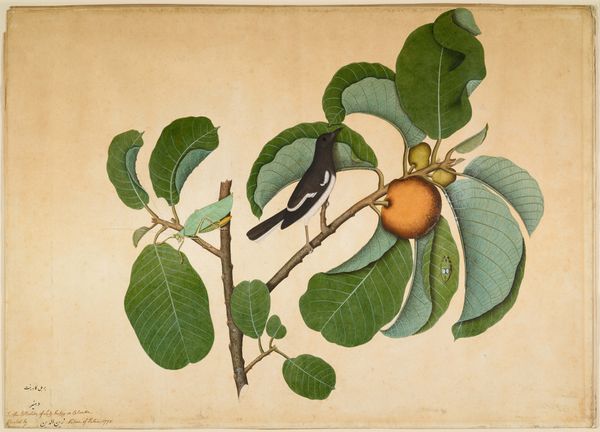
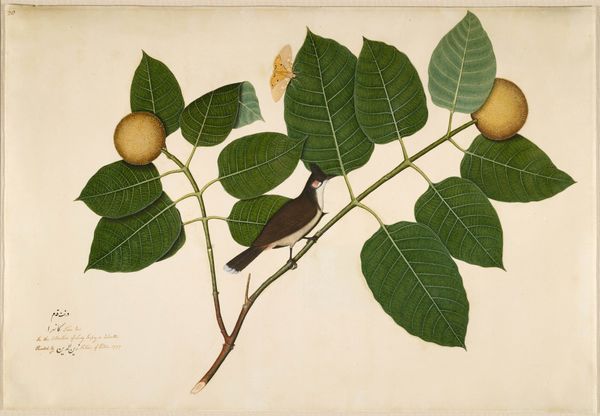
Editor: Here we have Sheikh Zain al-Din's "Indian Roller on Sandalwood Branch," created in 1779 using watercolor and ink on paper. It's striking how realistic the bird looks; the feathers are so carefully rendered. What stands out to you in this piece? Curator: Well, let’s consider the paper itself. Its sourcing, preparation, and the labor involved. It's not just a passive surface, but an active participant in the image's creation. What can the texture and origin of the paper tell us about the colonial context and the means by which these images were made? Editor: That's interesting, I hadn't thought about the paper that deeply! It looks fairly smooth. Did the artist prepare it a certain way for the watercolor to sit on the surface? Curator: Precisely. Consider also the pigments: where did Zain al-Din source these vibrant colors? Were they local, or were they traded goods? The materials speak volumes about the networks of exchange operating at the time and about how they enable Zain al-Din’s craft. Editor: So, understanding the trade routes for the paper and the watercolors tells us about global commerce and colonial impact even within something that appears to be a simple nature scene? Curator: Absolutely. And beyond just the materials themselves, consider the skill and labor needed to manipulate them into such detailed imagery. The time invested suggests the value placed on such depictions. Was this painting commissioned and by whom? Editor: Wow, I'm now thinking about the artist's studio as a workshop, producing for a specific market. Looking at it now, it appears to me that even a piece so focused on nature could become a cultural artifact, highlighting production methods. Curator: Precisely. By examining the materials and means of production, we uncover hidden narratives within the art itself.
Comments

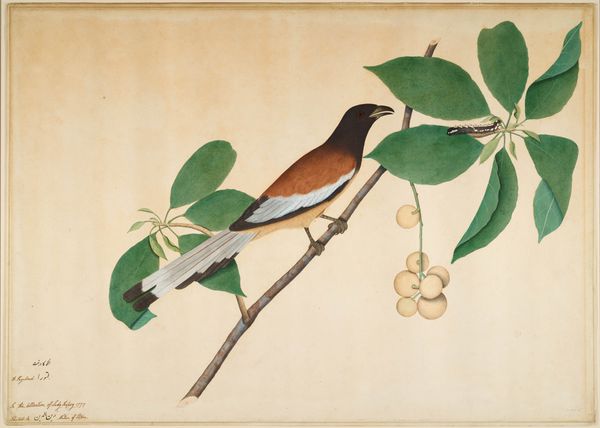
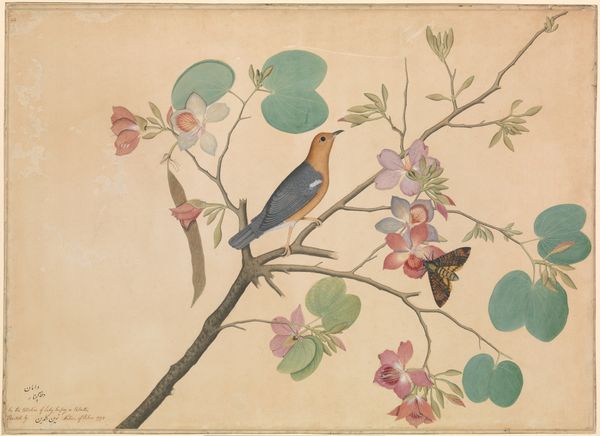
The famed ‘Impey Album,’ to which these 11 natural history studies originally belonged, marks the beginning of a new school in the canon of Indian Painting: that is “Company Painting’’—so called after the British East India Company, which by 1757 had taken effective rule over the sub-continent—spanning from c. 1760-1880 and distinguished by native painters adapting to the needs of Colonial tastes. The result was an emergence of a distinctive Anglo-Indian aesthetic, which we see in the remarkable paintings here. Between 1777-1783, Lady Mary Impey, wife of the recently appointed Chief Justice of Bengal, Sir Elijah Impey, commissioned three artists: a Muslim, Shaik Zain ud-Din, and two Hindus, Bhawani Das and Ram Das (all of whom trained in a Provincial Mughal atelier in the neighboring city of Patna) to record the newfound wonders of her Calcutta aviary and menagerie.


Join the conversation
Join millions of artists and users on Artera today and experience the ultimate creative platform.