drawing, watercolor
#
portrait
#
drawing
#
asian-art
#
watercolor
#
watercolour illustration
#
botanical art
#
watercolor
Dimensions: 30 × 38 × 1 in. (76.2 × 96.52 × 2.54 cm) (outer frame)
Copyright: Public Domain
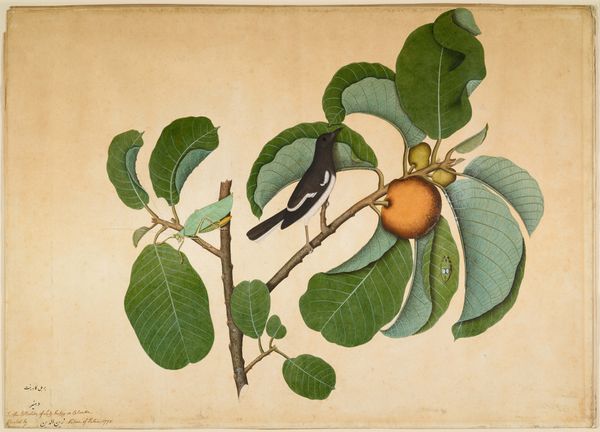
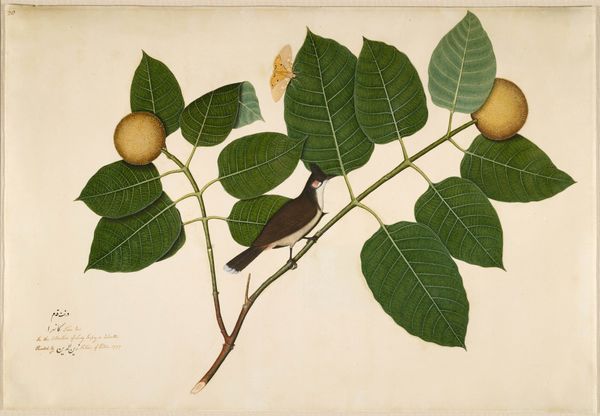
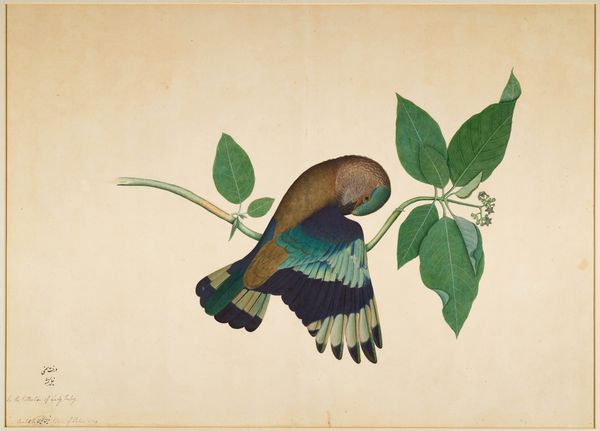
Sheikh Zain al-Din, an Indian artist working in the late eighteenth century, painted "Rufous Treepie and Caterpillar on Branch" with opaque watercolor on paper. Zain al-Din was among a number of Indian artists patronized by the British East India Company to record the flora and fauna of the Indian subcontinent. This piece exemplifies the kind of hybridity that emerged during the colonial period. Commissioned for British scientific documentation, it nonetheless resonates with the aesthetic sensibilities of Mughal painting traditions. The treepie is rendered with a naturalist's precision, its plumage carefully detailed, while the surrounding foliage suggests a deeper connection to its natural environment. Zain al-Din’s painting operates as both a scientific record and an aesthetic object, reflecting the complex power dynamics and cultural exchanges of colonial India. It invites us to consider the intersections of art, science, and empire. How do these intersections shape our understanding of the natural world and our place within it?
Comments

minneapolisinstituteofart over 2 years ago
⋮
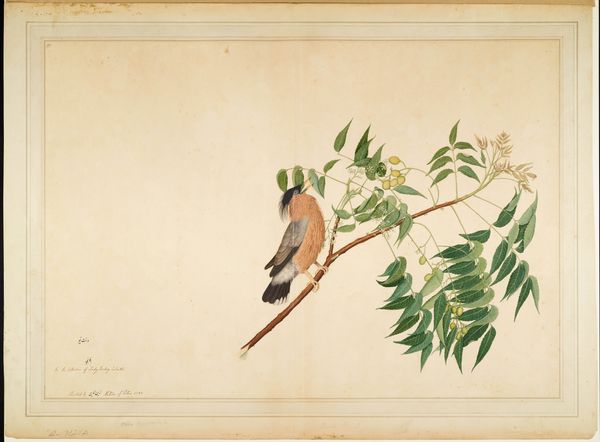
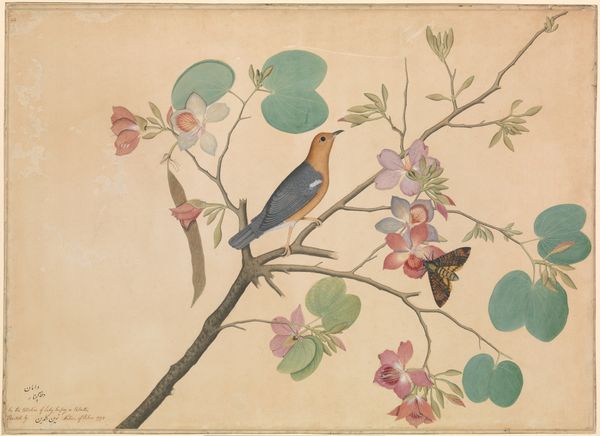
The famed ‘Impey Album,’ to which these 11 natural history studies originally belonged, marks the beginning of a new school in the canon of Indian Painting: that is “Company Painting’’—so called after the British East India Company, which by 1757 had taken effective rule over the sub-continent—spanning from c. 1760-1880 and distinguished by native painters adapting to the needs of Colonial tastes. The result was an emergence of a distinctive Anglo-Indian aesthetic, which we see in the remarkable paintings here. Between 1777-1783, Lady Mary Impey, wife of the recently appointed Chief Justice of Bengal, Sir Elijah Impey, commissioned three artists: a Muslim, Shaik Zain ud-Din, and two Hindus, Bhawani Das and Ram Das (all of whom trained in a Provincial Mughal atelier in the neighboring city of Patna) to record the newfound wonders of her Calcutta aviary and menagerie.


Join the conversation
Join millions of artists and users on Artera today and experience the ultimate creative platform.
 Collect
More like this