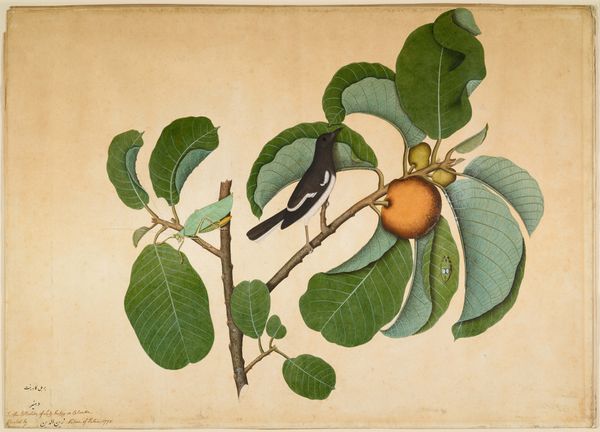
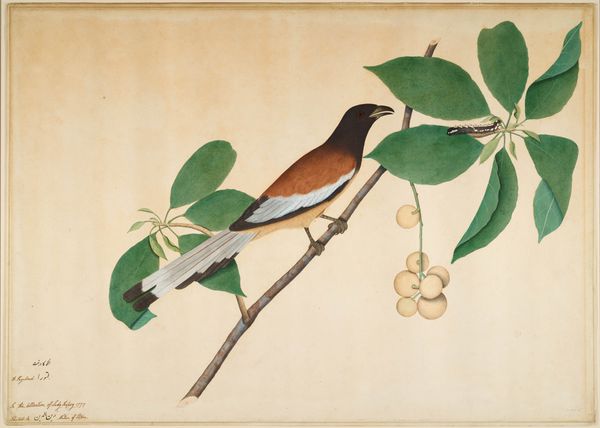
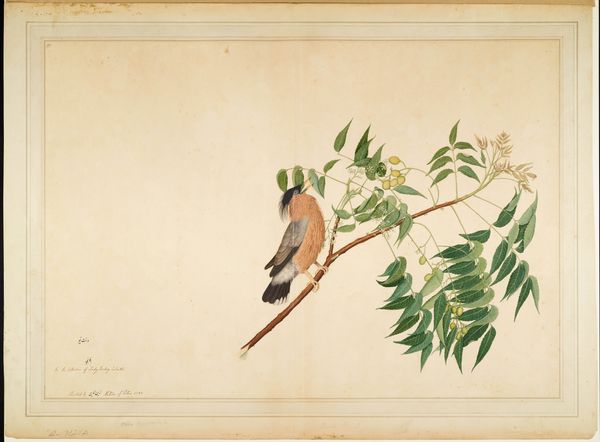
Red-whiskered Bulbul and Aganais Ficus Moth on Kadamba Branch 1777
0:00
0:00


painting, watercolor
#
portrait
#
water colours
#
painting
#
asian-art
#
watercolor
#
line
#
watercolour illustration
#
botanical art
#
realism
Dimensions: 28 1/2 × 37 × 1 in. (72.39 × 93.98 × 2.54 cm) (outer frame)
Copyright: Public Domain
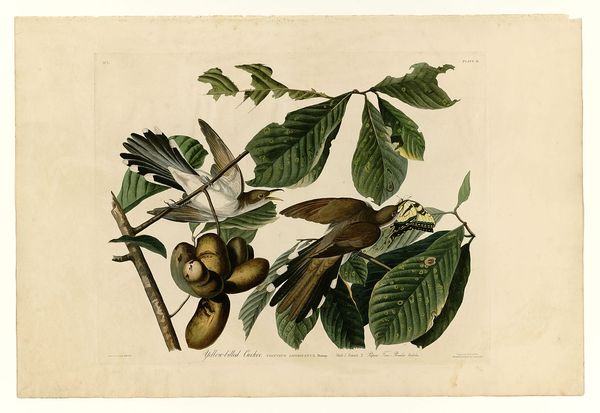
Curator: This lovely watercolor, "Red-whiskered Bulbul and Aganais Ficus Moth on Kadamba Branch," was completed in 1777. The artist, Sheikh Zain al-Din, created this while working as one of the artists supported by Lady Impey, the wife of the British Supreme Court Justice in Calcutta. Editor: The precision is really remarkable. The balance of greens and browns is very pleasing, too. It's simple, elegant. Curator: I think that Zain al-Din, working within the colonial context of 18th-century India, had an incredible ability to reflect a nuanced perspective on cross-cultural encounters. Lady Impey commissioned hundreds of paintings, reflecting her interest in the natural world, but the patronage also served imperial agendas by classifying and documenting the exotic 'other'. Editor: Absolutely. The clear outlines, the smooth application of pigment - it is Western in some senses. There is an illusionism and perspective at play, though, and Zain al-Din's draftsmanship and detail is what arrests your attention. Look at the veins in each leaf, for instance, meticulously drawn. Or the shading that creates volume on each fruit. Curator: And it invites us to consider this artist's own cultural positioning. Working in a style demanded by his patrons, but bringing his own perspective and skills to it. I read these types of commissions, in some ways, as active negotiations. Editor: I see your point entirely. The Kadamba branch is interesting, too, not only does it give the Bulbul a perch, the weight it provides structurally holds the piece in tension so well. The slight asymmetry also adds an element of realism. Curator: Well, exactly, by choosing to depict these specific elements of the natural world and presenting them in such detail, al-Din subtly asserts a counter-narrative, perhaps even a form of resistance, within a system designed to exoticize and control. Editor: So, both the commission and the artistry behind it reveal more on a deeper view. I find that so impressive. Curator: Yes, precisely. Looking at "Red-whiskered Bulbul and Aganais Ficus Moth on Kadamba Branch," as a window into a complex historical moment allows for deeper insight into identity, cultural exchange, and artistic agency under colonial rule. Editor: Indeed, it goes from something pretty, almost clinical in presentation, into something with real purpose through the details.
Comments

minneapolisinstituteofart about 2 years ago
⋮
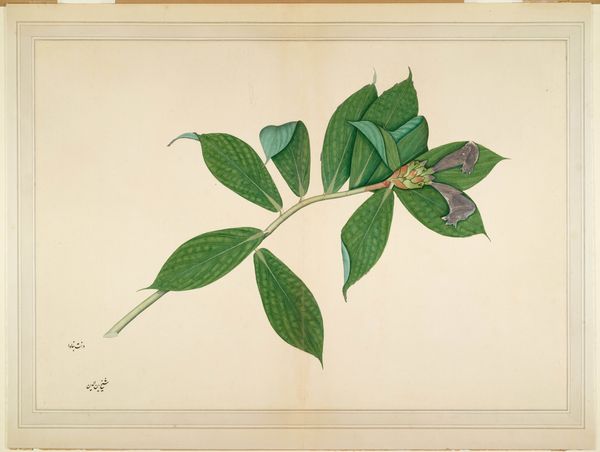
The famed ‘Impey Album,’ to which these 11 natural history studies originally belonged, marks the beginning of a new school in the canon of Indian Painting: that is “Company Painting’’—so called after the British East India Company, which by 1757 had taken effective rule over the sub-continent—spanning from c. 1760-1880 and distinguished by native painters adapting to the needs of Colonial tastes. The result was an emergence of a distinctive Anglo-Indian aesthetic, which we see in the remarkable paintings here. Between 1777-1783, Lady Mary Impey, wife of the recently appointed Chief Justice of Bengal, Sir Elijah Impey, commissioned three artists: a Muslim, Shaik Zain ud-Din, and two Hindus, Bhawani Das and Ram Das (all of whom trained in a Provincial Mughal atelier in the neighboring city of Patna) to record the newfound wonders of her Calcutta aviary and menagerie.


Join the conversation
Join millions of artists and users on Artera today and experience the ultimate creative platform.
 Collect
More like this