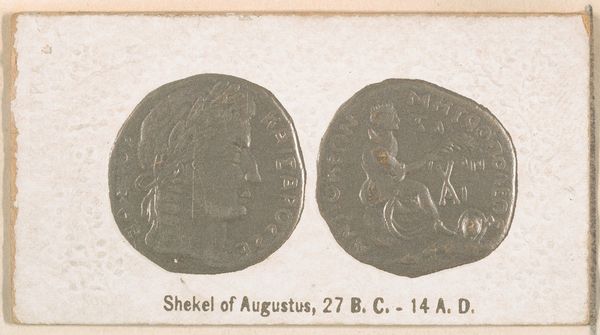
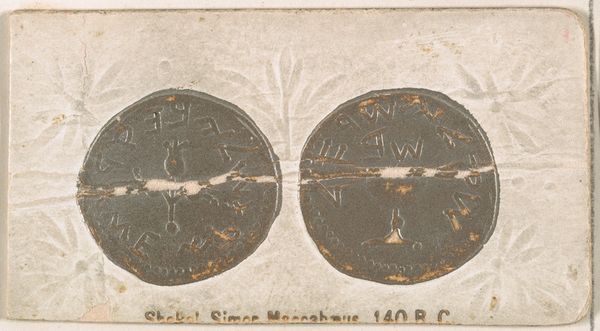
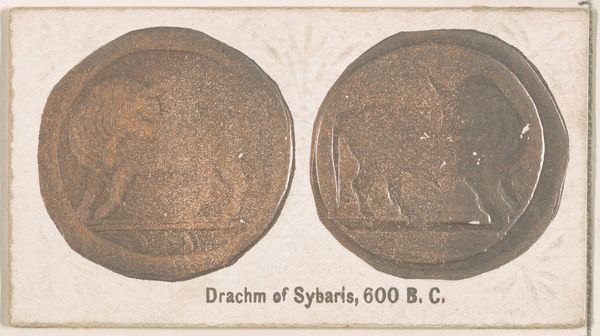
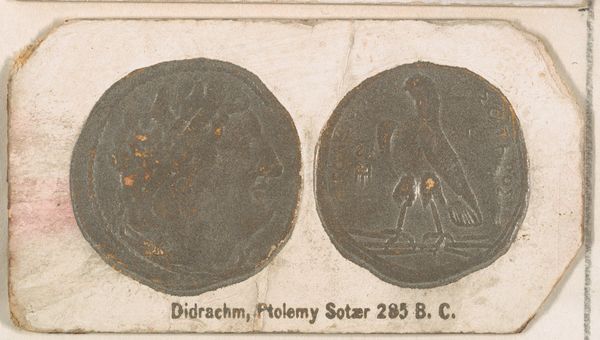
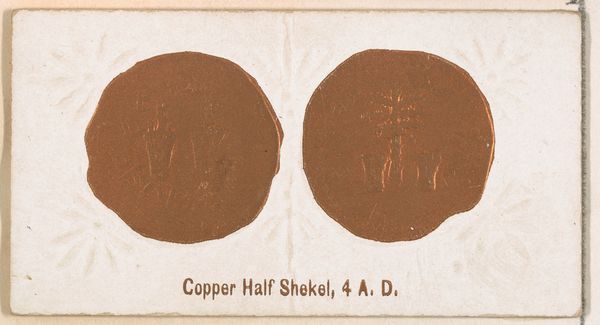
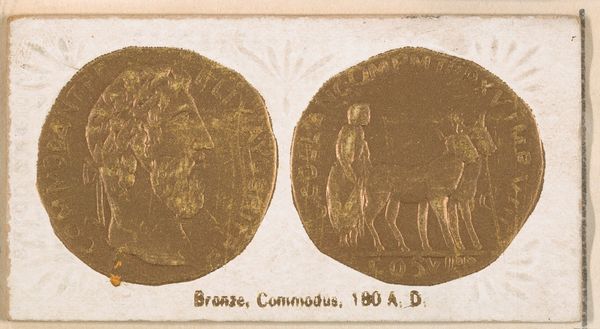
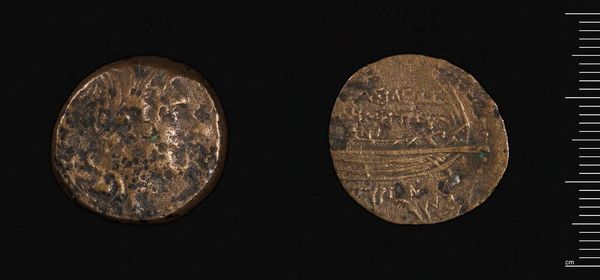
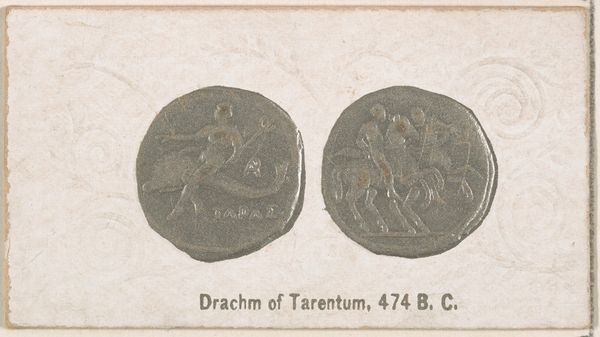
Shekel, Simon Prince of Israel, 69 A.D., from the Ancient Coins series (N180) issued by Wm. S. Kimball & Co. 1888
0:00
0:00


drawing, coloured-pencil, print
#
portrait
#
drawing
#
coloured-pencil
# print
#
coloured pencil
#
geometric
#
ancient-mediterranean
#
watercolor
#
realism
Dimensions: Sheet: 1 1/2 × 2 5/8 in. (3.8 × 6.7 cm)
Copyright: Public Domain
Curator: Here we have a drawing entitled "Shekel, Simon Prince of Israel, 69 A.D." created by Wm. S. Kimball & Co. in 1888. It’s part of the Ancient Coins series. It utilizes colored pencil and printmaking techniques. What are your first thoughts? Editor: There’s a powerful simplicity in the symmetry and the earth tones. The circles, imperfectly rendered as they are, feel ancient, weighty... evocative of an era marked by upheaval and transition. Curator: Indeed. Coins often carry deep symbolic weight. Here, we see the depiction of a palm tree, a well-known symbol within ancient Jewish iconography, representing life, resilience, and victory. Notice its central placement and relatively detailed execution, set against the coin's background and inscription. Editor: The palm also stands in stark contrast to the rigid geometry of the ancient Hebrew lettering surrounding it, yet is inseparable. This positioning infuses the entire composition with meaning beyond the mere rendering of a coin; it hints at cultural identity, perhaps resistance? Curator: Precisely! The lettering, though stylized in this reproduction, communicates value, authority, and cultural distinctiveness, all within a specific historical and geographical context. As this drawing was done in the late 19th century, it highlights a sustained interest in, and perhaps romanticization of, ancient cultures. Editor: I also note how the visual style captures the texture of an actual coin - a rough, almost palpable surface, a quality amplified by the warm colored pencil and the contrasting white background. The circular form of the coin, itself a symbol of completeness, encloses these cultural emblems, making it all the more enduring. Curator: And note the replication itself – the choice to create a colored drawing and print. The visual reproduction acts as a lens through which we might reflect on themes of authenticity, the passage of time, and the act of preserving collective memory through art. Editor: The drawing prompts reflections on not just the historical object itself but the continuous act of reinterpreting and reimagining our connections to the past through the visual. Thank you for pointing all of this out! Curator: A fruitful dialogue, exploring form, function, and cultural context.
Comments
No comments
Be the first to comment and join the conversation on the ultimate creative platform.
 Collect
 React
React Comment
More like this