mixed-media, acrylic-paint
#
portrait
#
mixed-media
#
self-portrait
#
postmodernism
#
acrylic-paint
#
oil painting
#
neo expressionist
#
portrait art
#
expressionist
Dimensions: 75 x 75 cm
Copyright: Richard Hamilton,Fair Use
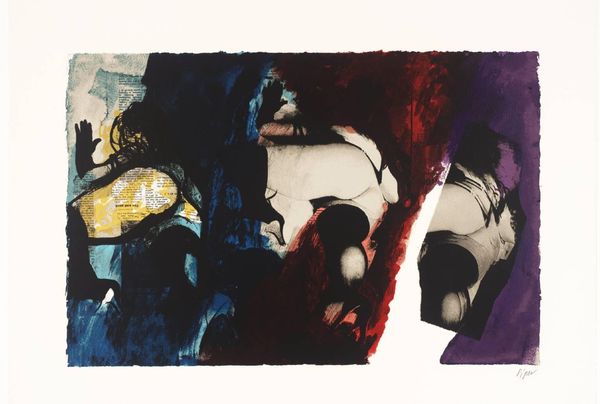
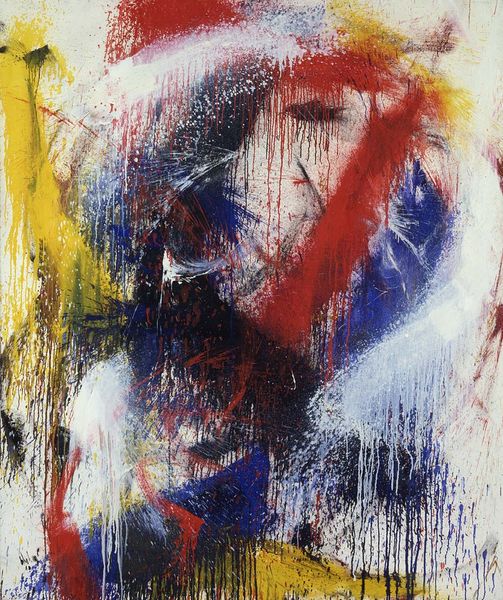
Editor: So, this is Richard Hamilton's "Four Self-Portraits 05.3.81," made in 1990. It's a mixed-media piece that includes acrylic paint, and what strikes me is how these bold, almost violent brushstrokes interact with the photographic self-portraits. What can you tell me about the way materials are used here? Curator: The layered process is fascinating, isn’t it? We have the photographic image, a medium readily available and reproducible. Then Hamilton intervenes, physically marking the surface with paint. This interplay is not just aesthetic; it questions the very act of portraiture and the artist's role. Are these portraits truly "self"-portraits, or are they manufactured representations, commodified and then disrupted through painterly gestures? Consider also the type of paint. Acrylics offered a flat fastness in industrial processes, but used with free gestures by the artist, what does that collision propose? Editor: So you're saying that his choice to combine photography with gestural painting is significant, because it undermines the perceived truth of a photograph? And potentially comments on portraiture? Curator: Precisely! Photography in this period was increasingly mass-produced, available to many and promising veracity, which traditional portraiture via painting held, but was available to so few. But Hamilton challenges the uncritical consumption of images, pushing us to think about their production. Are we meant to focus on the individual photographic self-portrait as separate to its reproduction, and what does this gesture, painted atop each representation, mean about how labor has shifted? Think too, how labor shifts within the arts itself as traditional portraiture, becomes mediated through mechanically made photos. Editor: That makes a lot of sense! It's like he's highlighting the materiality of image-making and its societal context. So the gesture makes sense too as labor. I hadn't really thought of it that way. Curator: The disruption itself can be considered part of that materiality! Think of this piece in light of mass production during the late 20th century and consumption practices. Editor: Thanks so much; this really helped me consider those issues more closely. Curator: A pleasure!
Comments
No comments
Be the first to comment and join the conversation on the ultimate creative platform.
 Collect
 React
React Comment
More like this