Charles Phillipe, Count of Artois, Brother of the King 1776
0:00
0:00


drawing, print, engraving
#
portrait
#
drawing
#
neoclassicism
# print
#
engraving
Dimensions: Sheet (trimmed): 9 7/16 × 6 1/4 in. (24 × 15.8 cm) Mount: 10 13/16 in. × 8 1/8 in. (27.5 × 20.7 cm)
Copyright: Public Domain
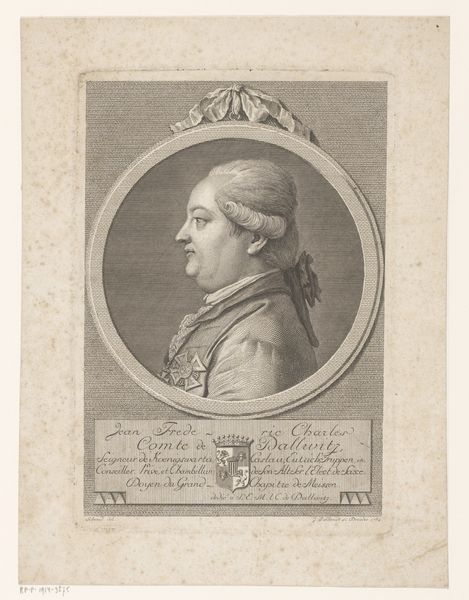
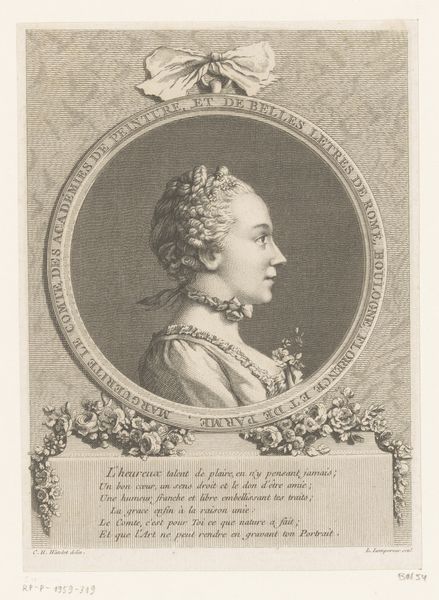
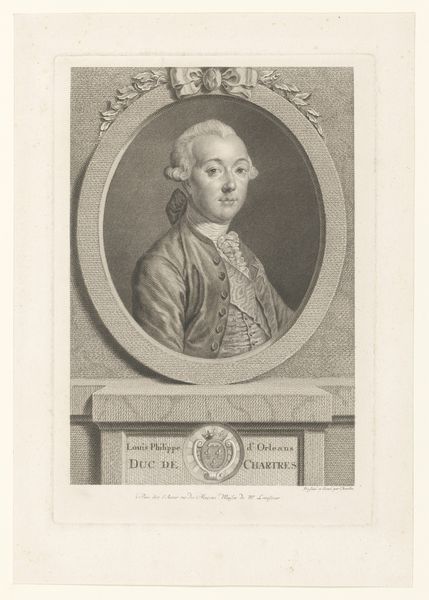
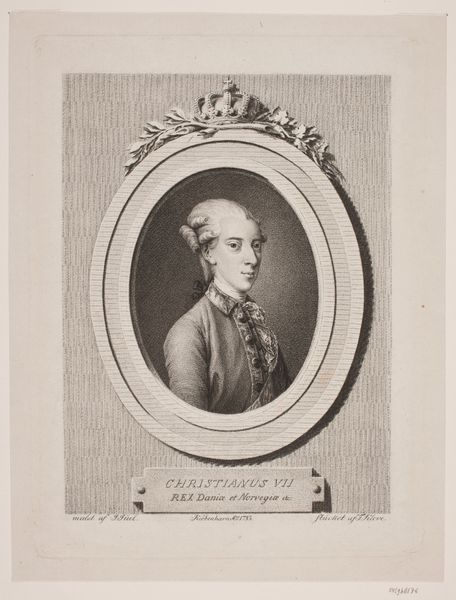
Curator: We’re now looking at an engraving from 1776 titled "Charles Phillipe, Count of Artois, Brother of the King." The portrait, housed here at the Metropolitan Museum of Art, was crafted by Marie Louise Adélaïde Boizot. Editor: My first thought? This guy just stepped out of a porcelain doll collection. A rather fetching one, mind you. It's all very contained, isn't it? Crisp lines, formal setting… He’s certainly presenting himself a particular way. Curator: Indeed. Boizot, working in that Neoclassical style, really captures the restrained elegance, that careful curation of image so crucial to the French aristocracy at the time. See how the floral garland reinforces notions of luxury, prosperity, even supposed virtue. The visual vocabulary is specific, intentional. Editor: "Supposed" is the key word there. I wonder what was happening beneath the powdered wig and fancy frills. It makes me think of performance – putting on a show, playing a role for the public. Royalty as theater, really. Curator: It absolutely was. This image would have been widely disseminated, shaping public perception. Boizot subtly emphasizes Philippe’s profile. In antiquity, the profile offered an ‘objective’ likeness, appealing to notions of truth, or perhaps… legitimacy. Note the insignia – symbols of status and connection that position him relative to others and their corresponding claims to legitimacy. Editor: It’s like reading a secret language, isn’t it? Deciphering what they *wanted* you to see, versus what might’ve actually been there. Maybe he just really loved bows and delicate ornamentation... maybe not. Curator: Possibly not! The portrait served as propaganda of a sort, reinforcing ideals. Now, these ideals weren't universally accepted even in the late 18th century...and in just over a decade the Revolution would explode those ideals... Editor: Yeah, makes you think, doesn't it? All this fuss, all the staging... and then poof! Vanished. Though the image remains. Makes one contemplate the vanity of earthly symbols, doesn’t it? Curator: I think so, and even as the symbols and structures are transient, a work like this remains, encoding both the symbol and its eventual fate for anyone who knows how to look.
Comments
No comments
Be the first to comment and join the conversation on the ultimate creative platform.
 Collect
 React
React Comment
More like this