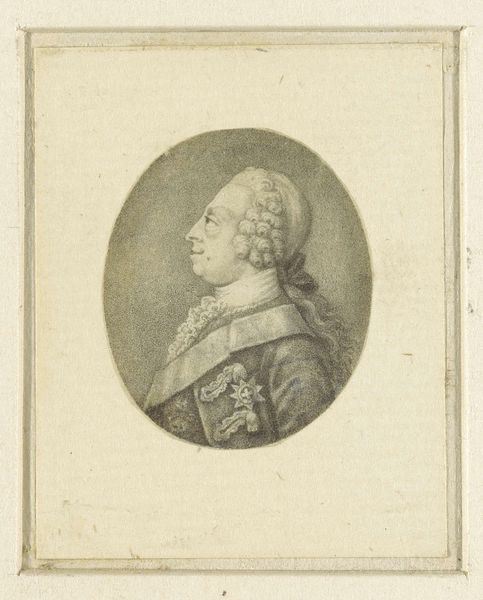
Dimensions: height 122 mm, width 76 mm
Copyright: Rijks Museum: Open Domain
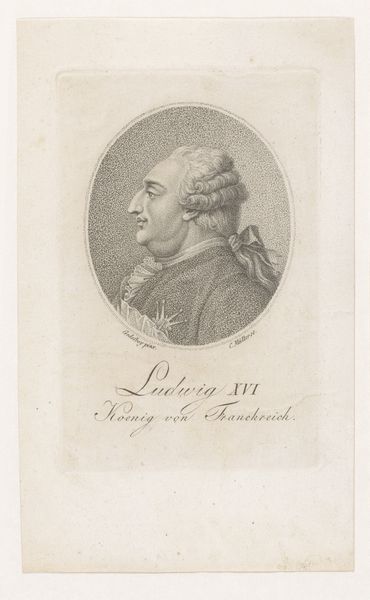
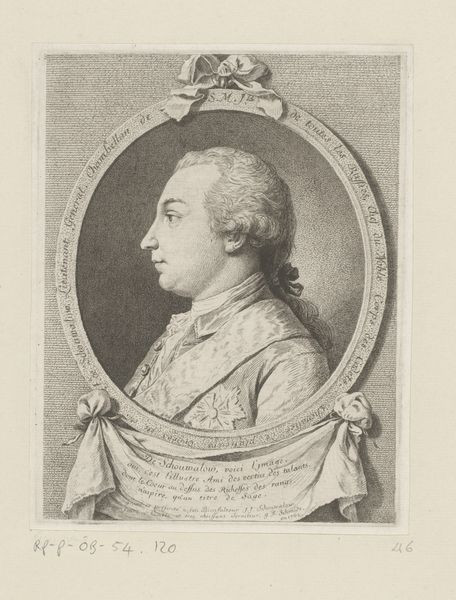
Editor: This is "Portret van keizer Peter III van Rusland" by Meno Haas, created sometime between 1762 and 1833. It's an engraving, giving it this almost ghostly feel. What's interesting to me is the artist choosing printmaking for such an important person. What do you make of this work? Curator: The choice of printmaking over painting offers us insight into the democratizing potential of art in the 18th and early 19th centuries. Consider that prints allowed for wider distribution of images. What social class might this portrait have been intended for? Editor: Maybe the growing middle class? Those who couldn't afford a painted portrait, but still wanted to participate in a sort of visual culture surrounding the monarchy? Curator: Exactly. And what does the formal presentation tell us? Note the oval frame, the subject’s profile, and the inscription. These visual cues pull from earlier portrait traditions, thereby legitimizing Peter III by associating him with established power structures. But consider how fleeting Peter III’s reign was; only six months. Does that change how you perceive this work? Editor: Definitely. It feels almost like an attempt to solidify a legacy that didn’t quite exist. Almost propagandistic in hindsight, knowing what happened. I see the role of the print differently now, as part of a construction of Peter’s image rather than just documentation. Curator: Precisely. This portrait, through its medium and style, reveals a deliberate effort to shape public perception, which ultimately reflects the power dynamics and political anxieties of the time. Editor: That's fascinating. I initially just saw a portrait, but now I see it as a piece of social history, capturing a very specific and turbulent moment. Curator: It's a reminder that art doesn't exist in a vacuum. Every brushstroke, every engraving line, tells a story about its creation, its purpose, and its reception within a broader socio-political context.
Comments
No comments
Be the first to comment and join the conversation on the ultimate creative platform.
 Collect
 React
React Comment
More like this