Dimensions: object: 1219 x 1219 x 178 mm
Copyright: © The estate of Richard Hamilton | CC-BY-NC-ND 4.0 DEED, Photo: Tate
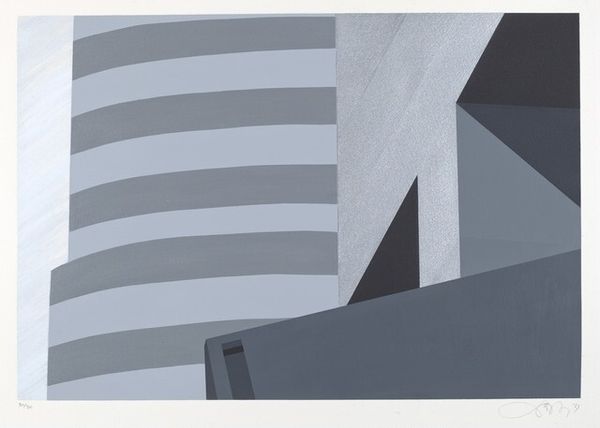
Curator: Richard Hamilton's "The Solomon R. Guggenheim (Neapolitan)" presents a layered, almost edible rendering of the iconic structure. Editor: The pastel palette and smooth, molded forms give it a decidedly artificial feel, like a prop from a stage set. Curator: Indeed, the piece's formal precision and simplified planes invite a reading through semiotic structures, abstracting the Guggenheim into a sign. The geometry suggests order. Editor: But what about the work itself? The visible seams and layered construction hint at the labor, the hands involved. It brings a real-world tactility. Curator: Precisely, by flattening the architectural masterpiece, Hamilton compels us to consider its inherent design principles and how they communicate cultural values. Editor: I suppose what strikes me most is how a monumental building is reduced to a confectionary object, questioning notions of high and low art. Curator: A fascinating contrast. Editor: Yes, a building and a dessert. Both carefully constructed, both consumed.
Comments

tate 12 months ago
⋮
http://www.tate.org.uk/art/artworks/hamilton-the-solomon-r-guggenheim-neapolitan-t01195


Join the conversation
Join millions of artists and users on Artera today and experience the ultimate creative platform.
tate 12 months ago
⋮
Frank Lloyd Wright’s striking spiral design for the Solomon R. Guggenheim Museum in New York was completed in 1959, and soon became a controversial icon of contemporary architecture. Hamilton came across some coloured postcards of the building which seemed to alter its character significantly,and embarked on his own series of variations on the theme. This work belongs to a sequence of six large reliefs, each using different colours. Its title refers to the use of pink, cream and green, associated by the artist with Neapolitan ice cream. Gallery label, November 2016
 Collect
More like this