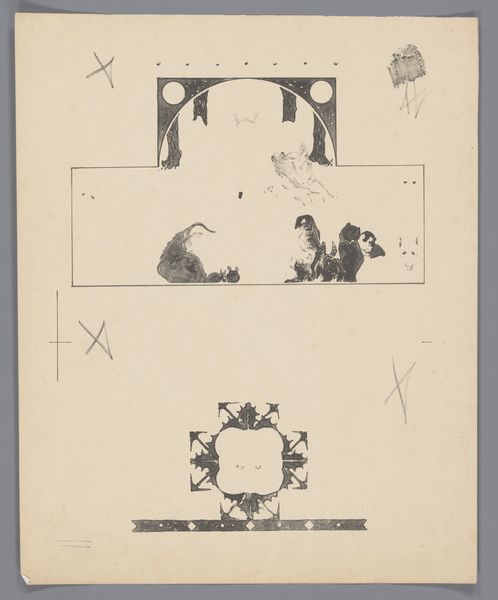
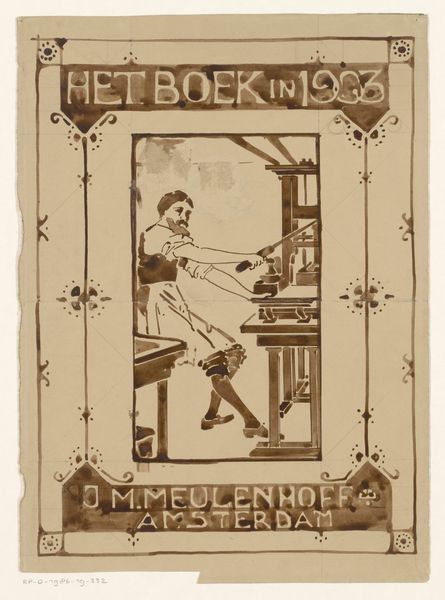
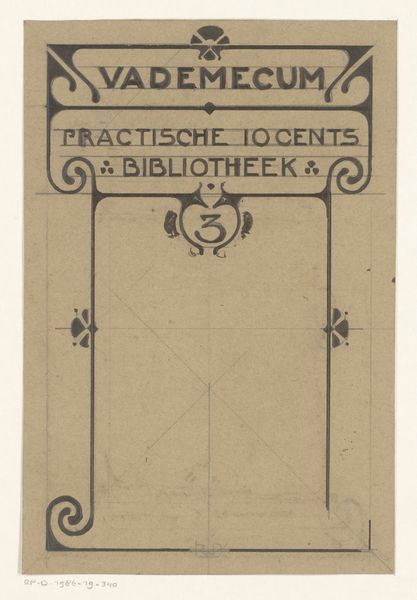
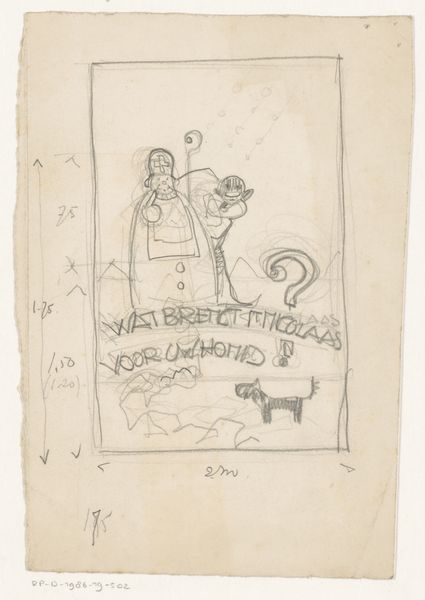
Omslagontwerp voor: Humoristisch weekblad, c. 1906 c. 1906
0:00
0:00

drawing, graphic-art, pencil, poster
#
drawing
#
graphic-art
#
art-nouveau
#
figuration
#
pencil
#
poster
Dimensions: height 320 mm, width 241 mm
Copyright: Rijks Museum: Open Domain
Curator: Looking at this piece, it strikes me immediately as being almost hesitant, a work in progress perhaps. It's a pencil drawing; a design by Reinier Willem Petrus de Vries for the cover of a Humoristich Weekblad, dating from around 1906. What is your impression of it? Editor: It’s incredibly charming! The figures framing the title—those little bellhops or guards, I’m not sure—give it a playful, inviting energy. Like a peek into a miniature, slightly absurd world. Curator: Absurdity, certainly a central tenet within the art-nouveau framework of the early twentieth century, one of experimentation in an escape of form. And given it’s a design for a humour magazine cover, such elements may speak to its overall function within the cultural context of the era. Notice, though, how the underlying grid remains visible. Editor: Right, the ghostly guidelines. I almost missed them! It makes me think about all the unseen labor behind even something meant to be lighthearted and fun. Five cents to be transported into this topsy-turvy world is all it would've cost! It has kind of dreamlike quality as a sketch, doesn't it? Curator: It emphasizes the preliminary stage, before full realization of form, the liminal phase where intent meets raw application; in contrast to fully formed printed imagery; you've used the word topsy-turvy; this points towards a central trope of fin-de-siecle illustration, often engaged to explore themes of political volatility. The poster feels deliberately and intriguingly unpolished. Editor: Yes. Like a backstage pass, perhaps? We glimpse the scaffolding and, oddly, it heightens our appreciation for the work of De Vries. Seeing the method elevates the art, and it also speaks of a world that could suddenly be rearranged at any moment with just a little nudge. Thank you; that makes me consider even further, not only where De Vries was going with this, but what else happened once the work had left his hands. Curator: Indeed, such material offers crucial keys towards unpacking any historical artwork: we can discern De Vries' formal methods. Such insights ultimately enhance our perspective on his artistry. Editor: Agreed. I initially felt drawn in, whimsically almost. It is fascinating how it can spark an analysis of artistic and societal frameworks!
Comments
No comments
Be the first to comment and join the conversation on the ultimate creative platform.
 Collect
 React
React Comment
More like this