About this artwork
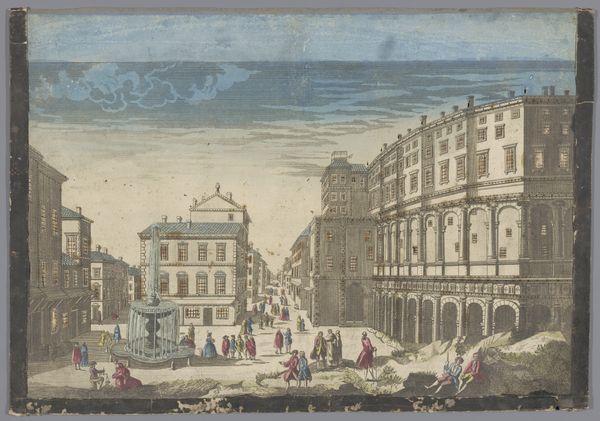
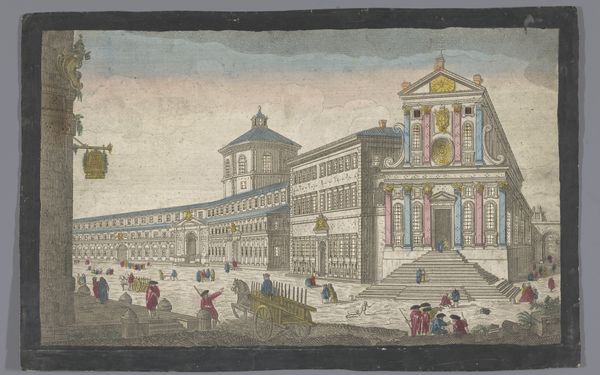
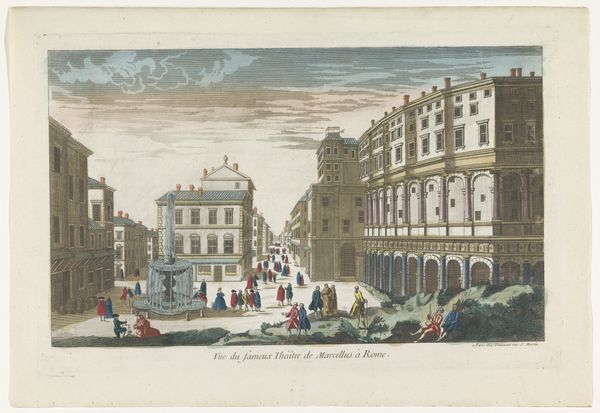
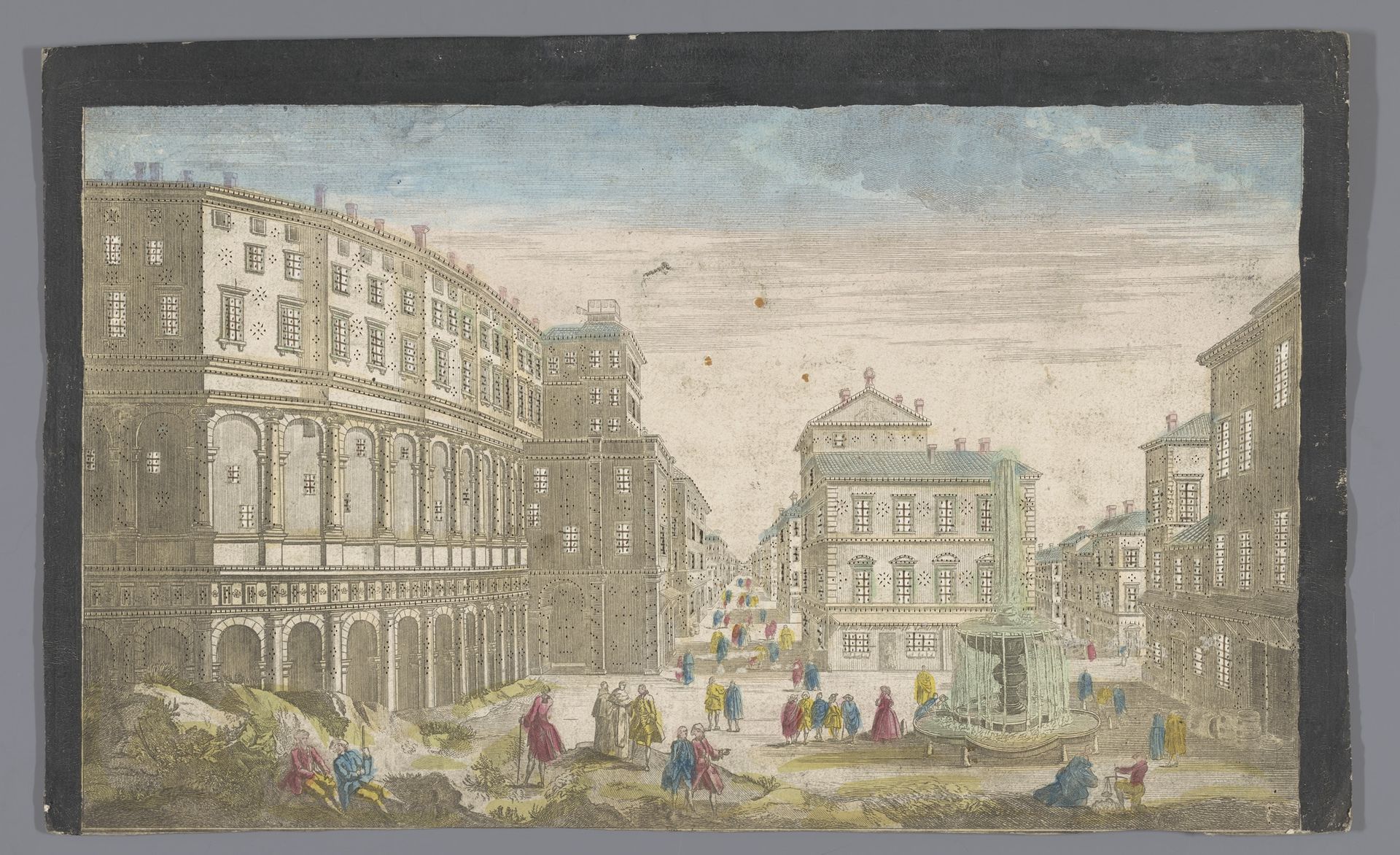
Jean-François Daumont created this print, "View of the Theatre of Marcellus in Rome," using etching and watercolor. The composition is structured around the receding lines of buildings that lead the eye towards a vanishing point, a classic example of Renaissance perspective. The drawing's architectural rendering is precise, emphasizing the theatre's rounded facade, and the buildings' linear symmetry. The overall pale colour palette, punctuated by small figures dressed in shades of red, blue, and yellow, animates the scene, yet the drawing’s emphasis remains firmly on the geometry and structure of urban space. The technique offers a somewhat detached observation of the site, aligning with the Enlightenment's interest in rational, objective representation. Daumont’s etching invites us to consider how architectural forms shape social life and visual perception. The clean lines and ordered space suggest not just a physical location, but a particular way of seeing and understanding the world through order and structure.
Gezicht op het Theater van Marcellus te Rome
1745 - 1775

Jean-François Daumont
1775Location
RijksmuseumArtwork details
- Medium
- print, etching, watercolor
- Dimensions
- height 271 mm, width 442 mm
- Location
- Rijksmuseum
- Copyright
- Rijks Museum: Open Domain
Tags
Comments
Share your thoughts
About this artwork
Jean-François Daumont created this print, "View of the Theatre of Marcellus in Rome," using etching and watercolor. The composition is structured around the receding lines of buildings that lead the eye towards a vanishing point, a classic example of Renaissance perspective. The drawing's architectural rendering is precise, emphasizing the theatre's rounded facade, and the buildings' linear symmetry. The overall pale colour palette, punctuated by small figures dressed in shades of red, blue, and yellow, animates the scene, yet the drawing’s emphasis remains firmly on the geometry and structure of urban space. The technique offers a somewhat detached observation of the site, aligning with the Enlightenment's interest in rational, objective representation. Daumont’s etching invites us to consider how architectural forms shape social life and visual perception. The clean lines and ordered space suggest not just a physical location, but a particular way of seeing and understanding the world through order and structure.
Comments
Share your thoughts