About this artwork
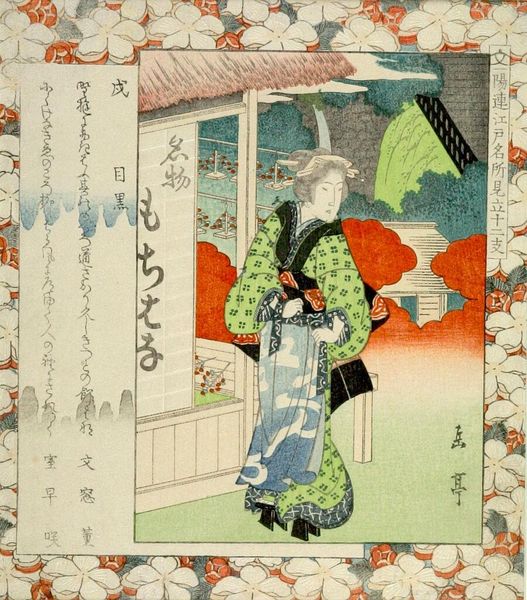
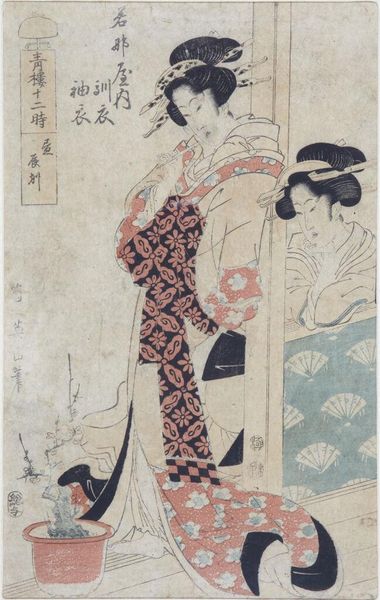
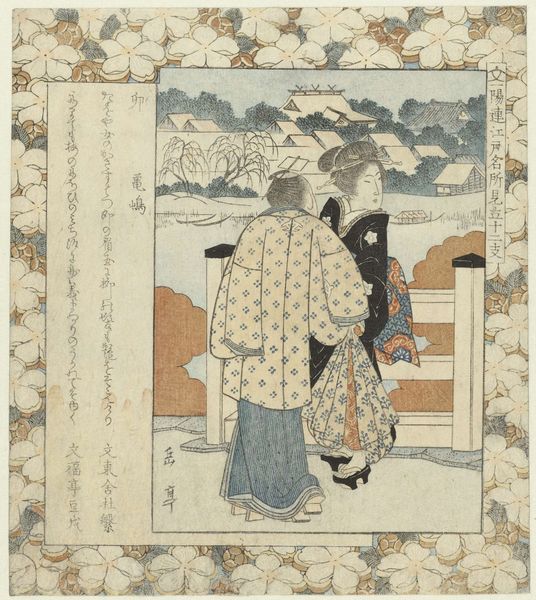
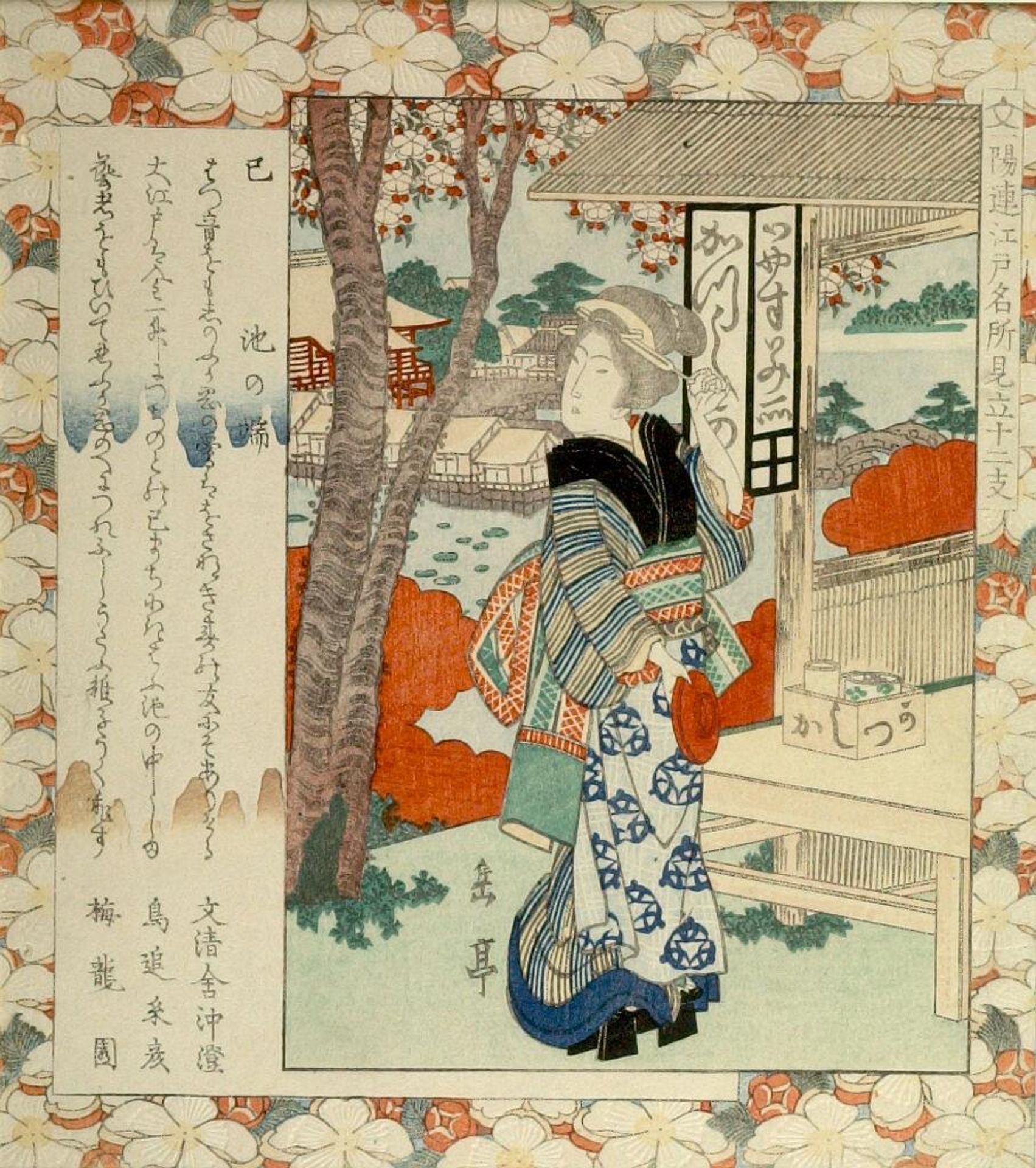
Curator: Yashima Gakutei’s woodblock print, "Tea House Hostess Standing by Rest Stand/ Snake," part of his "Allusions to the Twelve Zodiac Animals" series, offers a glimpse into Edo-period culture. It's currently held at the Harvard Art Museums. Editor: The first thing that strikes me is the air of serene melancholy; the hostess looks away, almost wistful, despite the surrounding floral imagery. Curator: That melancholic feel could be informed by the social realities of the time. Woodblock prints, while accessible, were also a medium through which marginalized figures, like courtesans, were often viewed and commodified. Editor: Absolutely. The poems included, though beautiful, reinforce the idea of women being allegorical or symbolic, rather than fully realized individuals. The entire Zodiac series operates similarly. How do we reconcile the beauty with the objectification? Curator: That tension is precisely where critical engagement begins. This print, and its context, become a space for discussing gender, class, and the power dynamics inherent in art production and consumption. Editor: It’s a disquieting reminder that aesthetic pleasure can coexist with complex social issues.
Tea House Hostess Standing by Rest Stand/ Snake (Mi) -- Ike no Hata, from the series Allusions to the Twelve Zodiac Animals at Famous Places in Edo for the IchiyÅ Circle (IchiyÅren Edo meisho mitate jÅ«nishi), with poems by Bunseisha Okizumi, Shimaoi Itohi
Possibly 1827


Artwork details
- Dimensions
- Paper: H. 21.0 cm x W. 18.7 cm (8 1/4 x 7 3/8 in.)
- Location
- Harvard Art Museums
- Copyright
- CC0 1.0
Comments
Share your thoughts
About this artwork
Curator: Yashima Gakutei’s woodblock print, "Tea House Hostess Standing by Rest Stand/ Snake," part of his "Allusions to the Twelve Zodiac Animals" series, offers a glimpse into Edo-period culture. It's currently held at the Harvard Art Museums. Editor: The first thing that strikes me is the air of serene melancholy; the hostess looks away, almost wistful, despite the surrounding floral imagery. Curator: That melancholic feel could be informed by the social realities of the time. Woodblock prints, while accessible, were also a medium through which marginalized figures, like courtesans, were often viewed and commodified. Editor: Absolutely. The poems included, though beautiful, reinforce the idea of women being allegorical or symbolic, rather than fully realized individuals. The entire Zodiac series operates similarly. How do we reconcile the beauty with the objectification? Curator: That tension is precisely where critical engagement begins. This print, and its context, become a space for discussing gender, class, and the power dynamics inherent in art production and consumption. Editor: It’s a disquieting reminder that aesthetic pleasure can coexist with complex social issues.
Comments
Share your thoughts