About this artwork
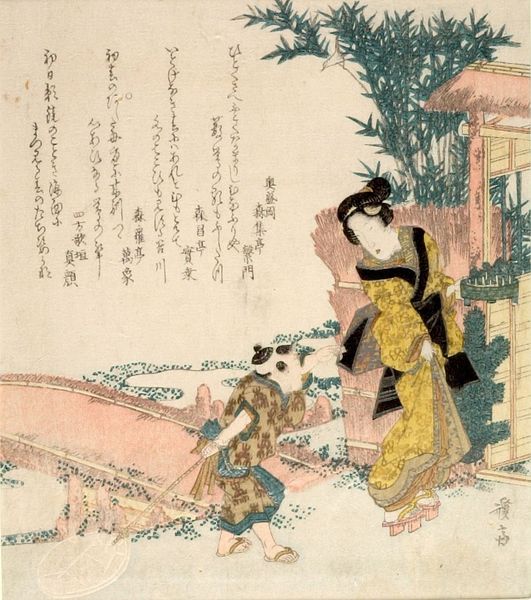
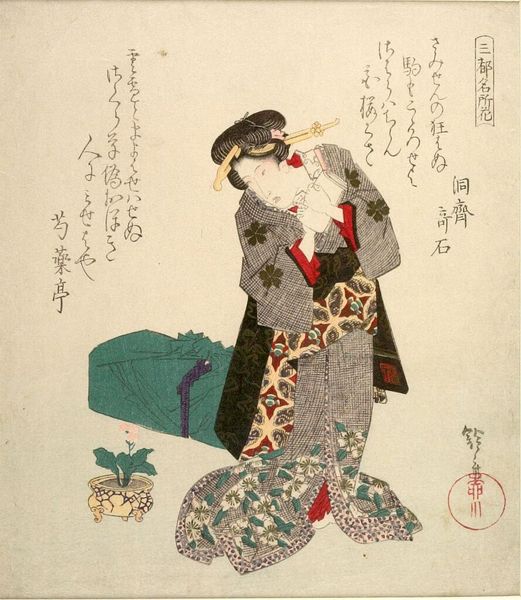
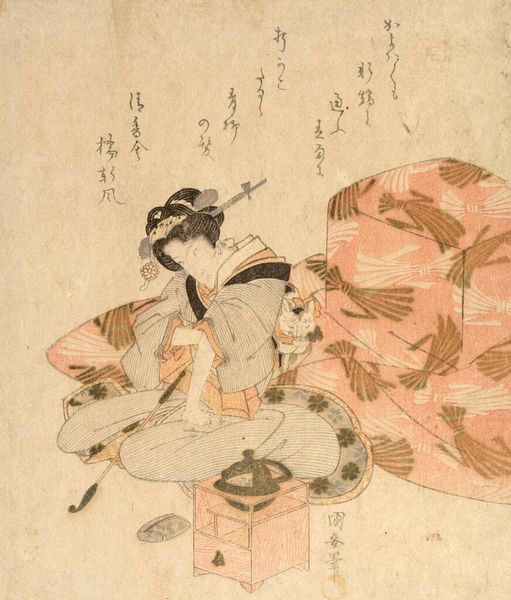
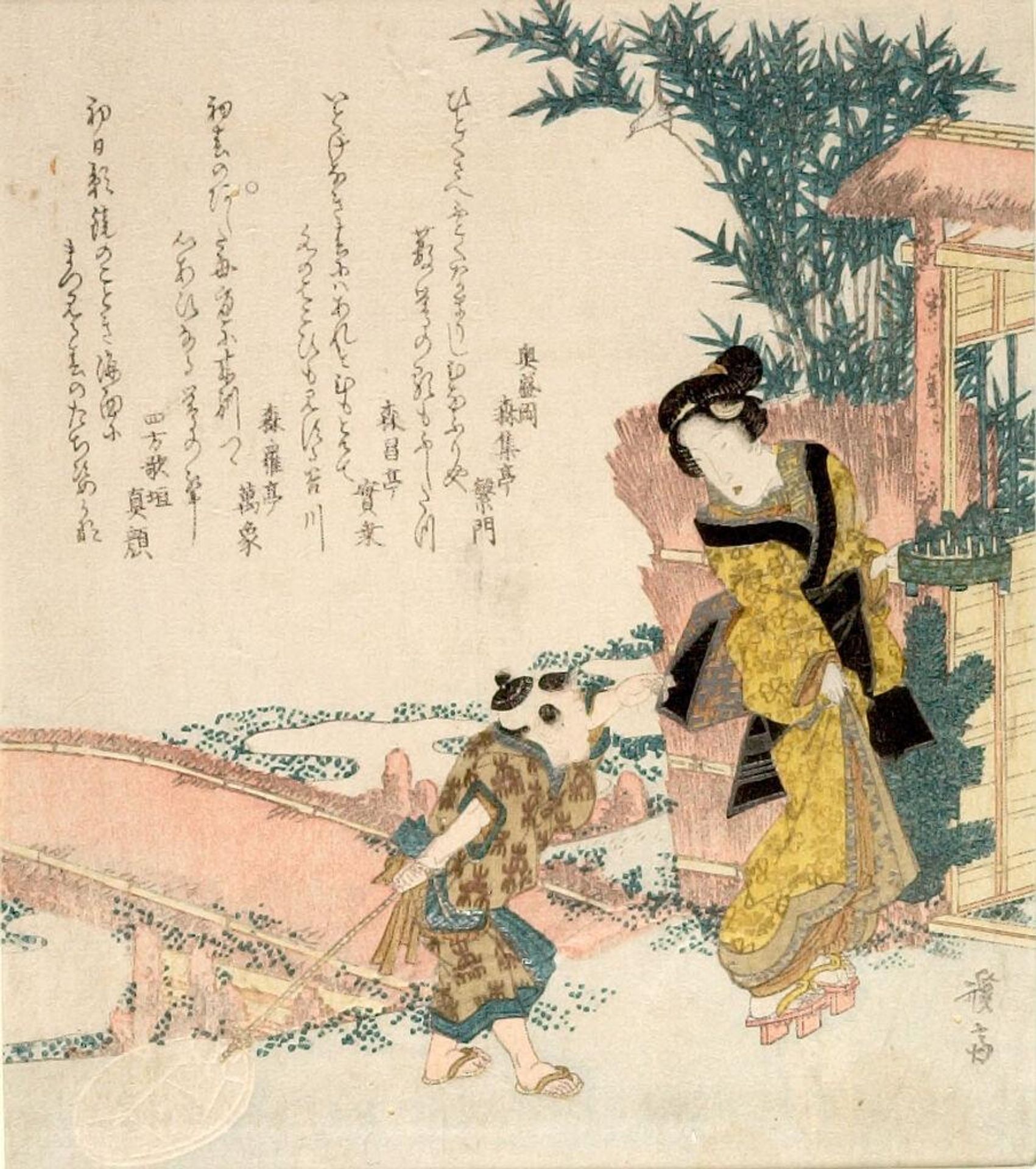
Curator: Keisai Eisen's "Mother and Boy with Ice," currently held at the Harvard Art Museums, presents a serene scene, almost dreamlike in its pastel hues. Editor: I’m immediately struck by the child’s mask and the woman's elaborate clothing; it speaks to roles and performances within the domestic space. Curator: Absolutely. Eisen, working in the first half of the 19th century, likely captured a moment of leisure amongst the merchant classes, but there is a complexity to the representation of this mother and child. Editor: The poem inscribed above the figures provides another layer of meaning. How might we interpret the relationship between the image and the text? Is it a lament, a celebration, or something else entirely? Curator: The inscription certainly invites us to consider the social status afforded to women and children in Edo society, and how these images functioned within broader cultural and political narratives. Editor: It's a powerful reminder that even seemingly simple scenes can hold profound insights into the human condition and the power dynamics of their time.


Artwork details
- Dimensions
- paper: H. 20.8 x W. 18.1 cm (8 3/16 x 7 1/8 in.)
- Location
- Harvard Art Museums
- Copyright
- CC0 1.0
Comments
Share your thoughts
About this artwork
Curator: Keisai Eisen's "Mother and Boy with Ice," currently held at the Harvard Art Museums, presents a serene scene, almost dreamlike in its pastel hues. Editor: I’m immediately struck by the child’s mask and the woman's elaborate clothing; it speaks to roles and performances within the domestic space. Curator: Absolutely. Eisen, working in the first half of the 19th century, likely captured a moment of leisure amongst the merchant classes, but there is a complexity to the representation of this mother and child. Editor: The poem inscribed above the figures provides another layer of meaning. How might we interpret the relationship between the image and the text? Is it a lament, a celebration, or something else entirely? Curator: The inscription certainly invites us to consider the social status afforded to women and children in Edo society, and how these images functioned within broader cultural and political narratives. Editor: It's a powerful reminder that even seemingly simple scenes can hold profound insights into the human condition and the power dynamics of their time.
Comments
Share your thoughts