About this artwork
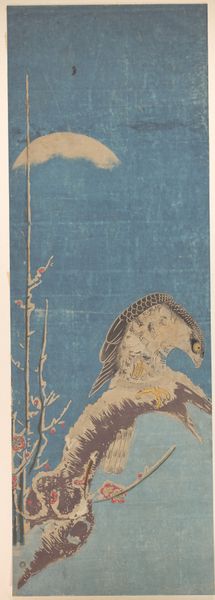
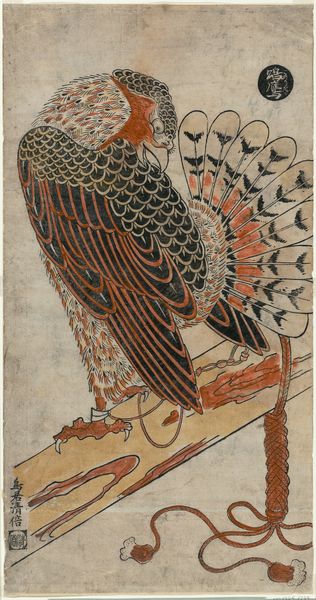
Isoda Koryūsai created this woodblock print, "Pheasants in the Snow on a Pine Branch over a Waterfall," in the late 18th century. It invites us to consider the place of art within a hierarchical society. Koryūsai was trained in the Kano school, an artistic institution endorsed by the shogunate. This print, however, reflects the rising popularity of ukiyo-e, or "pictures of the floating world," which catered to the tastes of the merchant class. The natural scene offers a serene escape from the rigid social norms of Edo-period Japan. Though the subject may seem apolitical, the very act of producing art for the commoner was in itself a progressive statement. To understand this shift, we can research the economic conditions that allowed the merchant class to flourish and challenge the established order. We might also investigate the ways in which artists navigated the patronage system to express their own creative vision.
Pheasants in the Snow on a Pine Branch over a Waterfall
1760 - 1780
Artwork details
- Medium
- print, woodblock-print
- Dimensions
- 26 3/8 x 4 3/5 in. (67.0 x 11.7 cm)
- Location
- Metropolitan Museum of Art, New York, NY
- Copyright
- Public Domain
Tags
Comments
Share your thoughts
About this artwork
Isoda Koryūsai created this woodblock print, "Pheasants in the Snow on a Pine Branch over a Waterfall," in the late 18th century. It invites us to consider the place of art within a hierarchical society. Koryūsai was trained in the Kano school, an artistic institution endorsed by the shogunate. This print, however, reflects the rising popularity of ukiyo-e, or "pictures of the floating world," which catered to the tastes of the merchant class. The natural scene offers a serene escape from the rigid social norms of Edo-period Japan. Though the subject may seem apolitical, the very act of producing art for the commoner was in itself a progressive statement. To understand this shift, we can research the economic conditions that allowed the merchant class to flourish and challenge the established order. We might also investigate the ways in which artists navigated the patronage system to express their own creative vision.

Comments
Share your thoughts