About this artwork
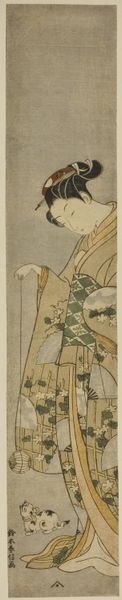
Isoda Koryūsai created this woodblock print, 'The Bijin Jurōjin', sometime in the late 18th century. Observe the crane nestled at the woman’s feet, its elegant neck arching upwards. In Japan, as elsewhere, the crane is a potent symbol, embodying longevity and good fortune, often appearing in art and folklore as a messenger of the gods or a companion to immortals. Consider how the image of a bird, with its connotations of flight and freedom, crosses cultures. The crane’s symbolic dance echoes through time. In ancient Greece, birds were associated with prophecy and divine insight; their movements interpreted as omens. The same motifs appear in different guises, shaped by the unique cultural landscape. The human psyche latches onto these symbols, drawn to the subconscious promise of transcendence. The symbolic power lies in its ability to evoke profound emotional responses, stirring a shared, deeply rooted, human experience. We see how symbols like the crane endure, evolving yet retaining their essence, carried on the winds of history and human imagination.
The Bijin Jurōjin 1760 - 1790


Artwork details
- Medium
- print, woodblock-print
- Dimensions
- 27 3/4 x 4 5/32 in. (70.5 x 10.6 cm)
- Location
- Metropolitan Museum of Art, New York, NY
- Copyright
- Public Domain
Tags
portrait
asian-art
landscape
bird
ukiyo-e
figuration
woodblock-print
Comments
No comments
About this artwork
Isoda Koryūsai created this woodblock print, 'The Bijin Jurōjin', sometime in the late 18th century. Observe the crane nestled at the woman’s feet, its elegant neck arching upwards. In Japan, as elsewhere, the crane is a potent symbol, embodying longevity and good fortune, often appearing in art and folklore as a messenger of the gods or a companion to immortals. Consider how the image of a bird, with its connotations of flight and freedom, crosses cultures. The crane’s symbolic dance echoes through time. In ancient Greece, birds were associated with prophecy and divine insight; their movements interpreted as omens. The same motifs appear in different guises, shaped by the unique cultural landscape. The human psyche latches onto these symbols, drawn to the subconscious promise of transcendence. The symbolic power lies in its ability to evoke profound emotional responses, stirring a shared, deeply rooted, human experience. We see how symbols like the crane endure, evolving yet retaining their essence, carried on the winds of history and human imagination.
Comments
No comments