print, engraving
#
portrait
#
baroque
# print
#
portrait reference
#
genre-painting
#
engraving
Dimensions: height 247 mm, width 185 mm
Copyright: Rijks Museum: Open Domain
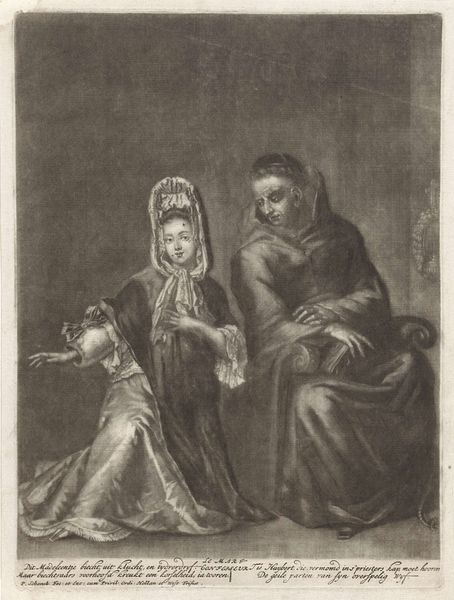
Curator: Here we have Pieter Schenk's "Confessing Woman," made between 1670 and 1713. This engraving is part of the Rijksmuseum's collection. I'm struck immediately by the scene's central conflict, presented so starkly. Editor: Indeed. The monk's raised finger—a gesture of admonishment—sets an immediately tense tone. His gaze is so stern, almost accusatory. Meanwhile, the woman, kneeling with clasped hands, embodies humility and perhaps, regret. It’s a very theatrical tableau. Curator: Consider how such images functioned in Baroque society. Religious engravings such as this provided a didactic function. The visual language here relies heavily on established conventions; a woman kneeling implies repentance, especially combined with the imagery of the confessional. But it's never simply about pure piety. Think of the intense theatricality Baroque art employed. Editor: Right. The print's use of chiaroscuro amplifies the drama, doesn't it? The monk is shrouded in shadow, only half visible, looming large as the arbiter of morality. It lends him this air of... authority but almost foreboding authority. The crucifix on the floor and rosary beads act as a clear marker to the codes within this world. The symbolic objects guide our interpretation here. Curator: Symbols and imagery definitely serve specific purposes, shaping not just how this particular narrative is interpreted, but perhaps affecting society’s understanding of confession and atonement itself. Her elaborately patterned cloak juxtaposes the simple folds of the monk's habit, highlighting social status at odds with spiritual posture. Does she stand for aristocracy at large? The psychological push and pull between transgression and redemption are rendered so effectively through these choices. Editor: I wonder about Schenk's intended audience, who they were, and what kind of meaning such scenes might carry for them politically and socially. I suppose it speaks of faith’s social and cultural pervasiveness. This work really illuminates an element of the relationship between Church and culture in the period, making its way into households as images, beliefs, or behaviours of power and status became further entwined. Curator: Agreed. The endurance of such potent visual structures really confirms their ongoing influence on individual belief and society at large. Editor: Absolutely. Looking at it again, that performative element of public and private atonement resonates quite vividly, even now.
Comments
No comments
Be the first to comment and join the conversation on the ultimate creative platform.
 Collect
 React
React Comment
More like this