drawing, print, wood-engraving
#
portrait
#
drawing
#
medieval
#
narrative-art
# print
#
charcoal drawing
#
figuration
#
pencil drawing
#
line
#
history-painting
#
wood-engraving
#
realism
Dimensions: 8 1/16 x 5 1/4 in. (20.48 x 13.34 cm) (image)11 x 9 1/8 in. (27.94 x 23.18 cm) (sheet)
Copyright: No Copyright - United States
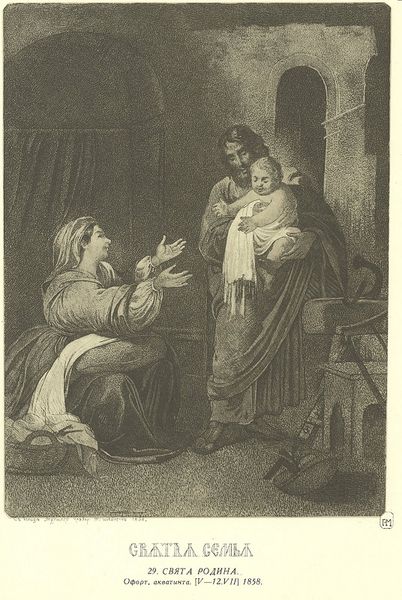
Curator: I find myself strangely drawn to the melancholy air of "Legend of Saint Ursula," a wood engraving created by Timothy Cole in 1892, currently residing at the Minneapolis Institute of Art. It feels almost as though the scene is veiled in a forgotten sadness. What's your immediate sense of this piece? Editor: Well, the most immediate thing is that the narrative isn't immediately accessible. The composition hints at a larger story steeped in a very gendered power dynamic—a queen attending a brooding king or nobleman, a silent power struggle within a somber interior. What are the historical connotations around Saint Ursula that we can glean? Curator: Saint Ursula, legend tells us, was a British princess who, along with eleven thousand virgins, was martyred, a tale spun from the threads of the Middle Ages. This particular work... it's interesting how Cole distills the narrative down to an intimate, almost claustrophobic moment between two figures. The room feels like a stage, and they, the only players left after the final act. I wonder, who are they and where is everyone? Editor: And what does that solitude mean? The absence of the eleven thousand? It spotlights, perhaps, the loneliness of leadership, the isolation that comes with power, especially for the female figure. The setting itself—a vaguely medieval interior—doesn't exactly invite lightness. Everything about the material handling and aesthetic choices seems geared to amplify feelings of introspection. Curator: Exactly! Look at the way Cole uses the light—it's not just illumination; it's a character in itself, shaping and sculpting the drama. See how it grazes her dress but almost refuses to touch the king? And what do you make of the subtle realism embedded within? Are the heavy clothes and concerned gaze clues? It looks like her mind is in a totally different place! Editor: Absolutely. Cole’s realism grounds the legend, giving these mythical figures a human weight. I find myself wondering, though: What does Cole, in 1892, gain from revisiting this medieval legend? What's the resonance for his audience? This moment feels almost universal. Perhaps the scene resonates with contemporary debates on duty, destiny, and female autonomy within societal structures, no? Curator: A good point. He strips away the spectacle to show something universally resonant about choices made or not made. Maybe that's why it speaks so clearly, despite the temporal distance. It seems almost like she's resigned to a certain role and it's her duty. Editor: Ultimately, it seems like “Legend of Saint Ursula” allows us a glimpse into the personal sphere of people who hold a lot of societal responsibility; by imbuing Saint Ursula’s tale with his style, Cole offers a space to reflect on larger themes surrounding expectations placed on marginalized folks of his era. Curator: An amazing consideration that makes us understand the real impact that the piece could generate.
Comments
No comments
Be the first to comment and join the conversation on the ultimate creative platform.
 Collect
 React
React Comment
More like this