Copyright: Public domain
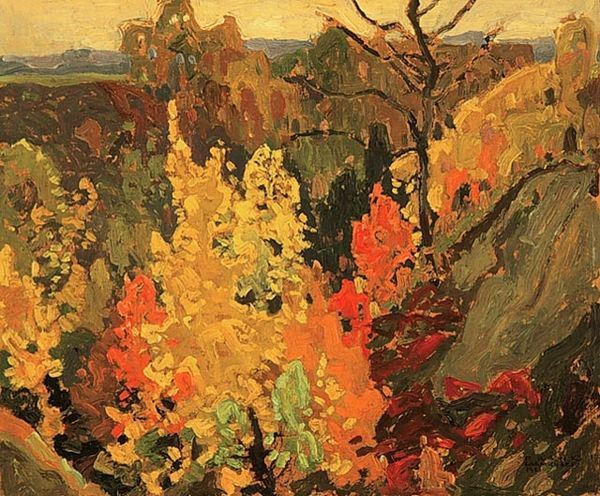
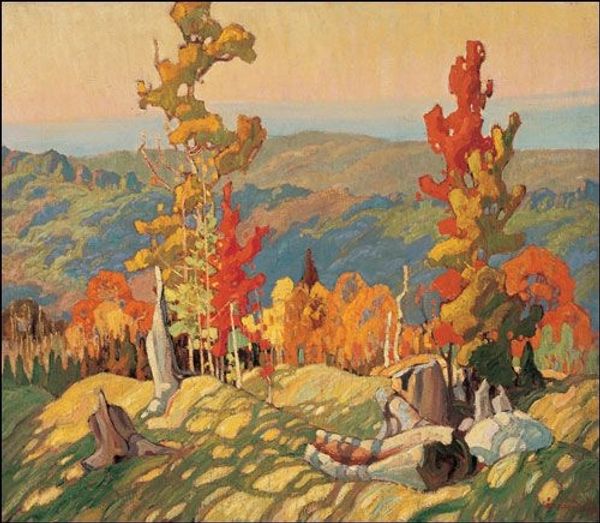
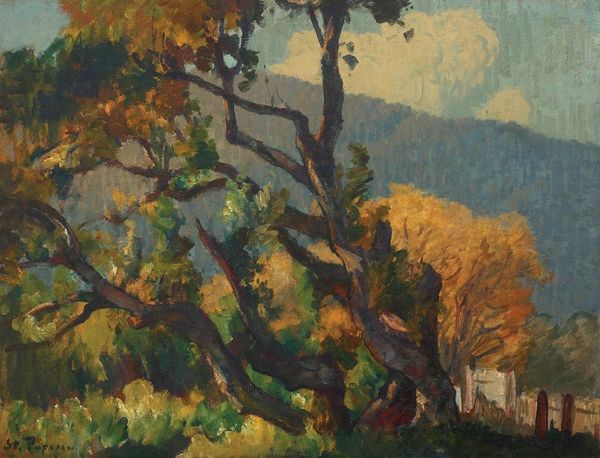
Curator: Here we have Franklin Carmichael's "Scrub Oaks and Maples," an oil painting created in 1935. Editor: Immediately, I’m hit by this intense feeling of brisk, almost biting air. It’s like standing at the edge of autumn, where the colors are bold but the warmth is definitely fading. Curator: Carmichael, as a member of the Group of Seven, was deeply invested in portraying a uniquely Canadian landscape. This work exemplifies their ethos, focusing on the raw, untamed beauty of the northern wilderness. We should perhaps consider its particular time frame in the midst of Canada defining itself as its own nation in relation to the British Commonwealth and consider the way painting served the goals of the state and settler ambitions for creating a truly ‘Canadian’ aesthetic by portraying untouched landscapes and romanticized scenes. Editor: I totally see that, the nationalism bit. It's impossible to extract yourself from the fact that this painting belongs to this specific historical juncture, and as such, inevitably communicates an ideology and worldview, regardless of the intent of the artist. That being said, can we also appreciate the actual textures in here? Like, those scrub oaks in the foreground are practically leaping out at me! He’s made them almost monstrous, but in the most glorious way. It is not "sublime" in the classic Western cannon in the aesthetic, but I definitely feel a sense of being utterly dwarfed by them. Curator: Indeed. Carmichael’s impasto technique is very evident. It’s more than just representation; it's an embodiment of the ruggedness. He’s not just showing us trees; he’s communicating a kind of stoic endurance inherent in the Canadian Shield. Editor: I’m also wondering how much the paintings serve as self-portraits, the self of Canada, but the artist's too. How does being immersed in and representing something so formidable alter one's experience of themselves, of the everyday, the self-perception, everything! It's an aesthetic experiment with significant political consequences. Curator: That's well put! It’s that interweaving of individual perception and collective identity, where the art serves to reflect and shape both. This landscape contributes to the grander, sometimes problematic, narratives of national identity and our engagement with the land. Editor: The light playing off those trees gives them so much dimension... anyway, I think that I might go buy myself a wool blanket and sit by a fire. Thanks for lending me your expertise.
Comments
No comments
Be the first to comment and join the conversation on the ultimate creative platform.
 Collect
 React
React Comment
More like this