painting, oil-paint
#
portrait
#
narrative-art
#
painting
#
oil-paint
#
painted
#
figuration
#
form
#
oil painting
#
mythology
#
human
#
history-painting
#
italian-renaissance
#
nude
Copyright: Public domain
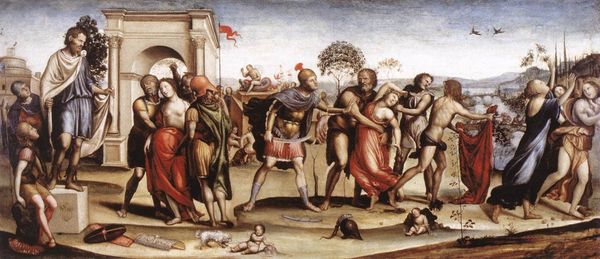
Editor: Here we have "The Myth of Prometheus," an oil painting created around 1515 by Piero di Cosimo. There's something haunting about it, maybe the juxtaposition of creation and suffering, the idyllic landscape and the brutal scenes playing out in the foreground. What captures your attention most in this work? Curator: Ah, Prometheus! He always stirs my soul, doesn't he? Piero, in his uniquely quirky way, has crammed so much into this canvas. Visually, the eye dances between the classical statue of Prometheus – a figure of defiant beauty – and the rather gruesome depictions of his creation, and subsequent punishment. It's a symphony of flesh, wouldn't you say? The earthy tones almost feel…primal. Does it strike you as oddly celebratory amidst all the torment? Editor: Celebratory? I hadn't really thought of it that way. I was more focused on the anguish. Curator: But consider the figures dancing almost giddily, giving life. It's Piero reminding us that creation, even divinely inspired, isn't without its mess, its price. It also speaks volumes of the Renaissance era preoccupation with Humanism; with Man as both a maker and a potential sufferer. Editor: That's a fascinating way to look at it! I'm starting to see the duality now – this interplay between the glorious and the grotesque. Curator: Precisely! It makes me think about the creative process itself, that strange alchemy where pain and inspiration become entwined. What do you take away from this? Editor: I think I’ll definitely see creation differently from now on, acknowledging that even the most beautiful things might have emerged from some kind of struggle. Curator: Indeed! Beauty often has thorns, doesn't it? And it's in acknowledging that very tension, the bittersweet truth of existence, where real understanding resides.
Comments
No comments
Be the first to comment and join the conversation on the ultimate creative platform.
 Collect
 React
React Comment
More like this