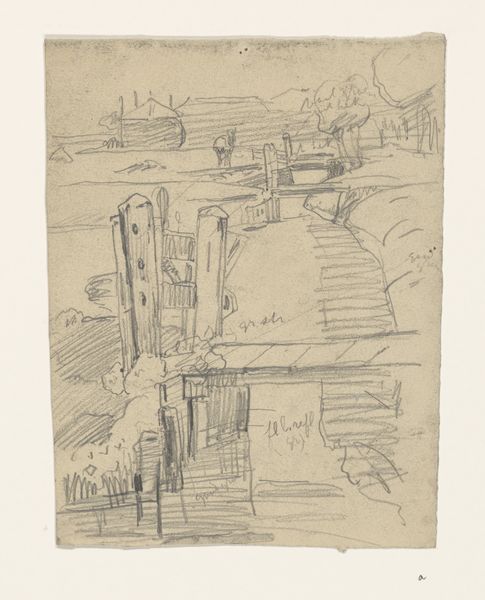
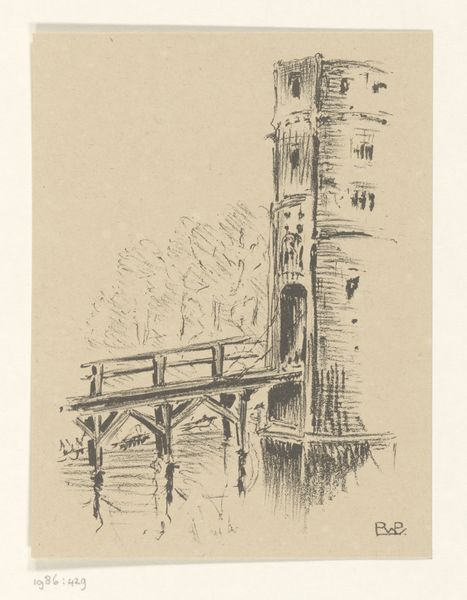
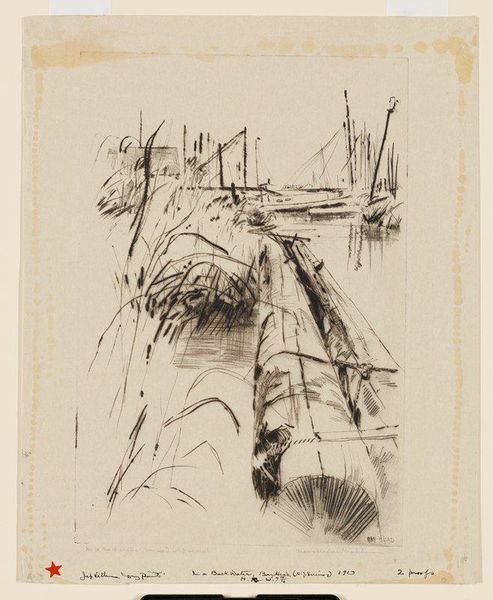
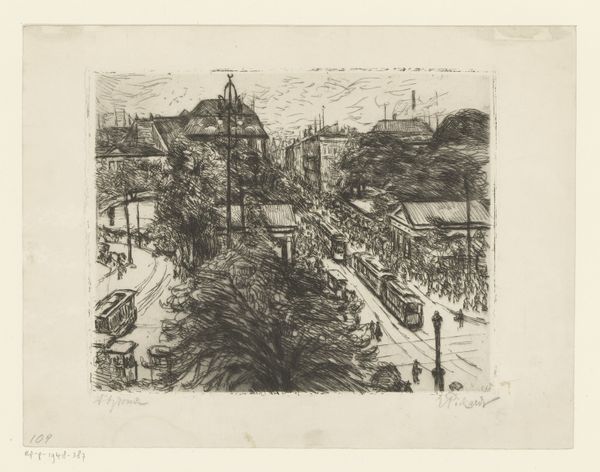
Landschap met telegraafpaal en kruis met Christusbeeld 1870 - 1914
0:00
0:00

willembastiaantholen
Rijksmuseum
drawing, plein-air, ink
#
drawing
#
narrative-art
#
pen sketch
#
plein-air
#
landscape
#
ink
#
realism
Dimensions: height 292 mm, width 204 mm
Copyright: Rijks Museum: Open Domain
Curator: Looking at this ink drawing, “Landscape with Telegraph Pole and Cross with Christ Figure” by Willem Bastiaan Tholen, created sometime between 1870 and 1914, my immediate response is how stark the imagery is. It is rather sombre. Editor: Yes, a somber, even eerie tone, pervades the work. What’s particularly striking to me is the artist's choice to juxtapose the traditional religious symbol—the cross—with a very modern industrial object—the telegraph pole. How do you interpret that? Curator: I see it as a powerful visual commentary on the evolving social and spiritual landscapes. The crucified Christ figure feels almost dwarfed, or perhaps co-opted, by the looming presence of technology and perhaps its secular authority. One figure suffers visibly and quietly, while the other facilitates connectivity, industry and ultimately productivity. There’s tension in the image, in the sense of conflicting systems of power, progress, tradition, belief and modern life. Editor: Indeed. Tholen's medium contributes to this feeling. The use of ink, rapidly applied "en plein air" suggests the immediacy of sketching and reportage, doesn't it? The artist documents his observations of a changing world using techniques that suggest production more than devotional representation. You have that visual weight pulling the eye toward a power pole made from timber that perhaps once would have been solely used to erect a monument. The labour to erect each is different but also somewhat comparable. Curator: Absolutely. Also, thinking about this in terms of gender, we also have to consider that there is also perhaps commentary on power relationships within Christianity and in industrial infrastructure. The very materiality speaks to the labor invested, but who profits? How is it represented? It forces us to think about labor practices, their representation, and who benefits from each symbol. Editor: It leaves you pondering. The piece uses commonplace elements that become entangled with larger forces: industry, faith, history. A stark image. Curator: Indeed. I'm grateful for the chance to reflect on these intersecting influences present in what could have been seen simply as a landscape.
Comments
No comments
Be the first to comment and join the conversation on the ultimate creative platform.
 Collect
 React
React Comment
More like this