16th-17th century
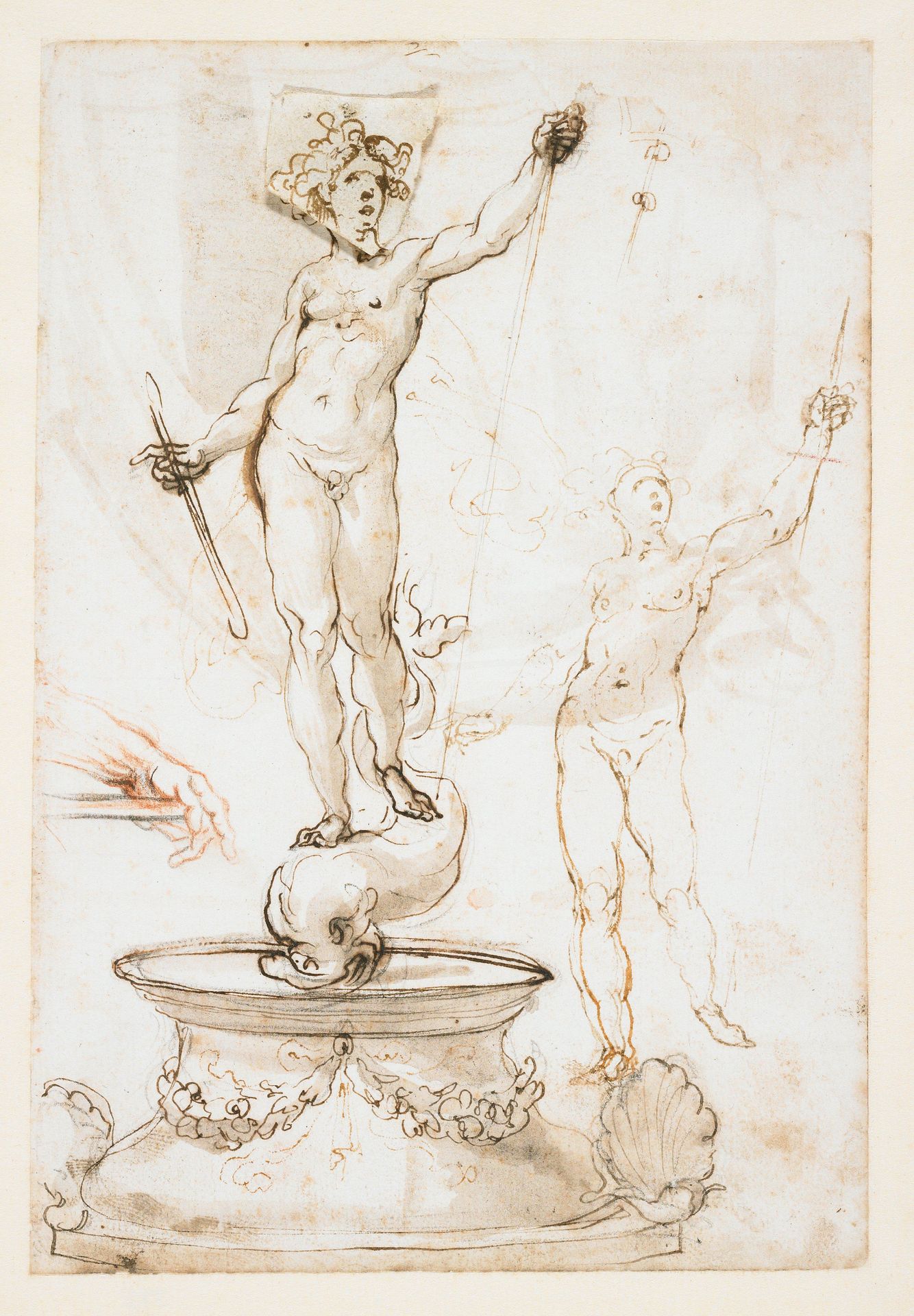
Study for a Fountain of Neptune


Listen to curator's interpretation
Curatorial notes
Curator: Before us is "Study for a Fountain of Neptune," an ink drawing likely dating from the 16th or 17th century, attributed to Cherubino Alberti and held within the collection of the Minneapolis Institute of Art. Editor: Immediately striking is the sketch's energetic quality. The artist hasn’t labored over precision; instead, we’re given a glimpse into the creative process, a rapid exploration of form and movement. There is dynamism in every swirling line. Curator: Precisely. The dynamism stems in part from Alberti’s mastery of line. Observe how he uses hatching and cross-hatching to model the figure of Neptune and give weight to the dolphin he stands upon. There's also a focus on the contrapposto stance. Editor: Indeed. Neptune, as the symbolic master of the seas, has always struck me as a powerful, assertive figure, which this preliminary sketch does well to reflect, yet here, in this drawing, Alberti also manages to infuse a degree of elegance with that assertiveness. Even the swirling water suggested at the base possesses a sort of delicate chaos. Curator: I concur. He presents more than a god of the sea but the sheer artistry of design. See how the curve of Neptune's raised arm mirrors the curve of the dolphin's body. There is a formal correspondence linking god, animal, and water. Editor: Water, fertility, dominion – the image vibrates with meaning. And that added study of a hand at the side! Is it a kind of annotation? Curator: Perhaps it is Alberti refining a specific detail, the rendering of human anatomy within a broader iconographic scheme. I find Alberti’s synthesis compelling; the formal rigor meets an undeniable, classical symbol. Editor: Agreed, it's fascinating to witness such preliminary creativity. In essence, this work is a rich confluence of skillful lines that speak of artistic intent. It highlights Neptune as a figure that holds dominion over so many symbolic meanings, so fluid and potent, as an entity in human consciousness and culture.