About this artwork
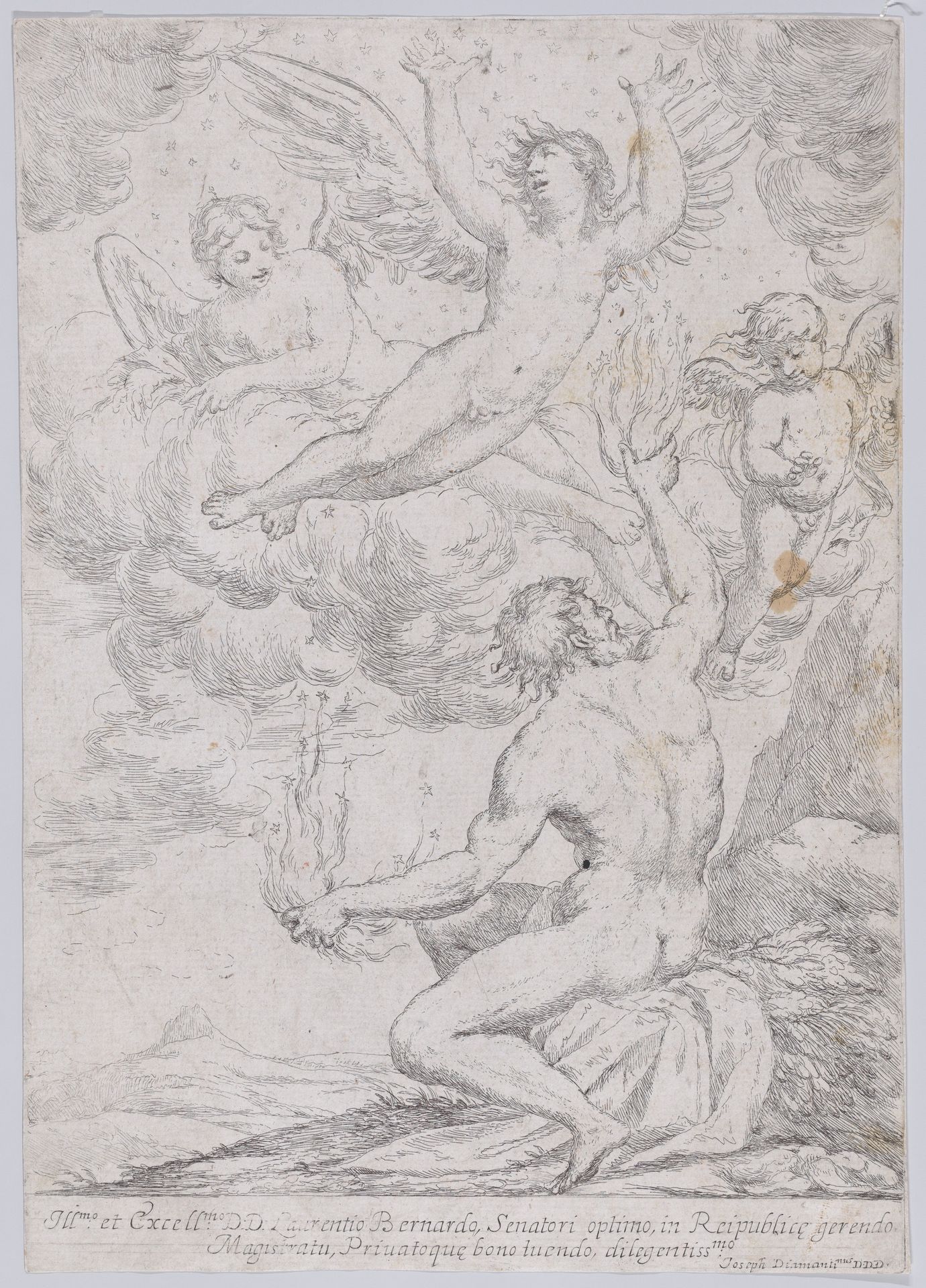
Giuseppe Diamantini made this etching, The Fall of Icarus, in Italy in the late 17th century. It depicts the moment when Icarus, having flown too close to the sun, plummets from the sky as his father, Daedalus, looks on in horror. What does this famous mythological scene tell us about its cultural moment? We might see this image as a commentary on the overreach of ambition. The classical myth of Icarus had a resurgence in popularity during the Renaissance and Baroque periods, becoming a symbol of hubris and the dangers of unchecked power. At this time, powerful families dominated Venetian politics. Diamantini dedicated this print to a member of the Venetian Senate. This image may warn the ruling class of the Republic of Venice about the consequences of excessive ambition. By studying the social and institutional context, we can discover the complex meanings embedded in this seemingly straightforward mythological scene.
The Fall of Icarus
1650 - 1700

Giuseppe Diamantini
1621 - 1705
The Metropolitan Museum of Art
Metropolitan Museum of Art, New York, NYArtwork details
- Medium
- drawing, print, etching, ink
- Dimensions
- Sheet (Trimmed): 11 13/16 × 8 5/16 in. (30 × 21.1 cm)
- Location
- Metropolitan Museum of Art, New York, NY
- Copyright
- Public Domain
Tags
Comments
Share your thoughts
About this artwork
Giuseppe Diamantini made this etching, The Fall of Icarus, in Italy in the late 17th century. It depicts the moment when Icarus, having flown too close to the sun, plummets from the sky as his father, Daedalus, looks on in horror. What does this famous mythological scene tell us about its cultural moment? We might see this image as a commentary on the overreach of ambition. The classical myth of Icarus had a resurgence in popularity during the Renaissance and Baroque periods, becoming a symbol of hubris and the dangers of unchecked power. At this time, powerful families dominated Venetian politics. Diamantini dedicated this print to a member of the Venetian Senate. This image may warn the ruling class of the Republic of Venice about the consequences of excessive ambition. By studying the social and institutional context, we can discover the complex meanings embedded in this seemingly straightforward mythological scene.
Comments
Share your thoughts