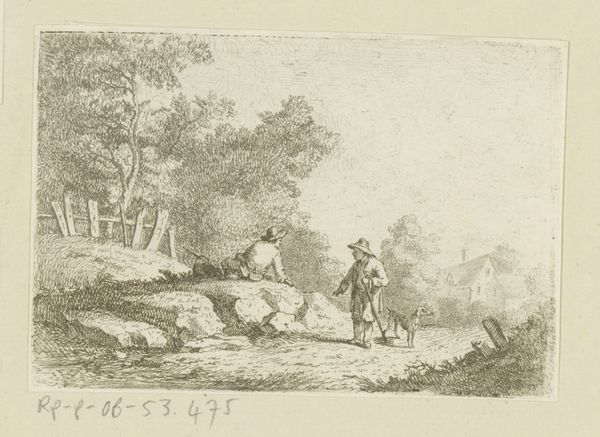
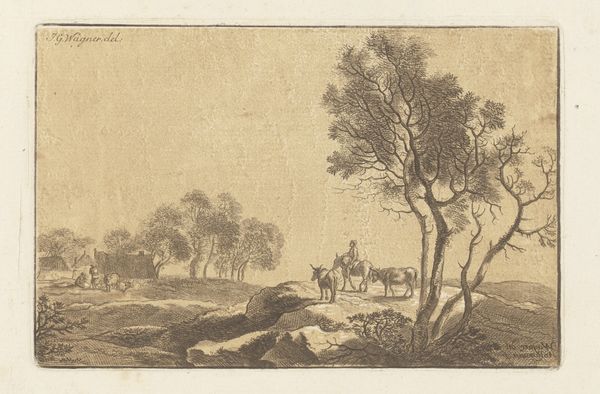
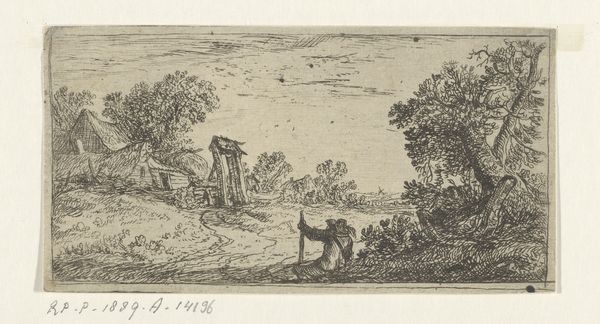
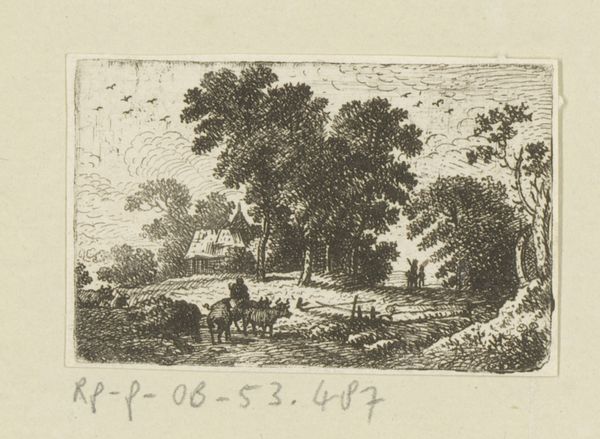
Landschap met ruiter en bedelaarster 1799 - 1874
0:00
0:00

hendrikjozeffranciscusvanderpoorten
Rijksmuseum
print, etching
#
narrative-art
# print
#
etching
#
landscape
#
figuration
#
road
#
romanticism
#
genre-painting
Dimensions: height 48 mm, width 94 mm
Copyright: Rijks Museum: Open Domain
Editor: So, here we have Hendrik van der Poorten's "Landschap met ruiter en bedelaarster," a landscape with a rider and a beggar woman, etched sometime between 1799 and 1874. It feels almost like a fleeting glimpse of another world; there’s a quiet dignity to the scene despite the obvious disparities in wealth. What do you see in this piece? Curator: I'm immediately drawn to the symbolism of the road. The road, the path…it speaks to journey, not only a physical one but the journey of life itself. Note how the rider, elevated on horseback, progresses confidently. How might we read that? Editor: Perhaps a symbol of status, someone with the means to navigate life with greater ease than the beggar? Curator: Precisely! And consider the beggar woman and child – embodiments of earthly struggle. Notice the artist’s delicate lines used to depict the figures. Does it remind you of anything? Editor: The etching is quite fine, but evokes Romantic landscapes… sort of a visual language from that period. Curator: Indeed! Landscape was considered more than a realistic depiction. It carried emotional and psychological weight, reflecting cultural values. Even a humble etching like this echoes larger societal narratives, right? Think about the cultural memory embedded in the archetype of the charitable rider. Editor: I see… a call back to ideals of nobility and compassion, but viewed through the lens of changing social realities. It's quite powerful when you consider the possible subtexts. Curator: Exactly. We look to images and they in turn reflect us, and inform us on a collective level. I keep pondering that rider, meeting that gaze! Editor: I learned how even a seemingly simple image can be dense with cultural and psychological meaning if you examine its visual language closely!
Comments
No comments
Be the first to comment and join the conversation on the ultimate creative platform.
 Collect
 React
React Comment
More like this