print, woodblock-print
#
portrait
# print
#
asian-art
#
caricature
#
ukiyo-e
#
woodblock-print
#
genre-painting
Dimensions: height 374 mm, width 252 mm
Copyright: Rijks Museum: Open Domain
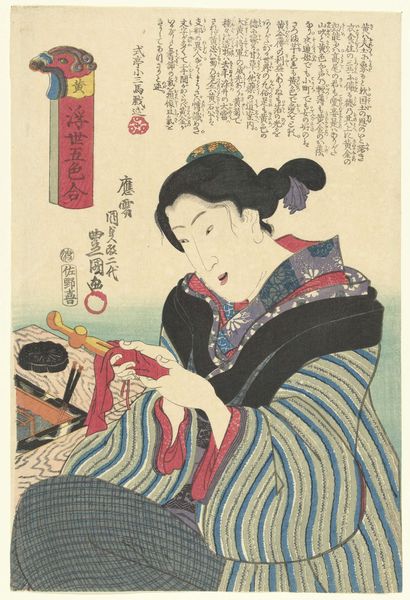
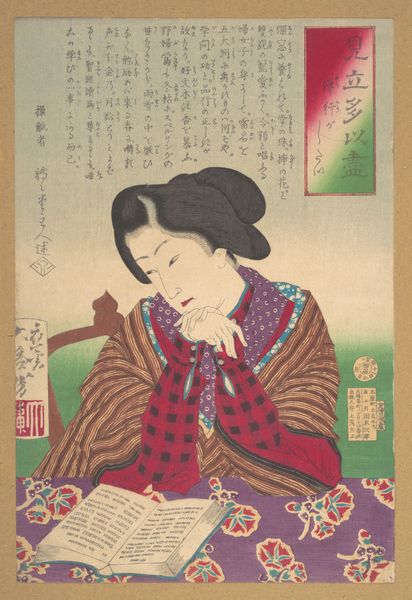
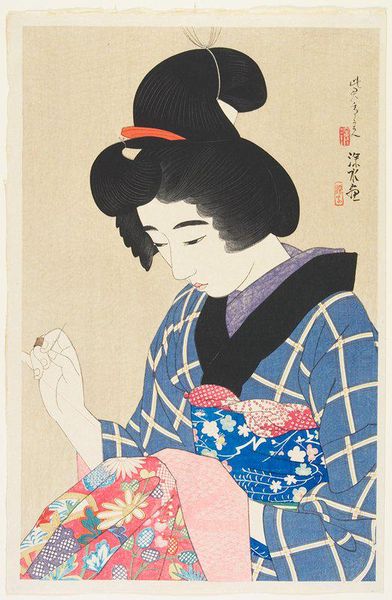
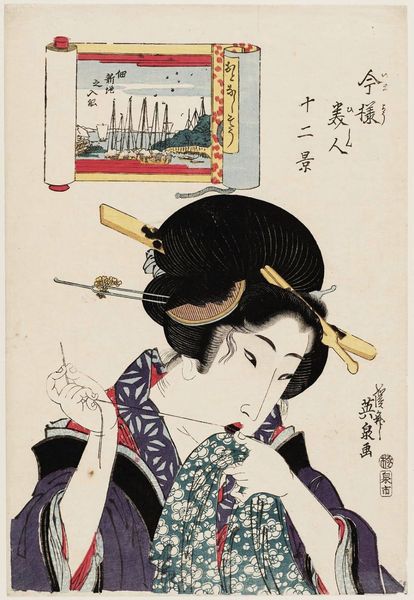
Editor: This woodblock print, titled "Rood," was created by Utagawa Kunisada in 1844. The woman seems focused, maybe even a little melancholy. What stories do you think this piece holds? Curator: I'm immediately drawn to the interplay of patterns – the stripes of the kimono contrasting with the checked fabric of her lower body, and floral print, each fabric acting as a different cultural text, if you will. Notice also the tools next to her: they suggest domesticity. What are the cultural implications of depicting her with this quiet focus, almost isolation? What does her intense concentration communicate? Editor: I hadn’t considered that detail. I was stuck on how…ordinary it seemed. What’s she cutting, exactly? And does it matter? Curator: Ah, but “ordinary” is a powerful statement in art. Her domestic task becomes imbued with a symbolic weight. We aren’t necessarily meant to understand *what* she is cutting. Rather, observe how her actions contribute to a greater understanding of societal roles during that era. She exists not just as a person, but as a signifier of women’s labor and the domestic sphere. Ukiyo-e prints allowed the common people a window into themselves. Do you see what that would communicate? Editor: That's a fascinating perspective. I was so busy looking at the immediate subject I wasn't fully considering the bigger picture. Seeing the woman’s quiet domestic act imbued with social meaning opens up whole new avenues of interpretation. Curator: Precisely! It's a cultural mirror, reflecting both the surface and the deeper, often unspoken, aspects of daily existence. The power of imagery, isn’t it remarkable?
Comments
No comments
Be the first to comment and join the conversation on the ultimate creative platform.
 Collect
 React
React Comment
More like this