Deuxieme Vue des Environs de Naples 1760 - 1770
0:00
0:00


Dimensions: Sheet (Trimmed): 10 1/4 × 13 7/8 in. (26.1 × 35.2 cm)
Copyright: Public Domain
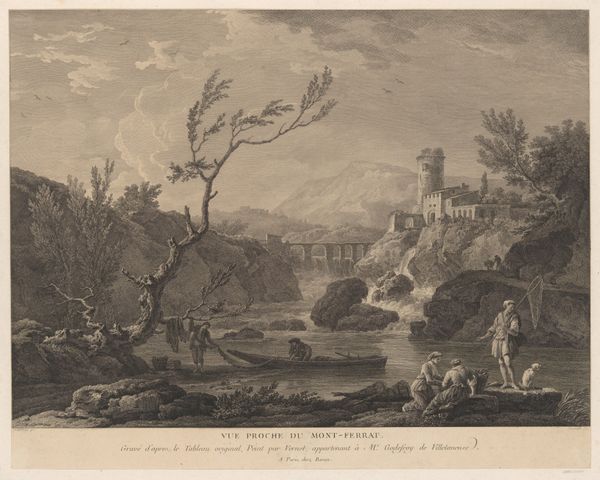
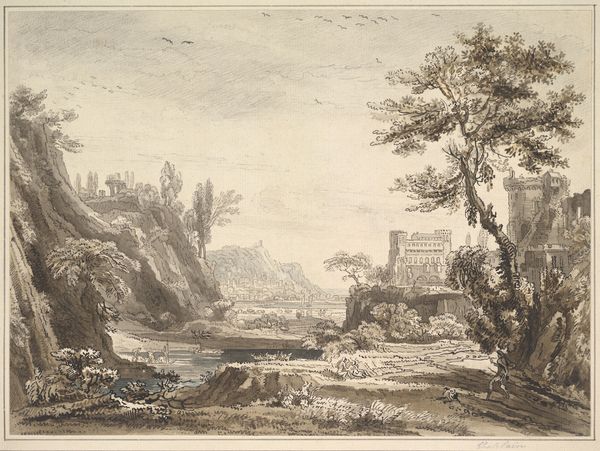
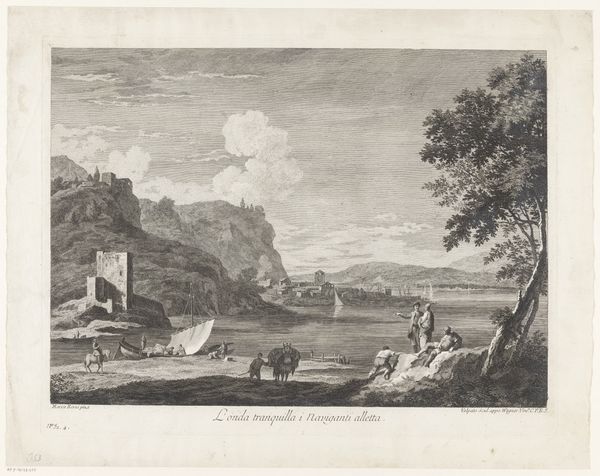
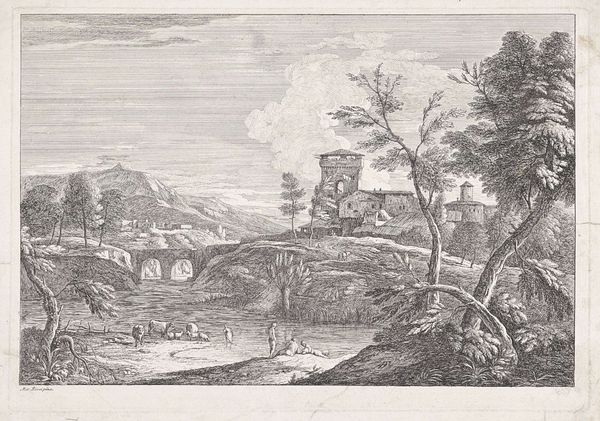
Curator: Here we have Pierre François Basan’s "Deuxieme Vue des Environs de Naples," created between 1760 and 1770. This engraving, currently held at the Metropolitan Museum of Art, presents a meticulously rendered landscape. Editor: It has a distinctly pastoral feel. I’m immediately drawn to the light—it almost feels as if a memory is trying to be captured, fading into the distant mountains, but the landscape overall, even the poses of the people, appear staged or arranged. Curator: Indeed. The composition emphasizes the interplay of light and shadow. Consider how the engraver uses line to define form. Look at the foliage of the trees against the softer textures of the water—how Basan orchestrates areas of deep blacks alongside airy openness. This division is key to reading the imagery here, from the human, tamed space to the distant wild landscape. Editor: Absolutely, and that visual balance extends to the human figures. The people are posed in archetypal ways: fishermen with nets evoking the abundance of nature, a shepherd embodying a pastoral existence, but they all have classical origins in bucolic poems and stage plays, recalling familiar values of tradition, simplicity and humanity’s relationship to its own geography. Curator: You’re speaking about the symbolic framework of this image—an ordered and balanced presentation of societal norms amid nature. Editor: And not just norms—ideals. Notice how the tower in the background, far from a humble hut, reminds us that authority and divine connection watches over even the most isolated idyll. The engraving then, seems less like documentation of reality and more like a symbolic landscape reflecting an ideal of its day. Curator: It reminds us that landscape art serves less to document places as they exist in themselves, and far more to suggest our shifting place in culture. This close attention to texture and contrast creates, as we observed earlier, a staging upon which that culture is presented to the viewer. Editor: A stage that’s set on an axis of memory, connecting us with those bygone interpretations. We realize that to see landscapes, we must understand their inherited symbolism, an act of understanding that can help make sense of our own relationship to the visual symbols.
Comments
No comments
Be the first to comment and join the conversation on the ultimate creative platform.
 Collect
 React
React Comment
More like this