drawing, mixed-media, watercolor
#
drawing
#
mixed-media
#
toned paper
#
light pencil work
#
quirky sketch
#
fantasy-art
#
abstract
#
personal sketchbook
#
watercolor
#
abstraction
#
sketchbook drawing
#
watercolour bleed
#
watercolour illustration
#
sketchbook art
#
surrealism
#
fantasy sketch
#
watercolor
Copyright: Modern Artists: Artvee
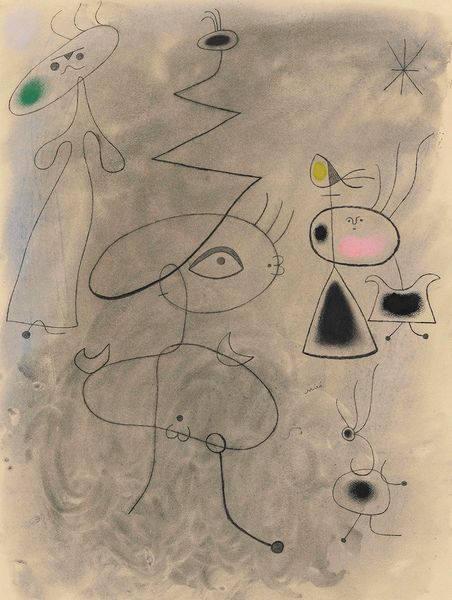
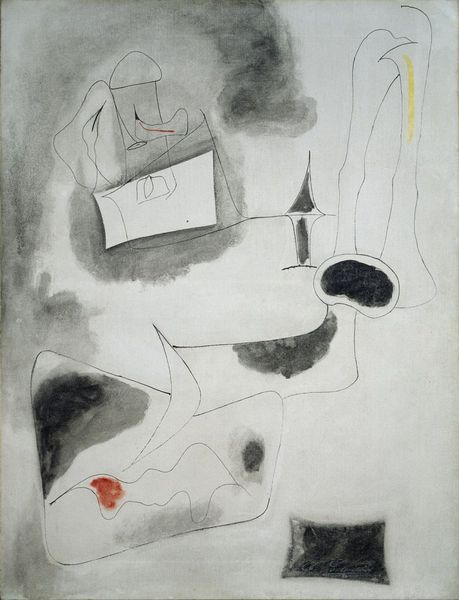
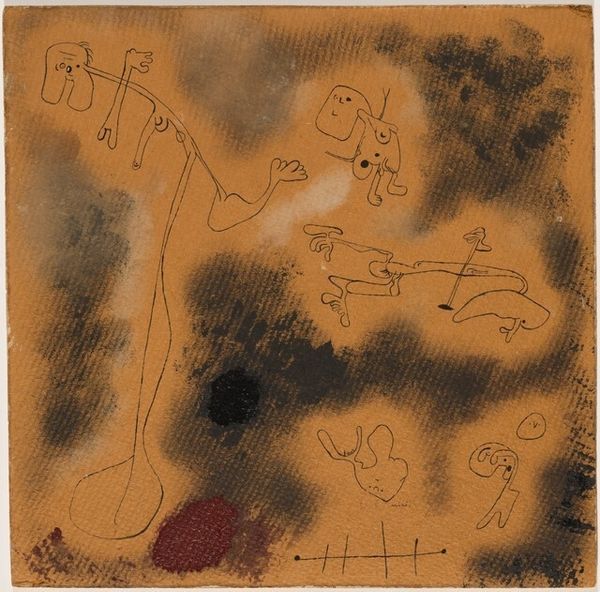
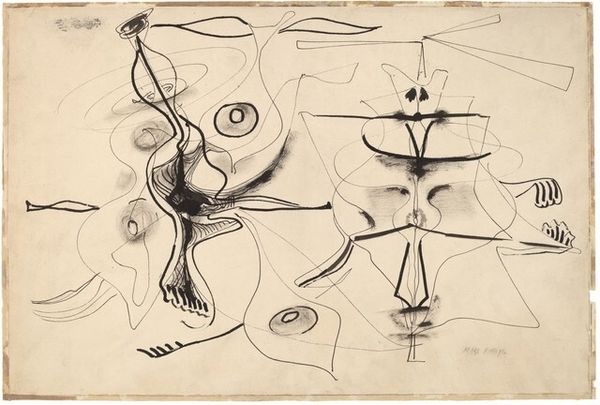
Curator: What a playful piece. It almost feels like peering into someone's dream journal. Editor: That's a wonderful way to put it. The work is titled "Femme, serpent, étoiles," or "Woman, Serpent, Stars," a mixed-media drawing created by Joan Miró in 1942. This was a period when the world was engulfed in war, and Miró, though living in Spain, felt deeply connected to the global struggle. It reflects themes of identity and disruption during times of upheaval. Curator: Absolutely. I’m fascinated by this piece's sense of controlled chaos, with its bizarre, disfigured entities. The muted watercolors give the piece a mystical aura. Editor: Looking closer, one can see Miró's negotiation of artistic language during political instability. The serpent, in many cultures, signifies duality—life and death, creation and destruction. Miró uses such symbology in a non-literal way, opening space for various narratives to emerge. Curator: I'm wondering what that face-like form below the "woman" character represents to you? Is that a separate, trapped being? I love how Miro leaves it so open. Editor: To me, the suspended character you described speaks to interconnectedness, reflecting feminist perspectives on collaboration and decentralization, dismantling individualist or hierarchical positions. This may challenge norms linked to gender and class, pushing a social discourse towards collaborative, rather than combative interactions. Curator: Yes! It feels like a dialogue. Seeing the humanlike figure alongside the face, serpent, and stars really reinforces to me the idea that Miró found some sense of continuity in chaos, and an expression of interconnection across different beings and concepts. It is something quite tender in the end. Editor: The magic of Miró truly is that the longer you look, the more there is to see, to interpret. There is always more room for perspectives to come in.
Comments
No comments
Be the first to comment and join the conversation on the ultimate creative platform.
 Collect
 React
React Comment
More like this