Possibly 1899
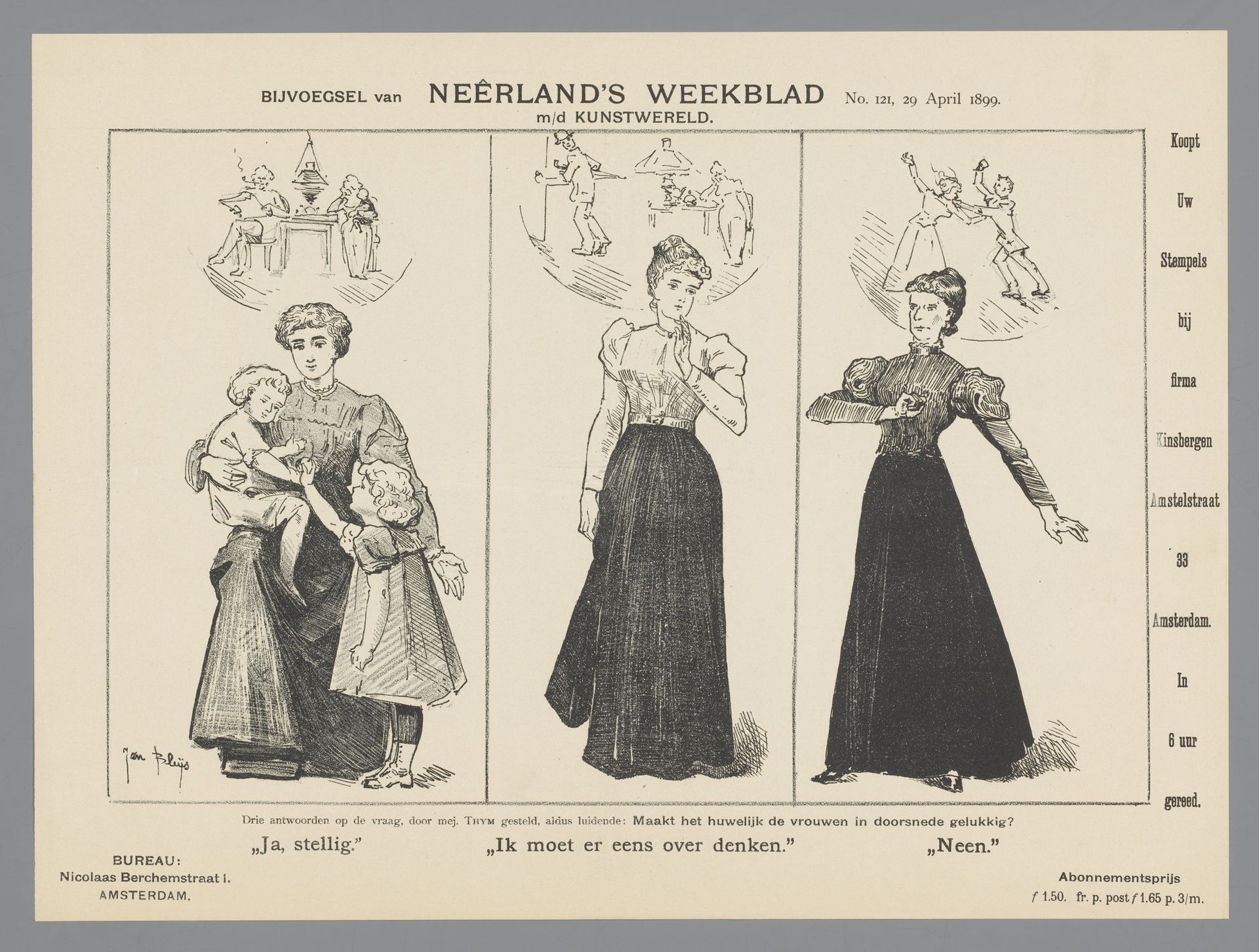
Maakt het huwelijk de vrouwen in doorsnede gelukkig?

Listen to curator's interpretation
Curatorial notes
Editor: This drawing, possibly from 1899 by Jan Bleijs, titled "Maakt het huwelijk de vrouwen in doorsnede gelukkig?" or "Does marriage make women happy on average?" It's a pen drawing, maybe even a print. It's stark. The women depicted appear trapped, not particularly content. What societal narratives were at play at the time? Curator: This piece immediately raises questions about the socio-political context of women in Dutch society at the turn of the century. Considering it appeared as a supplement in a weekly publication, it was meant to engage a broad public. The artist presents us with three archetypes and opinions of marriage, seemingly. But, how does Bleijs utilize the format of a widely disseminated publication to perhaps challenge conventional expectations or even the then current political climate of women in the late 19th century? Editor: So the artist might be using the setting - the weekly newspaper - to be a little subversive, like getting a message out to a large group, but secretly disagreeing with it? Curator: Precisely. Consider the format—a satirical illustration within a news context. Perhaps it aimed to ignite a conversation. The visual language points toward an active participation within a larger discussion on women's roles. We need to consider the institution of marriage at the time and the prevailing socio-economic conditions. Was it truly a path to happiness, or were women constrained by societal expectations and limited opportunities? Editor: So by posing the question directly, the artist opens up that space for discussion, makes people think rather than passively accept, no? What do you make of the differing imagery with the three characters? The inclusion of the "yes," "maybe," and "no" answers at the bottom? Curator: The imagery serves as a condensed visual argument. Each panel functions almost like a survey response made visible, a way to visualize societal pressures and opinions within the visual confines of the paper. How fascinating to think of art functioning in such an accessible and openly critical way! Editor: It makes me see how art, even something that looks straightforward, can be a commentary on the real world.