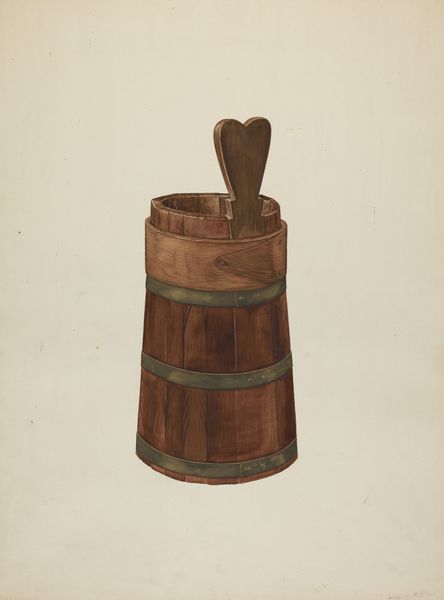
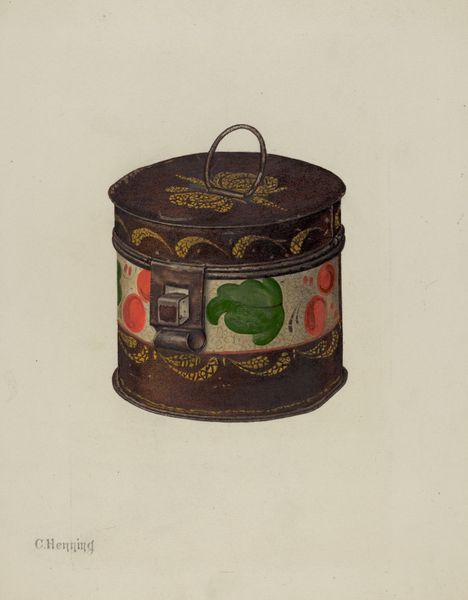
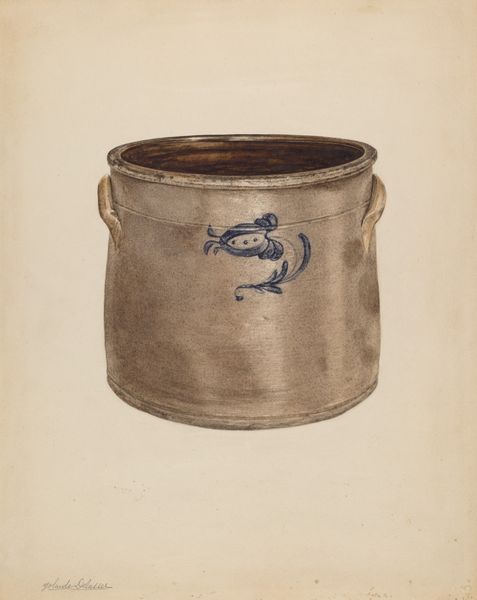
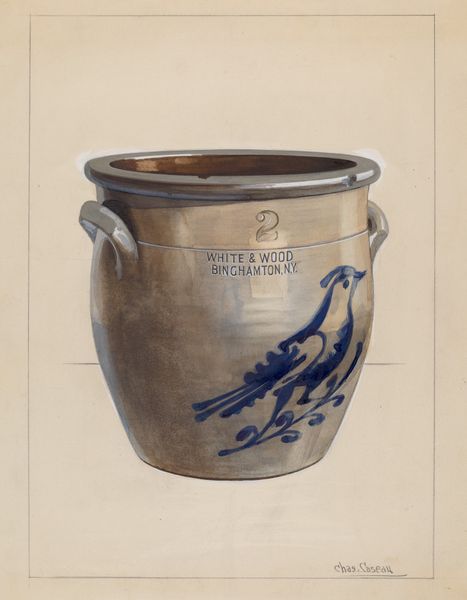
drawing, watercolor
#
drawing
#
watercolor
#
watercolour illustration
#
watercolor
Dimensions: overall: 27.1 x 20.9 cm (10 11/16 x 8 1/4 in.)
Copyright: National Gallery of Art: CC0 1.0
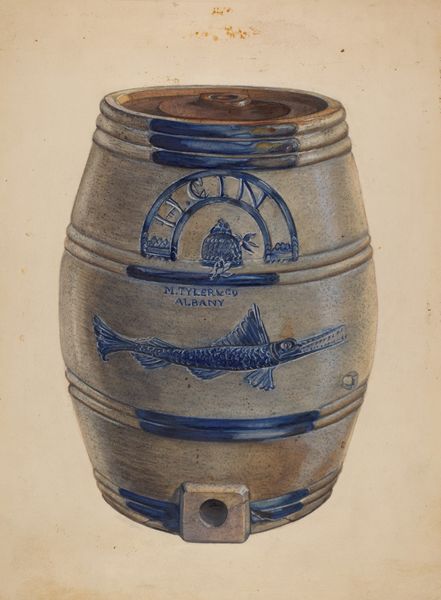
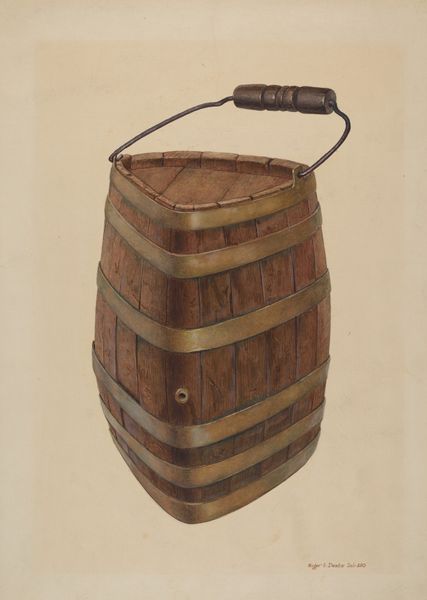
Curator: Before us, we have Charles Caseau's watercolor drawing, "Keg," dating back to around 1935. What strikes you first? Editor: Immediately, I'm drawn to its folksy charm. It’s almost a study in aged textures and muted tones, like a memory slowly fading. The colors feel grounded. Curator: This piece speaks volumes about regional identity and commercialism during the pre-war era. The "Lake Erie" inscription positions it geographically, hinting at local industries like fishing, shipping, or even breweries capitalizing on regional pride. It evokes thoughts of working class social experiences. Editor: Indeed. The eagle emblazoned on the keg is not merely decorative, but a powerful symbol. The eagle has historically signified authority, but here, within the context of possibly local goods, it also might evoke pride, maybe aspiration, in even a rural community. It could carry deeper undertones linked to a national narrative. What sort of cultural echoes can you perceive in Caseau’s rendition? Curator: There's a clear visual dialogue between nature and industry. The eagle feels slightly forced, perhaps even a critique of the romanticized view of progress. Its awkward posture and the commercial nature of the water container beneath speak of cultural and historical displacement and tension. Editor: I agree. I see something in that almost forced emblem. What’s interesting, of course, is the tension inherent. How do we see this tension replicated throughout this pre-war period? Curator: You begin to wonder: How did it feel, back then, to have one’s regional, working class identity used as a cog to build commerce? Caseau encourages us to reckon with how national narratives can so readily absorb localized meanings. Editor: Well, this watercolor really invites one to see our everyday symbols from an historical point of view, to better see how the images and objects around us become imprinted with identity. Curator: I concur. Caseau’s "Keg" reminds us of the interconnectedness between the visual languages we construct for ourselves. Editor: And how those languages often echo and shape us more than we expect.
Comments
No comments
Be the first to comment and join the conversation on the ultimate creative platform.
 Collect
 React
React Comment
More like this