photography, site-specific, albumen-print
asian-art
landscape
photography
site-specific
albumen-print
Dimensions: image: 26 × 34.3 cm (10 1/4 × 13 1/2 in.) mount: 45.5 × 58.4 cm (17 15/16 × 23 in.)
Copyright: National Gallery of Art: CC0 1.0
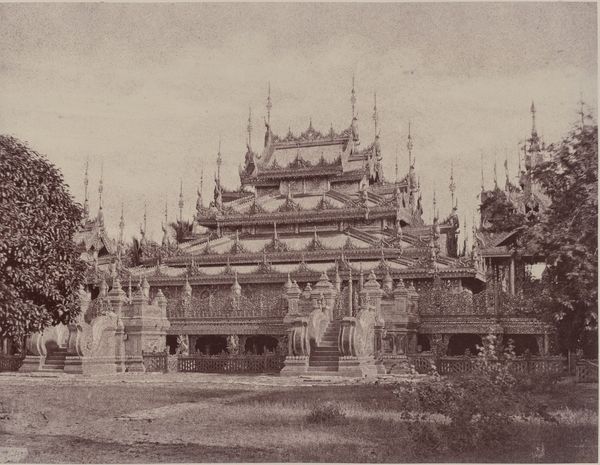
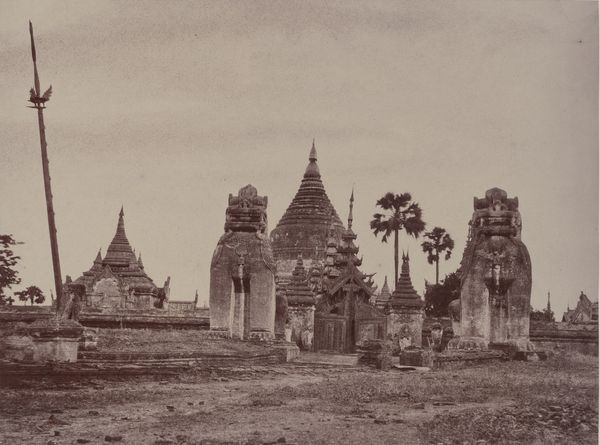
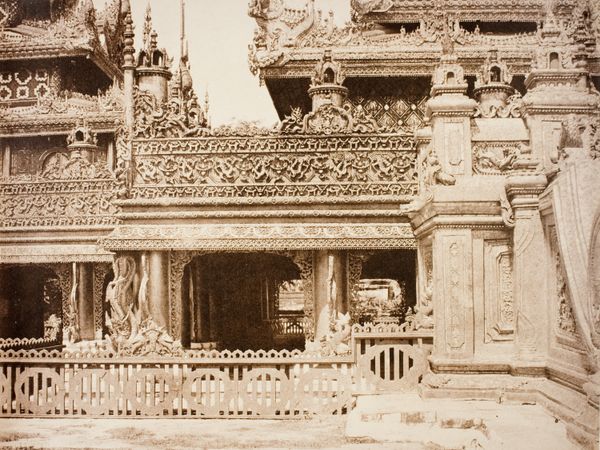
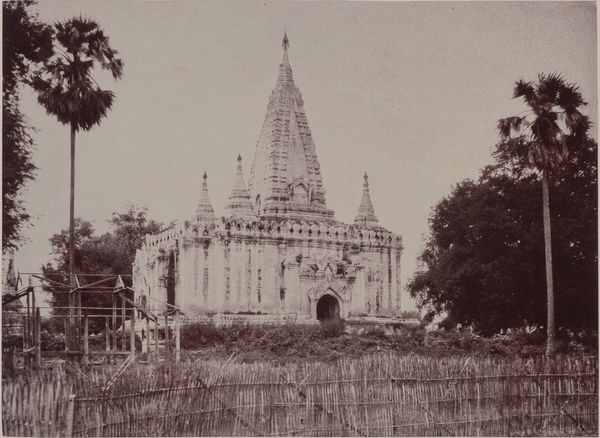
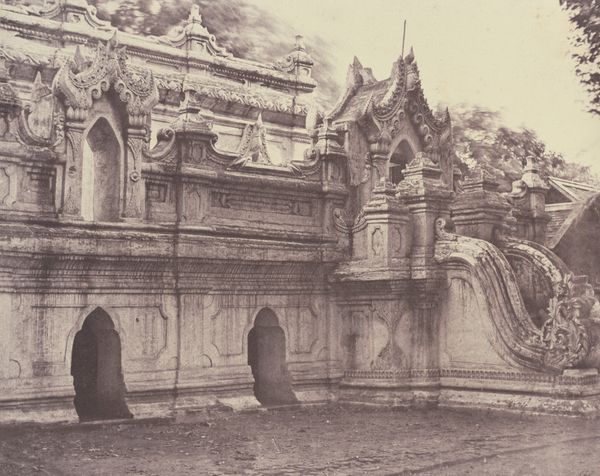
Curator: Oh, there's a dreamlike quality to this scene, isn’t there? Sort of melancholic beauty suspended in time. Editor: Indeed. What we're looking at is "Amerapoora: Sindu Shwe koo Pagoda," a site-specific albumen print from around 1855, captured by Linnaeus Tripe. Curator: It does have this hazy feeling, very architectural. The way the pagoda sits so grand, and the light kind of dissolves all the sharp edges makes me wonder if it had a big impact at the time. Editor: Absolutely. Tripe uses a symmetrical composition with detailed structure on the left and a sculpture of what looks like a lion guardian at the gate. These are recurring structural choices in his photographs across Asia. Curator: You know, when you put it like that it suddenly feels balanced, intentional, not just a snapshot but an assertion about Burmese artistic mastery and spirituality. It gives a peek into Burmese Buddhist tradition. I want to ask why that building? Editor: The image shows both spatial harmony and Tripe’s meticulous control of tones, allowing us to decode its significance. Curator: There's an aura in this composition. A sense of this place humming. Did the people Tripe capture think of what he was doing as some historical project, too, a way to beat time itself? I bet that lion saw everything... Editor: Well, with photography, particularly in the context of 19th-century colonialism, there are complicated ideas and assumptions present that make a concrete assessment more complex than our emotional impressions. It may not reflect the values or goals of all in Burmese culture then and today. Curator: Perhaps that’s true. But at the core it really just shows us an invitation to keep reflecting! Editor: I’m inclined to agree. This singular view provides valuable perspective on an approach to visual harmony and insight.
Comments
No comments
Be the first to comment and join the conversation on the ultimate creative platform.
 React
React Comment