About this artwork
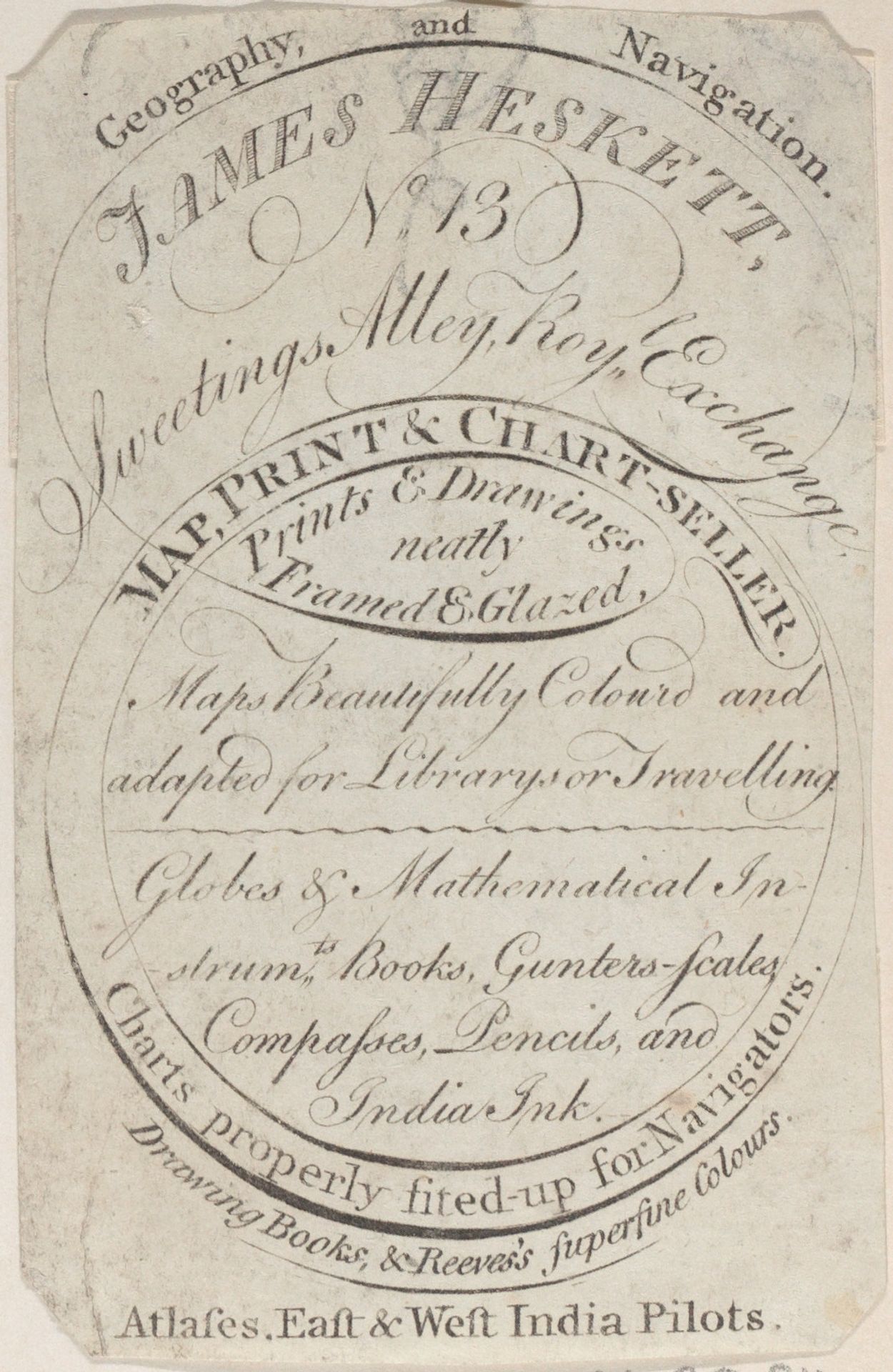
This printed trade card for James Heskett, a seller of maps and navigational tools, encapsulates the spirit of exploration and discovery. Its circular design, filled with text, evokes a globe, a potent symbol of worldliness. The globe motif carries echoes of antique maps, which represented not just physical space but also the boundaries of human knowledge and ambition. We see this repeated in Renaissance drawings where the image of the terrestrial orb conveys both the physical earth and the desire to comprehend the cosmos. But here, the globe has been flattened, confined to the dimensions of a trade card. This reduction reflects a shift from grand exploration to commercial enterprise, a move from the sublime wonder of discovery to the practical tools that enable it. It speaks to how symbols are not static, but fluid, shifting with the currents of human experience. The collective dream of charting new territories has been transformed into the concrete reality of a business transaction. It’s a reminder that the power of images lies not only in their original intent, but in their enduring ability to evoke a range of human emotions and aspirations, linking us to the past while grounding us in the present.
Trade Card for James Heskett, Map, Print, and Chart Seller 1800 - 1900


Artwork details
- Medium
- drawing, print, paper
- Dimensions
- Sheet: 2 3/8 × 3 1/16 in. (6 × 7.8 cm)
- Location
- Metropolitan Museum of Art, New York, NY
- Copyright
- Public Domain
Tags
drawing
paper
Comments
No comments
About this artwork
This printed trade card for James Heskett, a seller of maps and navigational tools, encapsulates the spirit of exploration and discovery. Its circular design, filled with text, evokes a globe, a potent symbol of worldliness. The globe motif carries echoes of antique maps, which represented not just physical space but also the boundaries of human knowledge and ambition. We see this repeated in Renaissance drawings where the image of the terrestrial orb conveys both the physical earth and the desire to comprehend the cosmos. But here, the globe has been flattened, confined to the dimensions of a trade card. This reduction reflects a shift from grand exploration to commercial enterprise, a move from the sublime wonder of discovery to the practical tools that enable it. It speaks to how symbols are not static, but fluid, shifting with the currents of human experience. The collective dream of charting new territories has been transformed into the concrete reality of a business transaction. It’s a reminder that the power of images lies not only in their original intent, but in their enduring ability to evoke a range of human emotions and aspirations, linking us to the past while grounding us in the present.
Comments
No comments