About this artwork
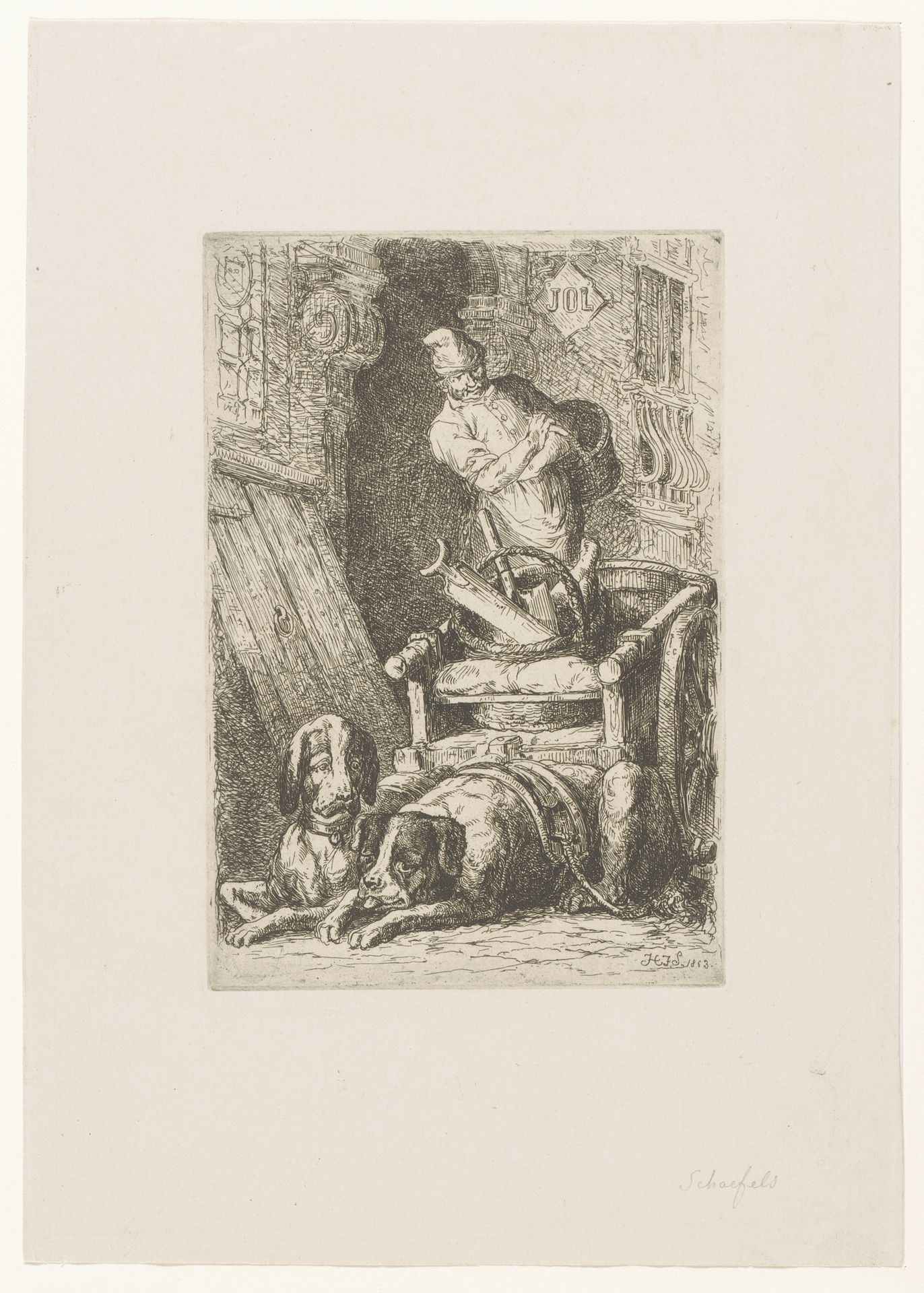
Henri François Schaefels created this etching, titled 'Butcher with a cart pulled by two dogs', using etching techniques on paper. The composition is organized around a central grouping of figures and objects, creating a sense of depth within a confined space. The butcher, positioned in the background, peers over a complex arrangement that includes a chair, a cartwheel, and two dogs. The textures, achieved through varying densities of etched lines, range from the smoothness of the butcher's attire to the rougher surfaces of the wooden cart and the dogs' fur. The spatial organization invites us to consider relationships between labor, domesticity and companionship. The detailed rendering of the scene reflects a semiotic system where each element signifies a different aspect of life and work. The butcher's profession is indicated through his placement near what appears to be his equipment, while the dogs could be interpreted as symbols of loyalty or working animals. This etching challenges fixed meanings by presenting a blend of everyday life and symbolic representation, inviting ongoing interpretation of its cultural and philosophical implications.

Artwork details
- Medium
- drawing, print, etching
- Dimensions
- height 150 mm, width 103 mm
- Copyright
- Rijks Museum: Open Domain
Tags
Comments
Share your thoughts
About this artwork
Henri François Schaefels created this etching, titled 'Butcher with a cart pulled by two dogs', using etching techniques on paper. The composition is organized around a central grouping of figures and objects, creating a sense of depth within a confined space. The butcher, positioned in the background, peers over a complex arrangement that includes a chair, a cartwheel, and two dogs. The textures, achieved through varying densities of etched lines, range from the smoothness of the butcher's attire to the rougher surfaces of the wooden cart and the dogs' fur. The spatial organization invites us to consider relationships between labor, domesticity and companionship. The detailed rendering of the scene reflects a semiotic system where each element signifies a different aspect of life and work. The butcher's profession is indicated through his placement near what appears to be his equipment, while the dogs could be interpreted as symbols of loyalty or working animals. This etching challenges fixed meanings by presenting a blend of everyday life and symbolic representation, inviting ongoing interpretation of its cultural and philosophical implications.
Comments
Share your thoughts