drawing, pen
#
portrait
#
pencil drawn
#
drawing
#
narrative-art
#
pencil sketch
#
charcoal drawing
#
pencil drawing
#
19th century
#
pen
#
portrait drawing
#
history-painting
#
academic-art
Copyright: Public domain
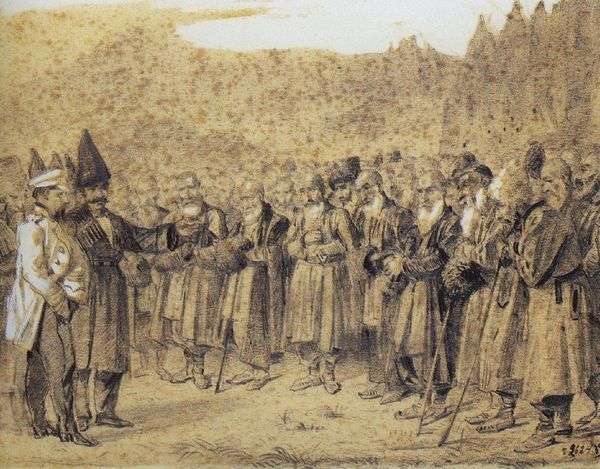
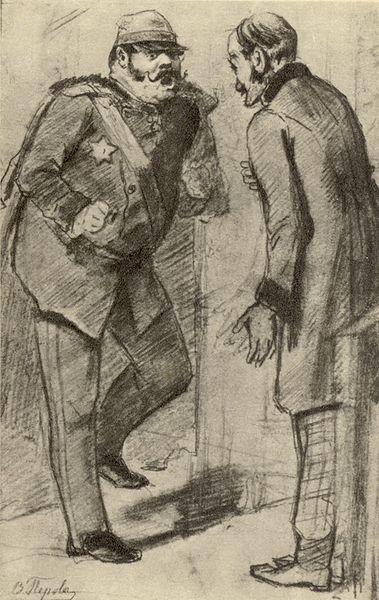
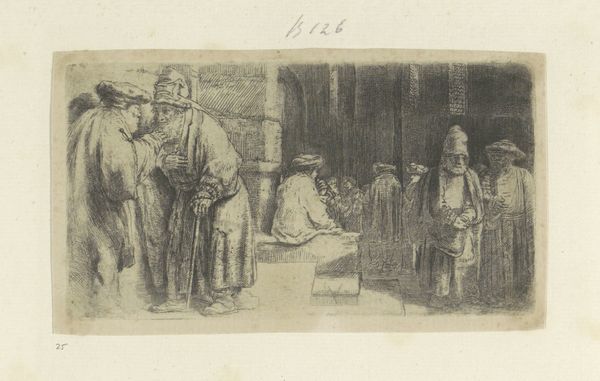
Curator: Look at the weight of history captured here in Jean Leon Gerome Ferris's drawing, "Osman Pasha Brought to Skobelev in Plevna," created in 1895. Editor: My first impression is one of exhaustion. All of these figures seem weary, almost defeated in posture, despite what I presume is a moment of victory depicted. Curator: Indeed. It depicts the surrender of Osman Pasha to General Skobelev during the Siege of Plevna, a pivotal moment in the Russo-Turkish War. What I find so compelling is the way Ferris, an American artist, interprets this complex geopolitical event through a lens of defeat, yes, but also honor, challenging traditional victory narratives. We see the Ottoman commander escorted by Russian soldiers. The artist made extensive use of both pen and pencil in executing this piece. Editor: Symbolically, the drawing speaks volumes about the shifting tides of power and cultural exchange. The contrasting attire – the ornate garb of the Ottoman officers versus the more subdued uniforms of the Russians – hints at deeper cultural tensions. There's an evident contrast in their bearings. Osman Pasha is physically supported but still carries himself with dignity. The other men behind him have beaming looks and a relaxed stature, juxtaposing him even more. Curator: And it’s precisely this juxtaposition that ignites discussion about imperial legacies. Ferris highlights the human cost of war, navigating complicated narratives of colonialism and resistance, masculinity, and national identity. What happens in our cultural memories when figures like Skobelev get hoisted up onto a hero's pedestal and others are reduced to a footnote? Editor: It's compelling how the composition funnels our attention to Pasha's face, revealing fatigue yet preserving some measure of pride or perhaps resignation. Even the seemingly celebratory figures in the background seem muted. Maybe they, too, grasp the profound implications of this moment. Bottles line the bench, but no one is raising them to the sky in victory. I notice a cluster of waving hands but there is something quite solemn about it all. Curator: This artwork transcends its historical context, sparking essential dialogues about representation and the responsibilities of artistic creation. This depiction really interrogates dominant power structures of that moment. Editor: And underscores the human experiences underpinning broader historical shifts, making those shifts less romanticized and more real.
Comments
No comments
Be the first to comment and join the conversation on the ultimate creative platform.
 Collect
 React
React Comment
More like this