drawing, print, ink, pen, engraving
#
drawing
#
medieval
#
narrative-art
# print
#
pen sketch
#
old engraving style
#
figuration
#
ink
#
pen-ink sketch
#
line
#
pen work
#
pen
#
engraving
Dimensions: height 447 mm, width 363 mm
Copyright: Rijks Museum: Open Domain
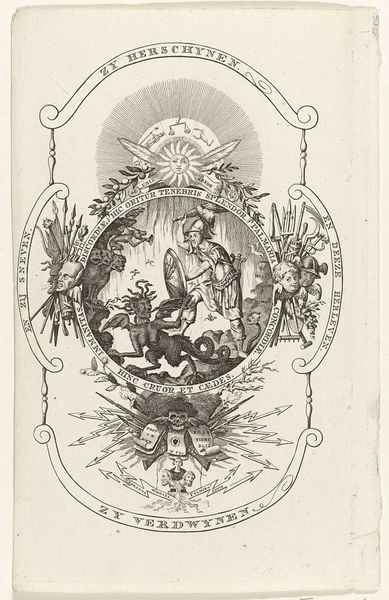
Curator: This is "Sinte Ioris," a pen and ink drawing and engraving attributed to van der Haeghen, made sometime between 1700 and 1865. You can see it here at the Rijksmuseum. Editor: What strikes me immediately is the density of line, creating such a dramatic tension between the knight and the beast. The stark black ink against the white really intensifies the encounter. Curator: Yes, the artist uses a striking linearity to define the forms. Observe how each element – the horse, the dragon, the armor – is meticulously outlined, creating a somewhat flattened pictorial space characteristic of earlier printmaking styles. Editor: Indeed. It's an iconic representation of St. George slaying the dragon. St. George, of course, symbolizes the triumph of good over evil, faith over paganism. The dragon, snarling and wild-eyed, embodies chaos and danger, common representations. Curator: Note also the crossbow and bones depicted above the figures. One cannot help but notice their symmetrical structure; these shapes lend to the drawing an element of visual balance—formal control despite the narrative's violent subject. Editor: They add to the symbolic load, though. Crossbows were powerful military weapons, and they signal victory, control and enforcement; skulls, reminders of the stakes. They certainly amplify the drawing's impact. Notice how the frame reinforces a sense of protection, warding off ill. Curator: I appreciate your focus on the dragon’s expressive features. The angularity of the limbs and the sharp contrasts generate a potent, dynamic, rather linear rhythm throughout the scene. This linearity is crucial to its visual identity and structural coherence. Editor: I see it as more than structural. These aren't just arbitrary lines—they convey movement, emotion, and the deep cultural resonance of a timeless battle, a continuous tradition that connects medieval understanding of Christian tradition to our own struggles. Curator: Van der Haeghen's technique exemplifies how limited artistic means can result in works with enormous impact; here a focus on line engenders both striking formal effects and powerful narrative meaning. Editor: It highlights the capacity of imagery to function as vessels, preserving cultural memories and offering viewers renewed encounters with these fundamental myths.
Comments
No comments
Be the first to comment and join the conversation on the ultimate creative platform.
 Collect
 React
React Comment
More like this