drawing, ink, pen
#
drawing
#
dog
#
figuration
#
ink
#
folk-art
#
pen-ink sketch
#
line
#
sketchbook drawing
#
pen
Dimensions: height 134 mm, width 208 mm
Copyright: Rijks Museum: Open Domain
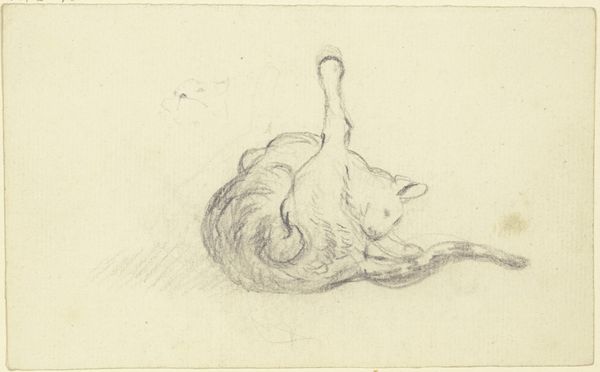
Curator: I’m struck by the seemingly simple image of this artwork: “Gapende hond in een mand” or “Yawning dog in a basket," made between 1887 and 1911, is the creation of Gust van de Wall Perné and resides here at the Rijksmuseum. It is executed with pen and ink. The image gives the impression of a casual sketch but contains volumes in terms of meaning. What's your initial reading, given your understanding of art forms? Editor: Initially, the drawing strikes me as understated yet precise, capturing a dog in a basket using an economy of line that is both sophisticated and witty. The monochromatic palette emphasizes form and texture, with the stark contrast of the black ink against the white paper creating a visual tension that animates the otherwise static scene. Curator: Absolutely, and understanding its historical context provides deeper insights. Drawings such as these frequently emerged within particular socio-economic conditions and were circulated amongst specific audiences; who and what was Perné seeking to represent? Does the yawn imply boredom, existential ennui perhaps, reflecting on societal indolence of the period? Or perhaps reflecting on social divisions? Who gets to rest easy in a "basket" of plenty, while others work? Editor: Intriguing question. Formally speaking, that yawn, rendered with such minimal strokes, acts as a focal point. The composition guides our eye from the detailed basket weave, upward to the relaxed canine form. It draws us into its almost comical, exaggerated expression of… listlessness? Curator: Or even discomfort perhaps? This piece speaks volumes to how marginalized individuals or groups may be perceived as "lazy" simply because societal systems preclude them from thriving. Is that reading too forceful? Editor: Not at all. From my perspective, it’s the artist’s mastery of line that gives the dog a certain charm, complicating a purely political interpretation. However, your reading definitely adds layers of societal significance that a purely formalist approach might overlook. It really encapsulates art's power to evoke and provoke across various frames of understanding. Curator: Yes, thank you. The context definitely enables a fuller appreciation and hopefully inspires conversations around these intersectional aspects in art viewing. Editor: Indeed. The beauty lies, perhaps, in art's ability to reflect back to us our own biases and perspectives, all while offering aesthetic delight.
Comments
No comments
Be the first to comment and join the conversation on the ultimate creative platform.
 Collect
 React
React Comment
More like this