About this artwork
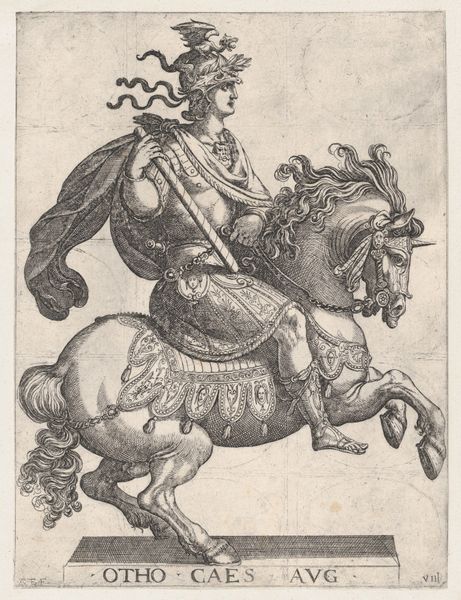
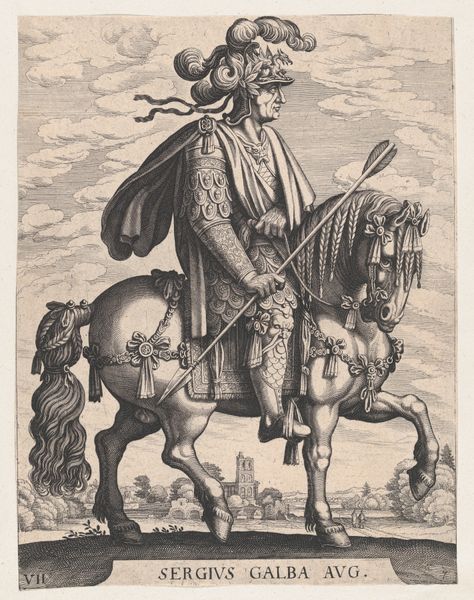
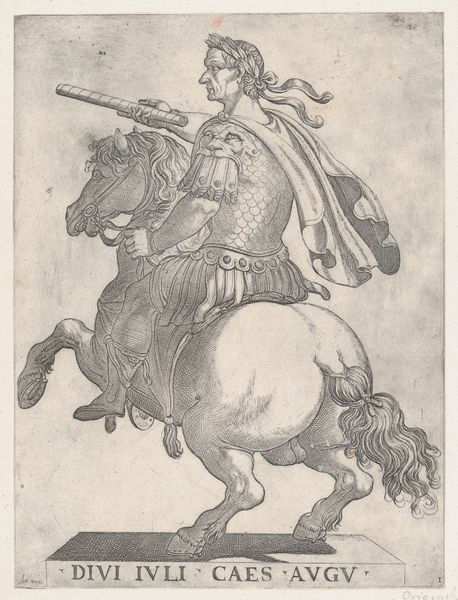
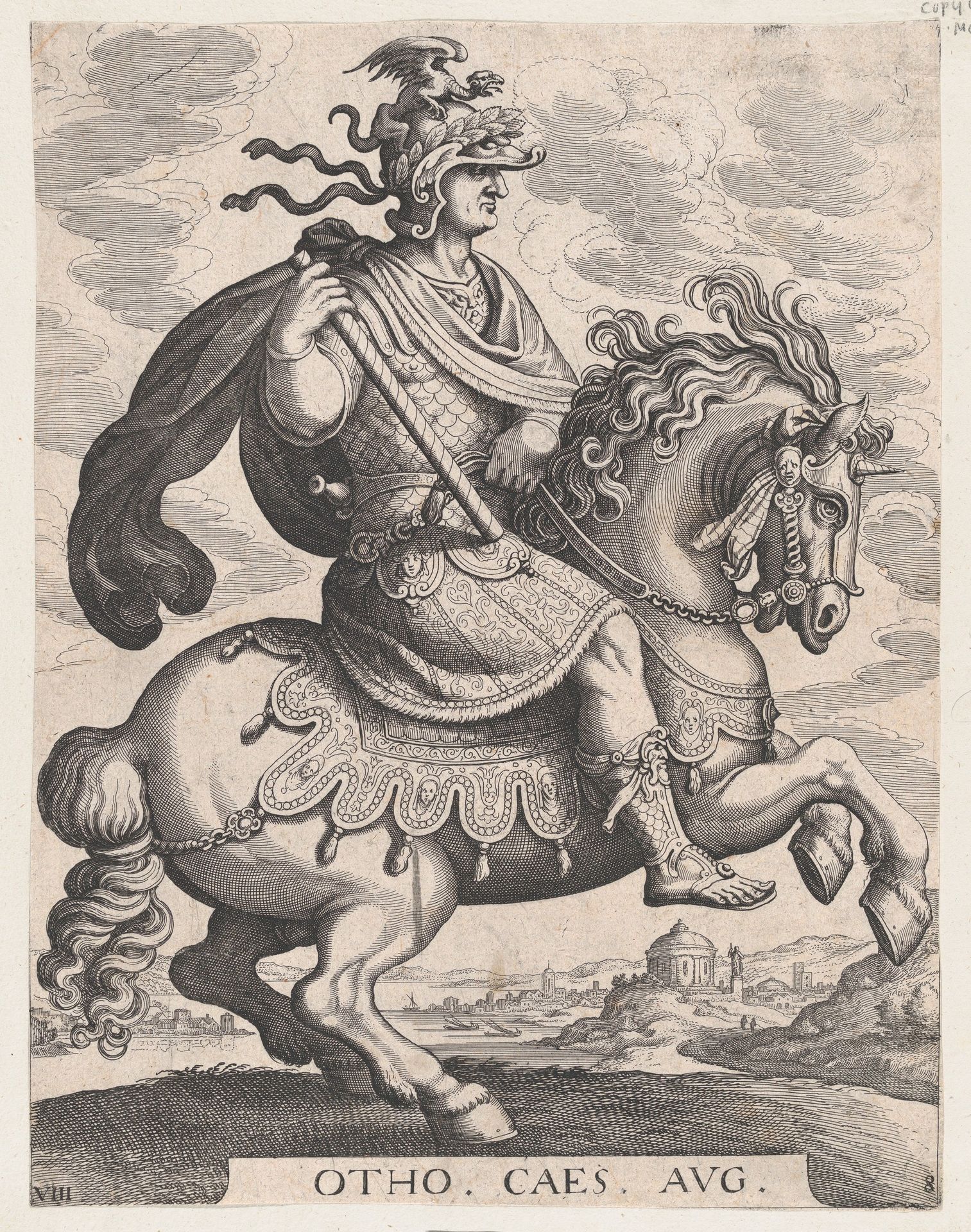
Curator: Here we have Plate 8, an engraving by Matthäus Merian the Elder, circa 1610 to 1650, titled “Emperor Otho on Horseback, from 'The First Twelve Roman Caesars', after Tempesta." Editor: My goodness, Otho really knew how to accessorize, didn't he? All that detail! It's as if he's daring the viewer to look away. Curator: This baroque print demonstrates a fascination with historical and allegorical symbols, depicting power through the image of the emperor mounted on a rearing horse, a symbol itself of Roman authority. Notice the eagle on his helmet, a common symbol of Roman imperial power, evoking strength, courage, and dominance. Editor: The horse looks almost…manicured? The way the mane curls is wonderfully absurd. But seriously, this image definitely conveys dominance. Even the tiny building in the background looks insignificant. Do you think it's meant to symbolize something? Curator: It probably situates the image in the geographical world known to its first audience, and grounds Otho's rule in something tangible and familiar. The engraving emphasizes a kind of visual continuity. What's intriguing to me is how Otho’s actual reign was quite short and turbulent; he’s not exactly known for long-lasting accomplishments. Editor: So, this grand image functions less as historical truth and more as pure... branding? Like an ancient propaganda poster? Makes you think about image-crafting, about how symbols and power intertwine, even across millennia. It seems power is about performance. Otho seems almost playful in his presentation of authority. Curator: Precisely. And the engraving, using techniques and symbolic languages already developed and known at the time, aims for the persuasive continuity of Roman authority, presenting a vision, more than just portraying a figure. Editor: Thinking about that now, I actually read that exaggerated power stance less like pure dominance, and more like performative anxiety. Maybe that’s just my projection, but it almost has an echo of desperation. Curator: A perceptive observation, one I'll ponder now whenever I look at it again. Thanks. Editor: Glad to lend a more anxiety-riddled perspective!
Plate 8: Emperor Otho on Horseback, from 'The First Twelve Roman Caesars', after Tempesta
1610 - 1650

Matthäus Merian the Elder
1593 - 1650
The Metropolitan Museum of Art
Metropolitan Museum of Art, New York, NYArtwork details
- Medium
- drawing, print, engraving
- Dimensions
- Sheet: 11 13/16 × 9 1/16 in. (30 × 23 cm)
- Location
- Metropolitan Museum of Art, New York, NY
- Copyright
- Public Domain
Tags
Comments
Share your thoughts
About this artwork
Curator: Here we have Plate 8, an engraving by Matthäus Merian the Elder, circa 1610 to 1650, titled “Emperor Otho on Horseback, from 'The First Twelve Roman Caesars', after Tempesta." Editor: My goodness, Otho really knew how to accessorize, didn't he? All that detail! It's as if he's daring the viewer to look away. Curator: This baroque print demonstrates a fascination with historical and allegorical symbols, depicting power through the image of the emperor mounted on a rearing horse, a symbol itself of Roman authority. Notice the eagle on his helmet, a common symbol of Roman imperial power, evoking strength, courage, and dominance. Editor: The horse looks almost…manicured? The way the mane curls is wonderfully absurd. But seriously, this image definitely conveys dominance. Even the tiny building in the background looks insignificant. Do you think it's meant to symbolize something? Curator: It probably situates the image in the geographical world known to its first audience, and grounds Otho's rule in something tangible and familiar. The engraving emphasizes a kind of visual continuity. What's intriguing to me is how Otho’s actual reign was quite short and turbulent; he’s not exactly known for long-lasting accomplishments. Editor: So, this grand image functions less as historical truth and more as pure... branding? Like an ancient propaganda poster? Makes you think about image-crafting, about how symbols and power intertwine, even across millennia. It seems power is about performance. Otho seems almost playful in his presentation of authority. Curator: Precisely. And the engraving, using techniques and symbolic languages already developed and known at the time, aims for the persuasive continuity of Roman authority, presenting a vision, more than just portraying a figure. Editor: Thinking about that now, I actually read that exaggerated power stance less like pure dominance, and more like performative anxiety. Maybe that’s just my projection, but it almost has an echo of desperation. Curator: A perceptive observation, one I'll ponder now whenever I look at it again. Thanks. Editor: Glad to lend a more anxiety-riddled perspective!
Comments
Share your thoughts