print, etching, engraving
#
portrait
#
neoclacissism
# print
#
etching
#
caricature
#
old engraving style
#
landscape
#
history-painting
#
engraving
Dimensions: height 285 mm, width 182 mm
Copyright: Rijks Museum: Open Domain
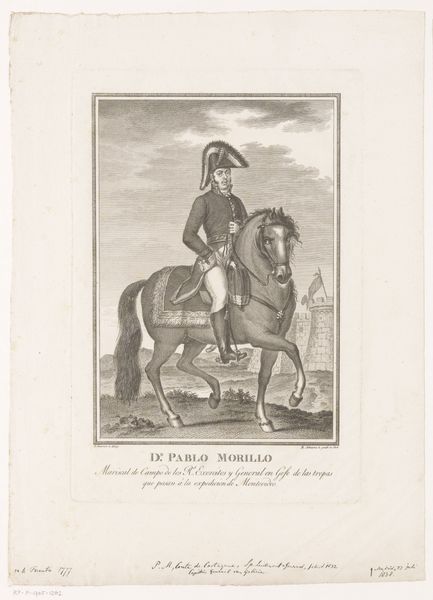
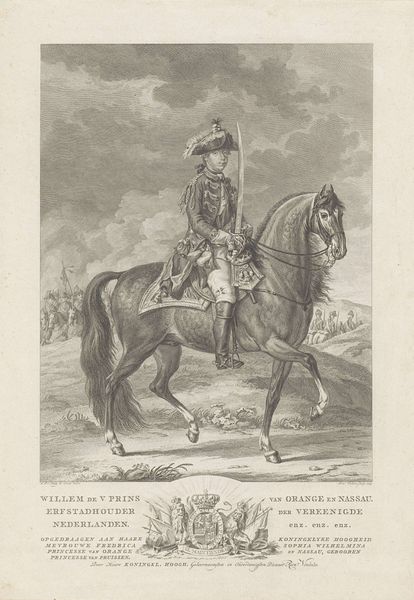
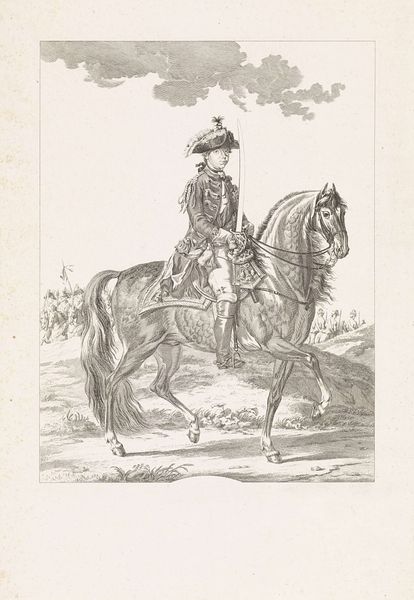
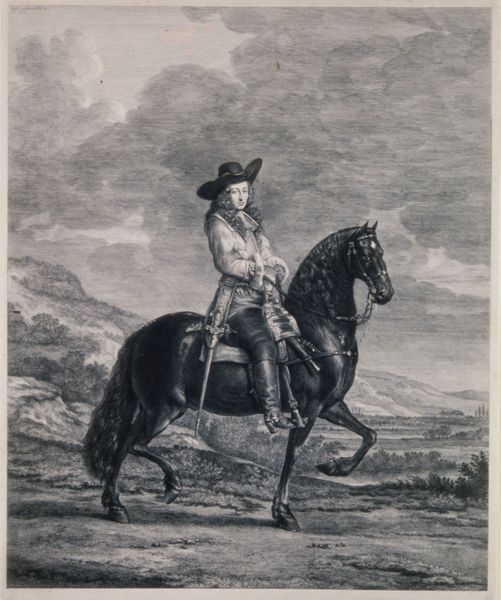
Curator: This is an etching and engraving, "Equestrian Portrait of Colonel José Manso y Solá," crafted sometime between 1810 and 1817 by Antonio Vázquez. Editor: There's something undeniably austere about the image, the monochrome tones lending it a stoic feel. Note how Vázquez arranges the composition to emphasize linear qualities and geometric shapes. Curator: Absolutely. The artist, Vázquez, positions the colonel prominently, astride his steed in what appears to be a proud, almost staged display of power and status, adhering to Neoclassical principles. The landscape is but an accent in service of the sitter, which enhances a very direct semiotic declaration, here, of hierarchy. Editor: Observe, too, how the values are handled—the contrasts aren’t terribly dramatic, yet it has enough contrast to still communicate with remarkable lucidity the subjects status and character Curator: As the name 'Manso' in the title suggests 'tranquility,' the very composure he embodies aligns seamlessly with the traditional archetype of a steadfast, esteemed leader, and that large hat and piercing look surely must signal a memory of Napoleon Editor: It's the detail that fascinates. Notice the minute lines suggesting texture, the subtle gradations rendering form. But I am drawn particularly to the balance that arises from the horse seeming almost as grand and powerful as its rider Curator: The etching provides historical and cultural insight beyond simple representation. This reflects, possibly, the evolving political circumstances of early 19th-century Spain, revealing much of a people at war. This work certainly prompts reflections about visual representations and power during transformative periods. Editor: It leaves me appreciating the craft itself and I wonder if there isn’t also in its restraint, a rather elegant subtlety in design and construction of this particular piece Curator: Ultimately, the enduring presence of works like this proves how much prints, whether political or military, echo through time and provide us ways to grapple with our past.
Comments
No comments
Be the first to comment and join the conversation on the ultimate creative platform.
 Collect
 React
React Comment
More like this