About this artwork
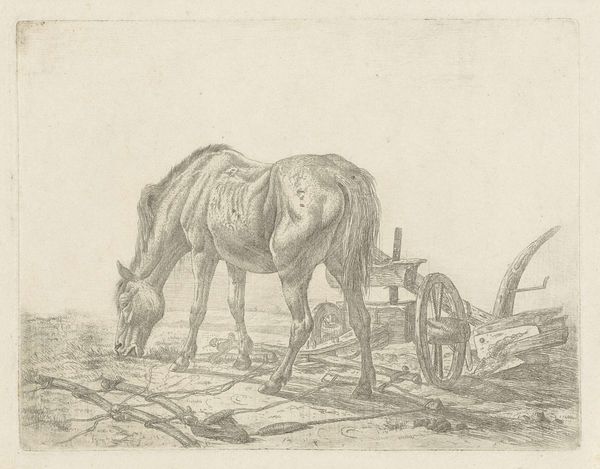
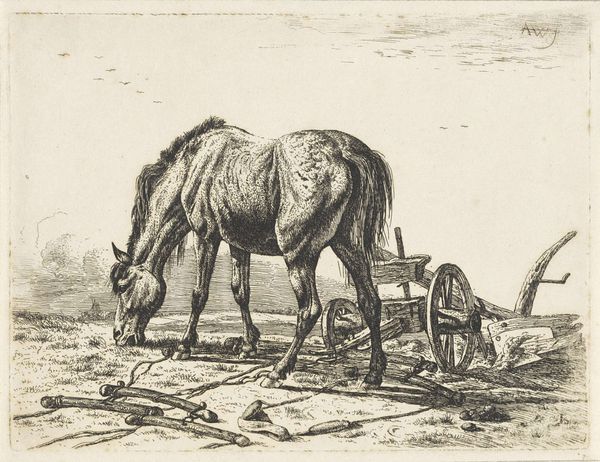
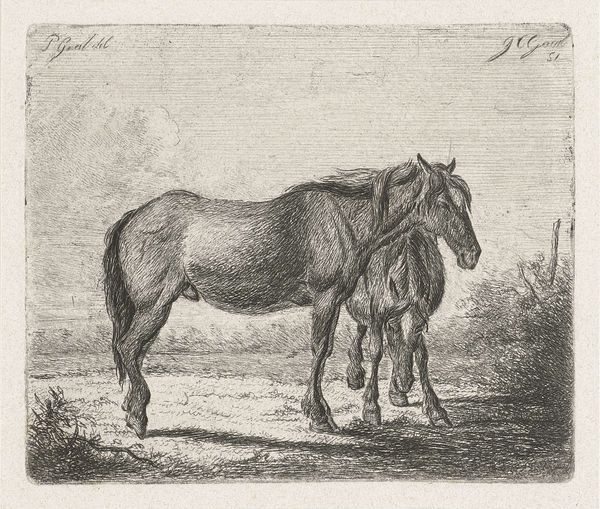
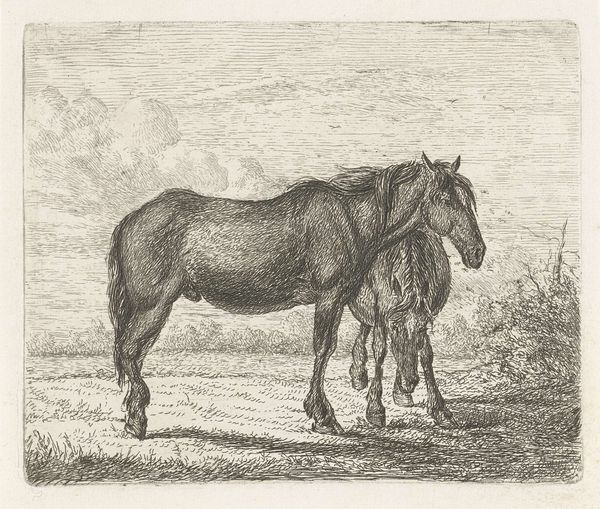
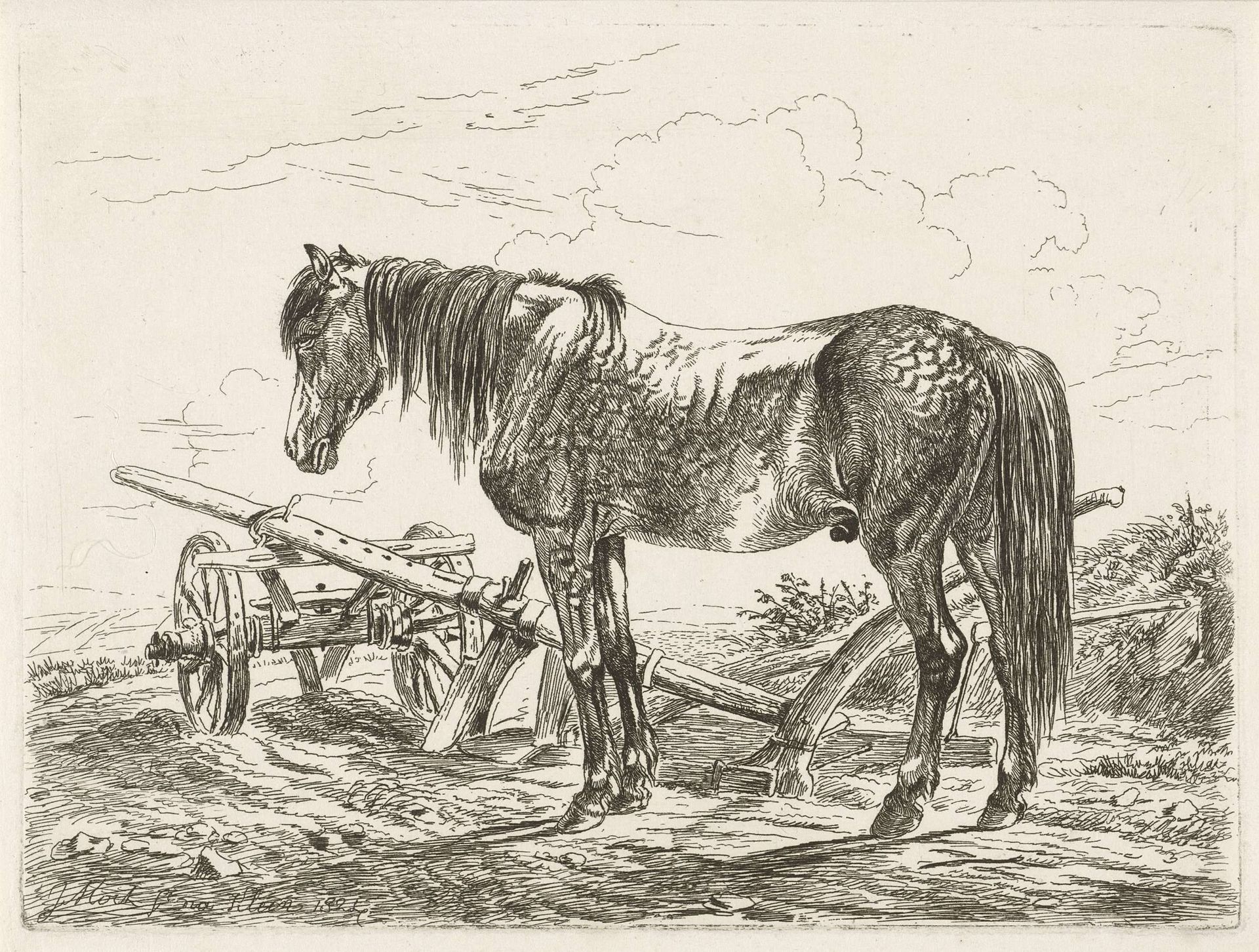
Editor: This is Johannes Mock's "Paard bij een ploeg," or "Horse by a plow" from 1824. It's a print – I'm really struck by the quiet stillness of the scene. The horse just standing there, seemingly exhausted, next to its heavy equipment. What do you see in this piece? Curator: It's tempting to see it as a straightforward depiction of rural life, but I wonder about its broader cultural context. In the 19th century, images of animals, particularly working animals, became powerful symbols. How might the rising urban middle class have viewed an image like this? Did it evoke nostalgia for a simpler past? Editor: That's a fascinating point. It definitely romanticizes farm work. But, considering the realities of rural poverty at the time, isn't it somewhat selective in its portrayal? Curator: Precisely. Consider how prints like this circulated. Were they meant for consumption primarily by urban dwellers, removed from the day-to-day hardships depicted? The picturesque aesthetic often glossed over social realities. Is there a sense of idealized labor at play, rather than a raw, unflinching view? Editor: So the artwork's public role isn't just about showing a horse and a plow, but it's also subtly communicating a message – perhaps even a political one? Curator: Exactly! Think about how such images might reinforce certain power structures or contribute to the creation of national identity, and how landscape imageries often carry messages related to class and the role of labor in society. This also becomes pertinent if you consider what the official Salon art looked like at the time, or the establishment's concept of beauty and the sublime. Editor: This really changes how I look at it. It's not just a horse; it's a statement about society. Thanks! Curator: Indeed. By examining art through a historical and social lens, we uncover deeper meanings embedded in seemingly simple depictions. It shows how important visual culture can be as historical source material.

Artwork details
- Medium
- drawing, print
- Dimensions
- height 131 mm, width 176 mm
- Location
- Rijksmuseum
- Copyright
- Rijks Museum: Open Domain
Tags
Comments
Share your thoughts
About this artwork
Editor: This is Johannes Mock's "Paard bij een ploeg," or "Horse by a plow" from 1824. It's a print – I'm really struck by the quiet stillness of the scene. The horse just standing there, seemingly exhausted, next to its heavy equipment. What do you see in this piece? Curator: It's tempting to see it as a straightforward depiction of rural life, but I wonder about its broader cultural context. In the 19th century, images of animals, particularly working animals, became powerful symbols. How might the rising urban middle class have viewed an image like this? Did it evoke nostalgia for a simpler past? Editor: That's a fascinating point. It definitely romanticizes farm work. But, considering the realities of rural poverty at the time, isn't it somewhat selective in its portrayal? Curator: Precisely. Consider how prints like this circulated. Were they meant for consumption primarily by urban dwellers, removed from the day-to-day hardships depicted? The picturesque aesthetic often glossed over social realities. Is there a sense of idealized labor at play, rather than a raw, unflinching view? Editor: So the artwork's public role isn't just about showing a horse and a plow, but it's also subtly communicating a message – perhaps even a political one? Curator: Exactly! Think about how such images might reinforce certain power structures or contribute to the creation of national identity, and how landscape imageries often carry messages related to class and the role of labor in society. This also becomes pertinent if you consider what the official Salon art looked like at the time, or the establishment's concept of beauty and the sublime. Editor: This really changes how I look at it. It's not just a horse; it's a statement about society. Thanks! Curator: Indeed. By examining art through a historical and social lens, we uncover deeper meanings embedded in seemingly simple depictions. It shows how important visual culture can be as historical source material.
Comments
Share your thoughts