About this artwork
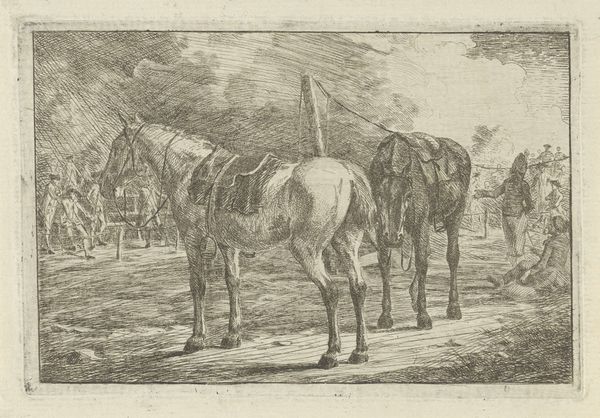
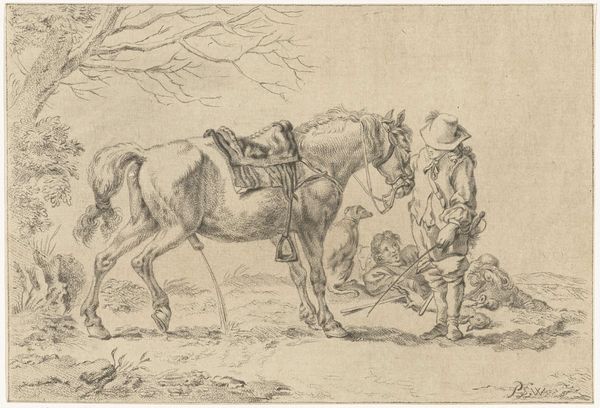
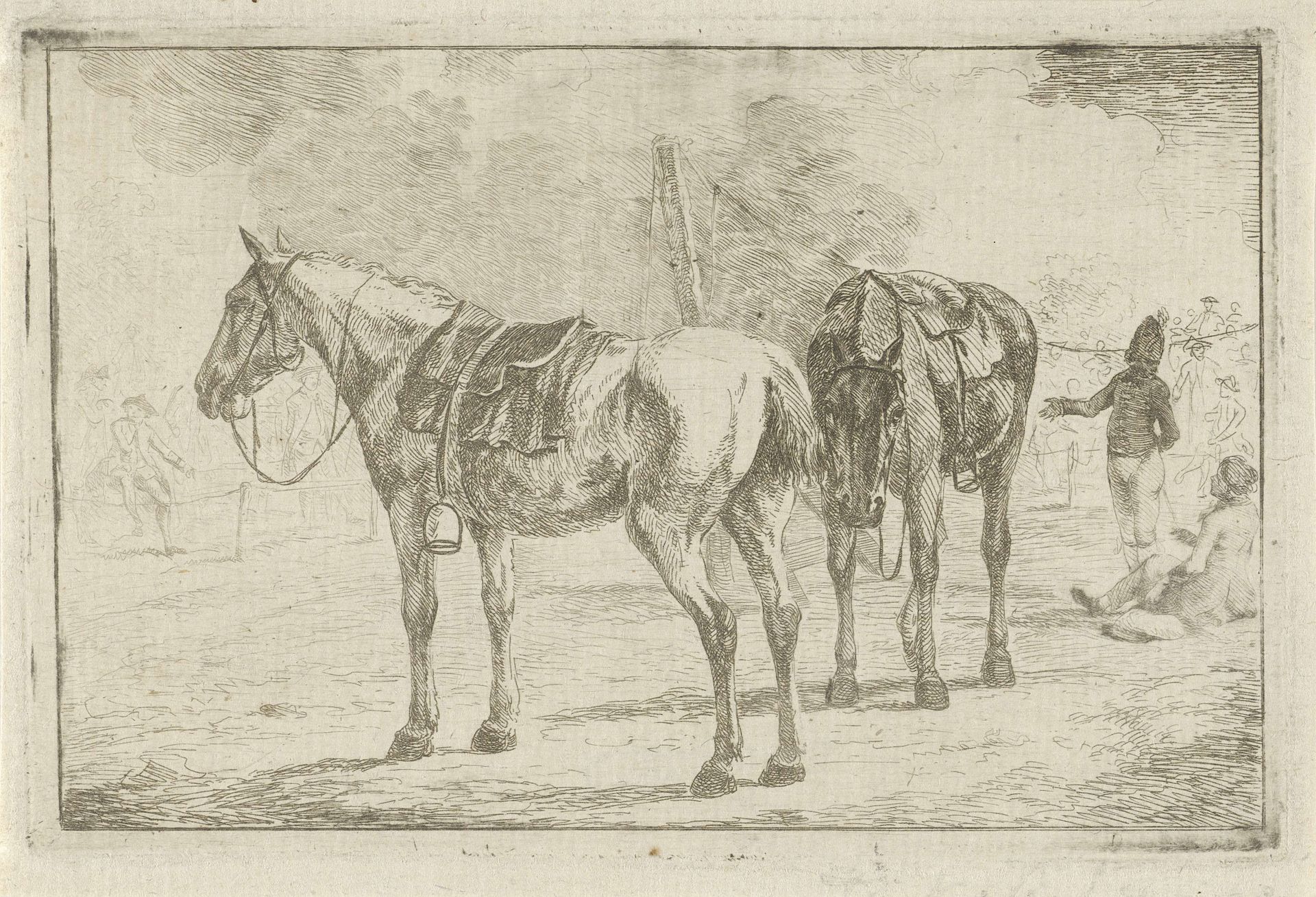
Editor: Here we have Dirk Langendijk’s "Two Saddled Horses Near a Military Camp," made sometime between 1758 and 1805, using etching, drawing, and print techniques. It's very detailed, almost like a snapshot, but I'm curious about the overall atmosphere. How do you interpret this work? Curator: Well, immediately, I’m drawn to how Langendijk captures the mundanity of military life. This isn’t a glorious battle scene, but a scene of waiting. Consider how this everyday image humanizes the military, disrupting the usual narratives of power and heroism that are often imposed from above. Do you think it reveals anything about the experience of the common soldier or, perhaps, about the horses? Editor: That's a great point. The horses look so…ordinary, just standing there. Maybe Langendijk is commenting on the exploitation inherent in military structures? The soldiers are relaxing in the background while the horses remain saddled, awaiting the next command. Curator: Exactly. The positioning and treatment of these animals invite us to consider class, labor, and the distribution of power. Were horses, in this context, symbols of domination or burdened servants of empire? It's crucial to examine art within its socio-political context. How does understanding its place in time affect your reading of it? Editor: It definitely makes me think about whose stories are being told and whose are being left out of the traditional history books. Thanks! I will explore that more deeply. Curator: Excellent. It’s by questioning the mainstream that we gain deeper insights. Let’s remember that art is rarely neutral.
Twee gezadelde paarden bij een legerkamp
1758 - 1805

Dirk Langendijk
1748 - 1805Location
RijksmuseumArtwork details
- Medium
- drawing, print, etching
- Dimensions
- height 95 mm, width 143 mm
- Location
- Rijksmuseum
- Copyright
- Rijks Museum: Open Domain
Tags
drawing
etching
landscape
15_18th-century
genre-painting
realism
Comments
Be the first to share your thoughts about this work.
About this artwork
Editor: Here we have Dirk Langendijk’s "Two Saddled Horses Near a Military Camp," made sometime between 1758 and 1805, using etching, drawing, and print techniques. It's very detailed, almost like a snapshot, but I'm curious about the overall atmosphere. How do you interpret this work? Curator: Well, immediately, I’m drawn to how Langendijk captures the mundanity of military life. This isn’t a glorious battle scene, but a scene of waiting. Consider how this everyday image humanizes the military, disrupting the usual narratives of power and heroism that are often imposed from above. Do you think it reveals anything about the experience of the common soldier or, perhaps, about the horses? Editor: That's a great point. The horses look so…ordinary, just standing there. Maybe Langendijk is commenting on the exploitation inherent in military structures? The soldiers are relaxing in the background while the horses remain saddled, awaiting the next command. Curator: Exactly. The positioning and treatment of these animals invite us to consider class, labor, and the distribution of power. Were horses, in this context, symbols of domination or burdened servants of empire? It's crucial to examine art within its socio-political context. How does understanding its place in time affect your reading of it? Editor: It definitely makes me think about whose stories are being told and whose are being left out of the traditional history books. Thanks! I will explore that more deeply. Curator: Excellent. It’s by questioning the mainstream that we gain deeper insights. Let’s remember that art is rarely neutral.
Comments
Be the first to share your thoughts about this work.