Karikatur einer katholischen Meßzeremonie auf einer Todesanzeige 1864


drawing, print, paper, dry-media, pencil, chalk
portrait
drawing
16_19th-century
caricature
paper
dry-media
pencil
chalk
Copyright: Public Domain
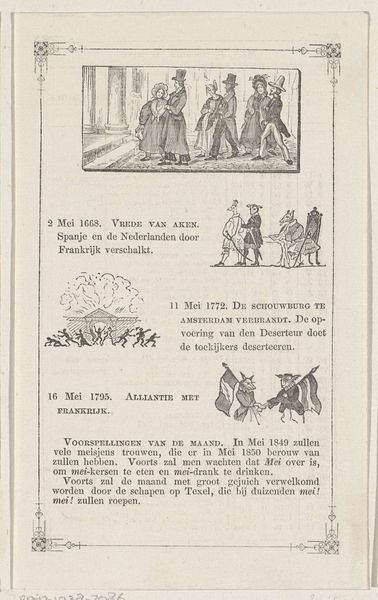
Curator: I find this drawing intensely cynical. The way the artist weaponizes anthropomorphism against religious rituals—it's deeply unsettling. Editor: We’re looking at a caricature by Victor Müller, dating back to 1864. The title translates to something like “Caricature of a Catholic Mass Ceremony on a Death Announcement.” It’s a print done in pencil and chalk, held at the Städel Museum. What visual cues strike you so forcefully? Curator: The juxtaposition of animals enacting a mass… those simian figures! They parody the rituals of grief and the church, drawing a harsh comparison. What's your interpretation of the figures? Editor: I see these creatures within a tradition of medieval bestiaries and satirical prints, where animals serve as symbols—often exposing human folly. Notice the procession of creatures at the top, almost like a twisted frieze. And at the bottom there are more bestial symbols that may imply a critique of earthly existence versus ethereal being. What social commentary can we extract here? Curator: This was a period of intense social upheaval and questioning of religious authority, especially in Germany. This piece uses dark humor as a critical lens. It could point to deeper anxieties of societal hypocrisy that intersect class, religion, and personal liberty. The family in the middle made of monkey-esque characters underscores the class anxiety as monkeys had a low place in society and human culture at the time. Editor: Precisely! Think of the weight each symbol would carry for Müller's contemporary audience— the animals performing a solemn Catholic Mass, a blatant subversion. Are we also seeing a jab at the perceived pomp and circumstance of the clergy? It’s as if the imagery questions if we all blindly perform death for ritual alone. Curator: Exactly, I appreciate how Müller isn't merely mocking religious practice but implicating society’s complicity with these symbolic power structures. In that, this work transcends simple critique and speaks to our contemporary understanding of how traditions can obfuscate individual agency. Editor: It’s that powerful play of visual symbols alongside political commentary that allows the print to echo into present dialogues. The best symbolical art has something to say in more times than it was created in.
Comments
No comments
Be the first to comment and join the conversation on the ultimate creative platform.
 React
React Comment