1670 - 1713
Coridon en Silvia

Pieter Schenk
1660 - 1711Location
RijksmuseumListen to curator's interpretation
Curatorial notes
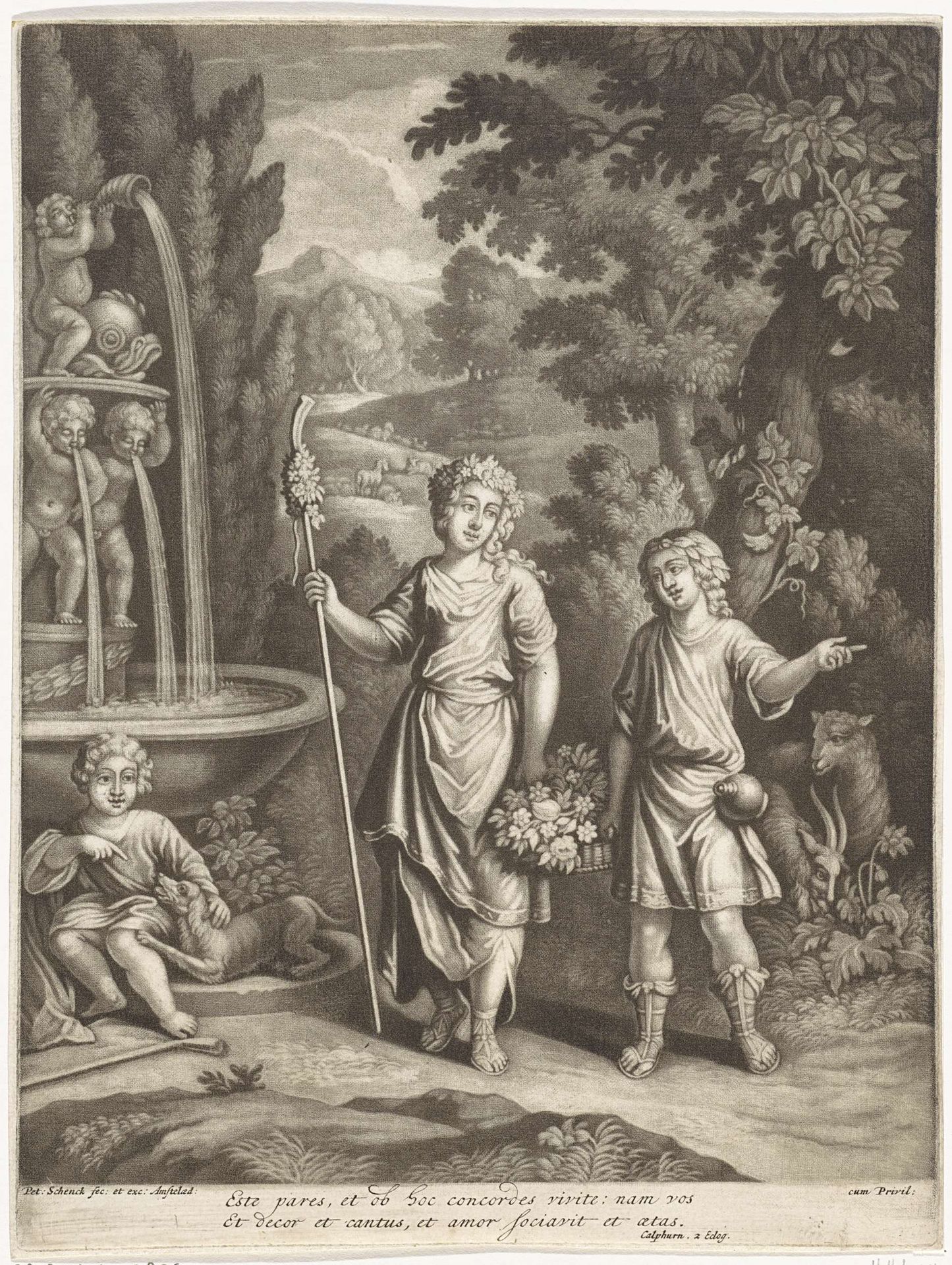
Editor: So this is Pieter Schenk’s "Coridon en Silvia," an engraving from around 1670 to 1713, currently held in the Rijksmuseum. It feels like a theatrical pastoral scene with that elaborate fountain on the left, almost as if it is a stage. How would you interpret this work from a formalist perspective? Curator: The interest lies primarily in the articulation of form. Observe the binary oppositions established by the artist: the structured artifice of the fountain juxtaposed with the "naturalness" of the landscape; the refined drapery of Silvia's dress versus the more functional clothing of Coridon. Notice how these contrasting elements are carefully balanced in the composition to create a visually harmonious whole. Editor: That's a really interesting point. I hadn’t thought about it as a set of oppositions. Does the dog add to the dynamic? Curator: Indeed. Its placement in the lower left, mirroring the direction of Coridon's pointed finger, creates a visual echo that strengthens the overall unity of the image. The dog's stillness also acts as a counterpoint to the active flow of water and Coridon's gesture, adding a layer of dynamic tension. Where does this contrast draw your eyes? Editor: I keep coming back to the cherubic fountain; the architecture seems incongruous with the surrounding Baroque aesthetic and themes. It feels classical. Curator: Precisely. By juxtaposing classical motifs with baroque sensibilities, Schenk achieves a dynamic interplay of form and idea, inviting viewers to engage with the visual vocabulary itself. It showcases the interplay between order and expression inherent in art making. Editor: I never would have picked up on those levels of visual encoding. Thanks for your perspective. Curator: My pleasure. Reflecting on Schenk's calculated placement of each element really reveals the deeper structures that operate in the artwork.