About this artwork
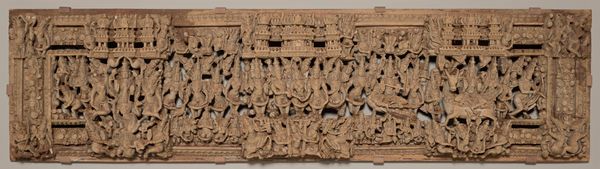
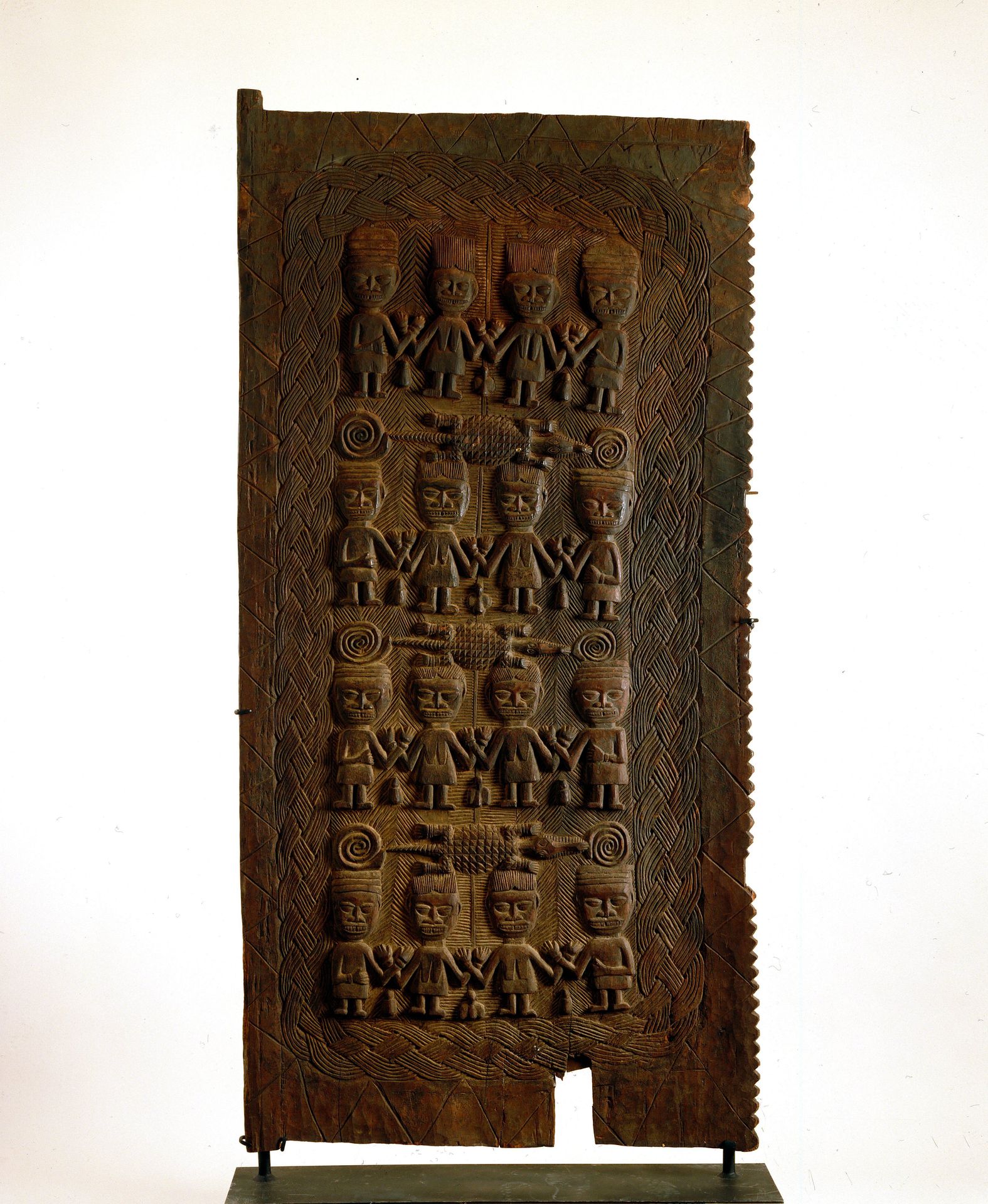
Curator: Welcome. We're looking at an early 20th-century carved wood door attributed to the Yoruba people, currently residing here at the Minneapolis Institute of Art. What are your initial thoughts? Editor: The patina of age gives it such weight, doesn't it? And those rows of figures create a mesmerizing pattern, although there's something solemn about their repetition. Curator: Let's consider the material itself. Wood as a primary medium roots the artwork in readily available, local resources, directly connecting the artist’s labor to their environment. How do you interpret the use of such an everyday, practical material in a culturally significant object like this? Editor: Immediately, I'm drawn to thinking about whose stories were considered worthy enough to be literally etched into a doorway. This carving presents an opportunity to consider how community, power, and identity intersect within Yoruba culture at that specific turn of the century. Are we looking at an elite family's narrative, perhaps? Or a mythological scene being propagated to maintain social structures? Curator: That's precisely the kind of narrative complexity I find intriguing. The uniformity in carving – suggesting possibly the labor of several hands contributing to one piece, not solely one "master artist." It challenges Western art’s glorification of individual genius by spotlighting shared processes. Editor: And think about where it leads! What did it mean to control entry? Whose movements are being surveilled? Was the production, the making of the door, inherently about labor control? Curator: It makes you question where it leads now too. As a museum object, wrenched from its architectural context, the door itself transitions from utility to artifact. I see the story also now concerning colonial intervention and commodification... Editor: Exactly. Looking at it that way encourages us to grapple with the violence embedded within the art world, asking critical questions about ownership, display, and the responsibilities of cultural institutions like this one. Curator: I agree; even today this 'Door' makes me pause to consider craftsmanship and how value changes across history, economics and power. Editor: And I leave understanding that a piece like this is so much more than aesthetic appreciation—it is a prompt to question, reflect, and, crucially, act for change.
Door c. early 20th century


Artwork details
- Medium
- carving, relief, sculpture, wood, architecture
- Dimensions
- 89 1/2 x 43 1/2 x 1 1/4 in. (227.3 x 110.5 x 3.2 cm) (irregular)
- Location
- Minneapolis Institute of Art
- Copyright
- Public Domain
Tags
african-art
carving
narrative-art
sculpture
relief
figuration
sculpture
wood
yoruba-art
architecture
Comments
No comments
About this artwork
Curator: Welcome. We're looking at an early 20th-century carved wood door attributed to the Yoruba people, currently residing here at the Minneapolis Institute of Art. What are your initial thoughts? Editor: The patina of age gives it such weight, doesn't it? And those rows of figures create a mesmerizing pattern, although there's something solemn about their repetition. Curator: Let's consider the material itself. Wood as a primary medium roots the artwork in readily available, local resources, directly connecting the artist’s labor to their environment. How do you interpret the use of such an everyday, practical material in a culturally significant object like this? Editor: Immediately, I'm drawn to thinking about whose stories were considered worthy enough to be literally etched into a doorway. This carving presents an opportunity to consider how community, power, and identity intersect within Yoruba culture at that specific turn of the century. Are we looking at an elite family's narrative, perhaps? Or a mythological scene being propagated to maintain social structures? Curator: That's precisely the kind of narrative complexity I find intriguing. The uniformity in carving – suggesting possibly the labor of several hands contributing to one piece, not solely one "master artist." It challenges Western art’s glorification of individual genius by spotlighting shared processes. Editor: And think about where it leads! What did it mean to control entry? Whose movements are being surveilled? Was the production, the making of the door, inherently about labor control? Curator: It makes you question where it leads now too. As a museum object, wrenched from its architectural context, the door itself transitions from utility to artifact. I see the story also now concerning colonial intervention and commodification... Editor: Exactly. Looking at it that way encourages us to grapple with the violence embedded within the art world, asking critical questions about ownership, display, and the responsibilities of cultural institutions like this one. Curator: I agree; even today this 'Door' makes me pause to consider craftsmanship and how value changes across history, economics and power. Editor: And I leave understanding that a piece like this is so much more than aesthetic appreciation—it is a prompt to question, reflect, and, crucially, act for change.
Comments
No comments