Copyright: Public domain
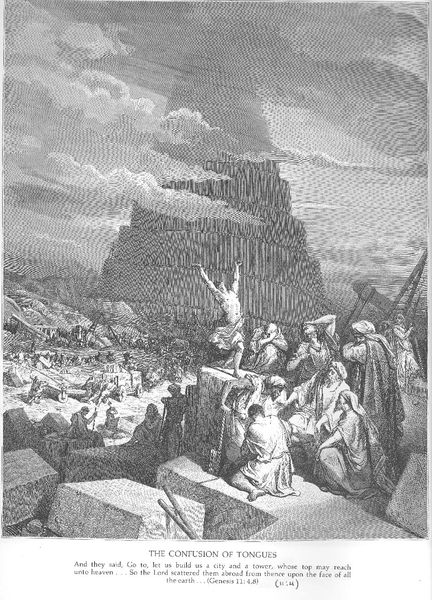
Editor: Here we have Gustave Dore’s "The Confusion of Tongues," an engraving from 1868. It’s all in monochrome, and the sheer scale of the tower under construction is what really strikes me. How do we even begin to unpack a work like this? Curator: It’s a fantastic example to examine through the lens of labor and materiality. Think about the production of the print itself: the physical act of engraving, the tools used, the transfer of the image onto the printing plate. Do you see the meticulous detail, all those tiny lines creating light and shadow? Editor: Absolutely, the craftsmanship is incredible. The process seems so painstaking! Curator: Precisely. Now consider the depicted scene, the Tower of Babel. What's its creation dependent on? Raw materials—stone, undoubtedly quarried and transported—and human labor on a massive scale. These biblical figures aren't just passively present; they are actively engaged in the construction. Editor: So, the engraving style itself mirrors the epic scale and intense labour of the tower’s construction. But what about the “confusion” aspect of it? How can a Materialist perspective expand on that? Curator: Look at the different social roles represented. Consider the project’s patrons versus the workers actually lifting stones. Who benefits and who labors? The confusion arises not just from language, but perhaps from the unequal distribution of power and resources inherent in such an undertaking. And consider who then consumes such a print as this - who is it marketed to? Editor: I hadn't thought about it in terms of class and production. That's really interesting! It's not just about the myth, but about the systems behind its material representation and those in the depicted scene. Curator: Exactly! Analyzing the artwork's production alongside its subject allows us to explore broader social and economic dynamics. There is a clear relationship between all participants, artist and consumer! Editor: I will be taking notes; seeing it this way really opens up the work to new perspectives for me. Curator: Glad to have contributed to your material understanding!
Comments
No comments
Be the first to comment and join the conversation on the ultimate creative platform.
 Collect
 React
React Comment
More like this