drawing, pencil
#
portrait
#
drawing
#
imaginative character sketch
#
light pencil work
#
pencil sketch
#
cartoon sketch
#
figuration
#
form
#
personal sketchbook
#
idea generation sketch
#
character sketch
#
ink drawing experimentation
#
pencil
#
sketchbook drawing
#
initial sketch
Dimensions: height 207 mm, width 314 mm
Copyright: Rijks Museum: Open Domain
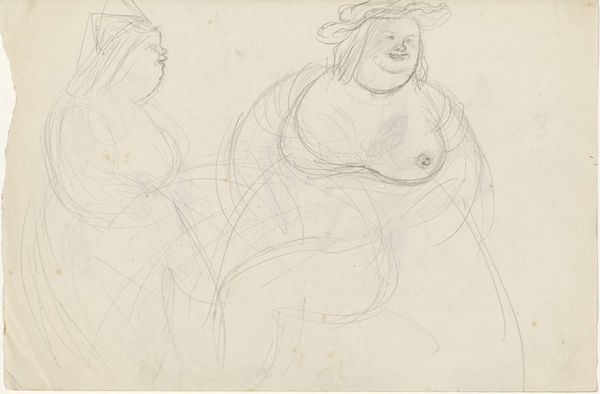
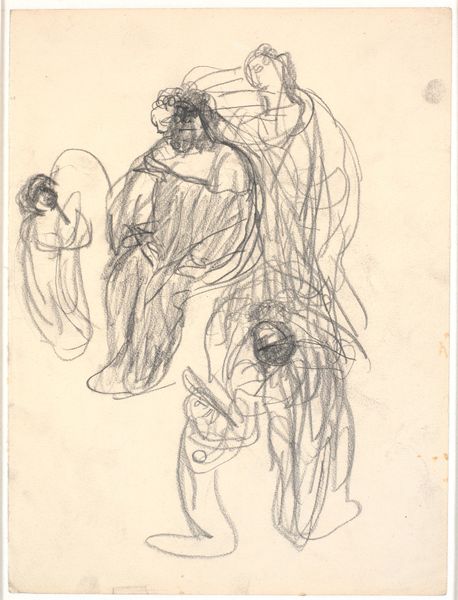
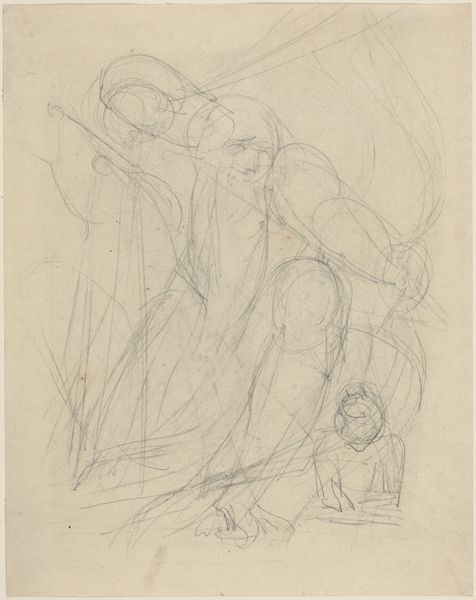
Curator: Here we have “Zittende reus en reuzin,” or "Seated Giant and Giantess," a pencil drawing by Henk Henriët dating from around 1936 to 1940. Editor: My first thought? There’s a lightness to it, even a playful quality. It doesn't convey the weight I would expect from figures of such imagined size. Curator: That's interesting, because for me the visual language of these characters evokes deep-seated archetypes of power, dominance, and perhaps even societal control, particularly within the patriarchal structure reflected in the figure of the giant. Editor: But isn’t that challenged by the fluidity of the pencil lines, the sketch-like quality that suggests a mind still grappling with the idea, not yet fixed in its portrayal of power? Curator: Perhaps the choice of medium points to the instability of such constructs. Giants, after all, have represented different things throughout history, often tied to anxieties around the "other," be it foreign invaders or internal rebels. Editor: I agree. The giant, or even the idea of the giant, transforms. Looking at the recurring circular patterns, I wonder about Henriët's interest in cycles, in repetition... Is there a sense that these archetypes resurface, evolve, adapt over time? The lines of their hair, for instance, echo the form of waves—suggesting something timeless and constantly in motion. Curator: Yes, and from a sociopolitical perspective, the "giantess," though less defined, raises questions about the role of women in such power structures. Is she merely an extension of the giant's power, or does she represent a different kind of force? Editor: Her gaze, or what we can make of it through the delicate sketch, seems almost introspective, detached from the obvious show of power beside her. What symbolic weight do we give to a female figure in such a dominating pose but in a subservient position? Curator: It prompts us to reconsider the symbols we attach to "giants," to challenge the narrative of brute strength. Editor: Exactly! These are preliminary images, in the midst of coming to a realization about our history, about ourselves.
Comments
No comments
Be the first to comment and join the conversation on the ultimate creative platform.
 Collect
 React
React Comment
More like this