About this artwork
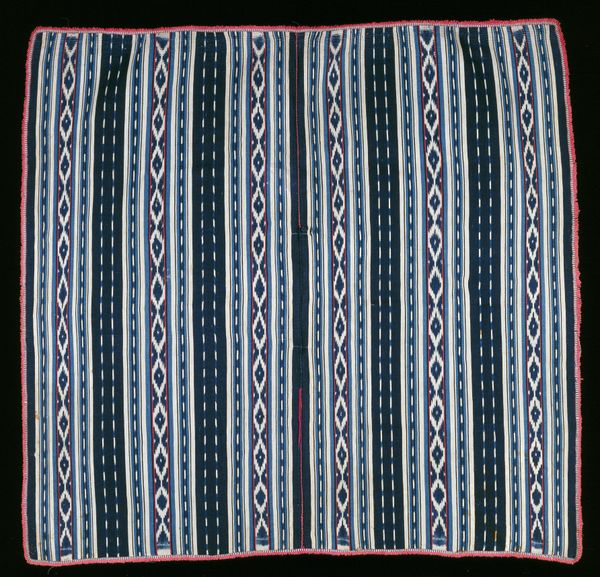
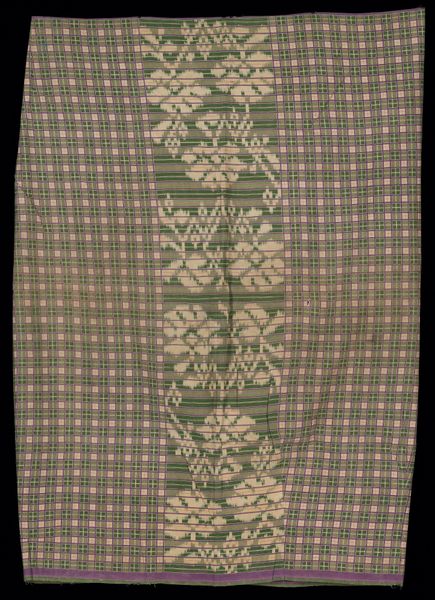
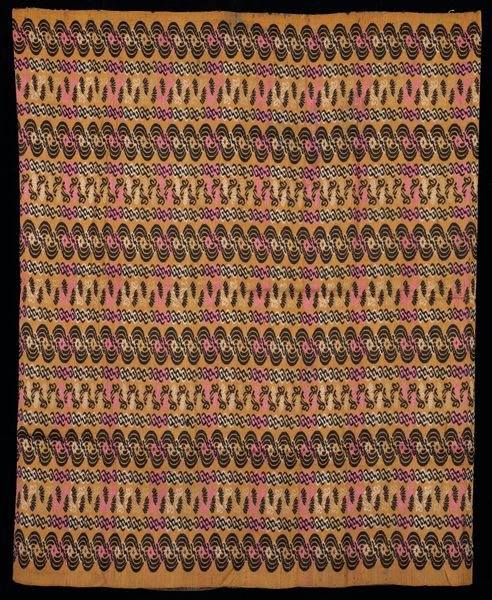
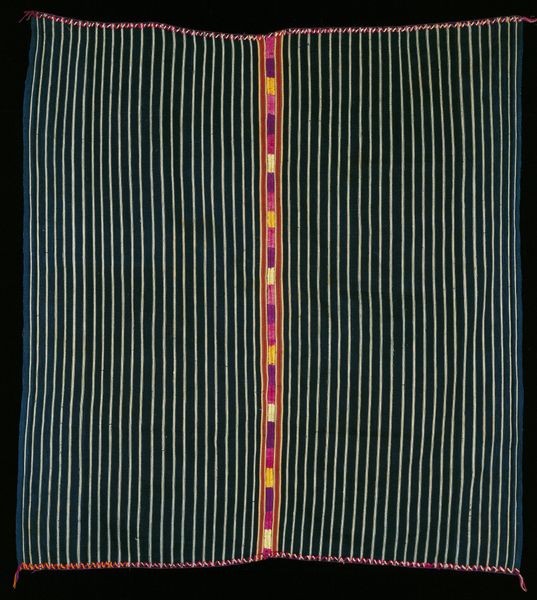
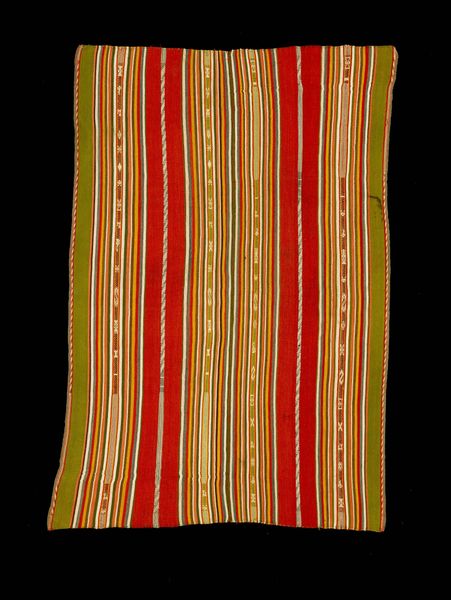
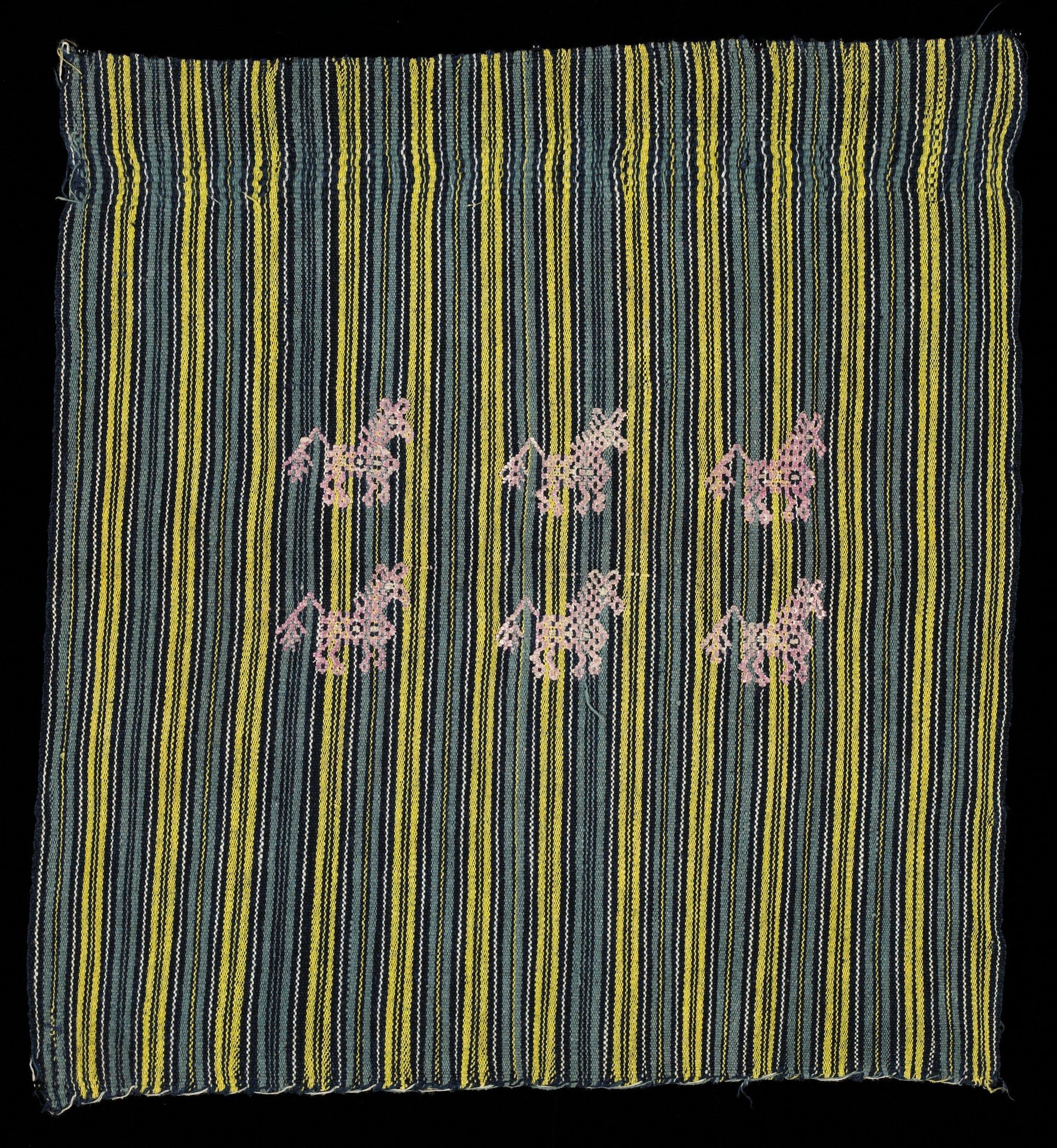
Curator: Let’s spend a few moments contemplating this 'Tzute-Cofradia.' This cotton textile piece dates from sometime between 1920 and 1930 and originates from the Indigenous Americas. It's part of the Minneapolis Institute of Art's collection. Editor: Wow, those colours just sing, don’t they? The vertical stripes in shades of ochre and teal, it gives off a very subtle, yet playful vibe. Like a minimalist painting… but warmer. And then those tiny horse-like figures—they seem so fragile, like memories. Curator: The Tzute, traditionally created by Maya weavers, functions beyond simple adornment. Its social and spiritual importance resides in its role within ceremonial practices. This piece would have likely been employed within a cofradía, a religious brotherhood common in many parts of Latin America. Editor: So, not just pretty ponies, but an integral part of a community ritual. It makes me wonder what these little creatures represented. Were they a personal symbol of the weaver? Or part of the community’s broader narrative? I also can’t stop imagining all the steps—picking and cleaning cotton, teasing the yarn… centuries of expertise flowing into each thread. Curator: Exactly. These weavings were instrumental to religious and social life within these communities. They serve as reminders of colonial legacies and continuous indigenous resistance and resilience. The inclusion of geometric, animal-like forms can be traced to long-standing indigenous aesthetics. Editor: It gives new meaning to every tiny detail, huh? I'm reminded of my grandma's cross-stitching and quilting... this piece just vibrates with the spirit of those hands and that careful labour, not merely religious dedication, but personal vision. Curator: Precisely. And while the introduction of the horse by colonizers significantly transformed the Americas, its adoption into textiles and iconography represents indigenous negotiation with outside influence. This work blends the geometric forms and line-work with powerful cultural symbols. Editor: Beautiful, it definitely elevates "Tzute-Cofradia" beyond mere aesthetics for me... I guess it's less of a textile and more like a soft-spoken cultural manifesto. It makes me question the story I am leaving behind for the world... Curator: I agree. A reminder that even within the simplest forms, you may encounter profoundly intricate histories.
Tzute-Cofradia 1920 - 1930


Artwork details
- Medium
- fibre-art, weaving, textile, cotton
- Dimensions
- 15 3/4 x 14 5/8 in. (40.01 x 37.15 cm)
- Location
- Minneapolis Institute of Art
- Copyright
- Public Domain
Tags
fibre-art
weaving
textile
geometric pattern
geometric
line
cotton
indigenous-americas
Comments
No comments
About this artwork
Curator: Let’s spend a few moments contemplating this 'Tzute-Cofradia.' This cotton textile piece dates from sometime between 1920 and 1930 and originates from the Indigenous Americas. It's part of the Minneapolis Institute of Art's collection. Editor: Wow, those colours just sing, don’t they? The vertical stripes in shades of ochre and teal, it gives off a very subtle, yet playful vibe. Like a minimalist painting… but warmer. And then those tiny horse-like figures—they seem so fragile, like memories. Curator: The Tzute, traditionally created by Maya weavers, functions beyond simple adornment. Its social and spiritual importance resides in its role within ceremonial practices. This piece would have likely been employed within a cofradía, a religious brotherhood common in many parts of Latin America. Editor: So, not just pretty ponies, but an integral part of a community ritual. It makes me wonder what these little creatures represented. Were they a personal symbol of the weaver? Or part of the community’s broader narrative? I also can’t stop imagining all the steps—picking and cleaning cotton, teasing the yarn… centuries of expertise flowing into each thread. Curator: Exactly. These weavings were instrumental to religious and social life within these communities. They serve as reminders of colonial legacies and continuous indigenous resistance and resilience. The inclusion of geometric, animal-like forms can be traced to long-standing indigenous aesthetics. Editor: It gives new meaning to every tiny detail, huh? I'm reminded of my grandma's cross-stitching and quilting... this piece just vibrates with the spirit of those hands and that careful labour, not merely religious dedication, but personal vision. Curator: Precisely. And while the introduction of the horse by colonizers significantly transformed the Americas, its adoption into textiles and iconography represents indigenous negotiation with outside influence. This work blends the geometric forms and line-work with powerful cultural symbols. Editor: Beautiful, it definitely elevates "Tzute-Cofradia" beyond mere aesthetics for me... I guess it's less of a textile and more like a soft-spoken cultural manifesto. It makes me question the story I am leaving behind for the world... Curator: I agree. A reminder that even within the simplest forms, you may encounter profoundly intricate histories.
Comments
No comments