print, typography, poster
#
art-nouveau
# print
#
typography
#
poster
Copyright: Rijks Museum: Open Domain
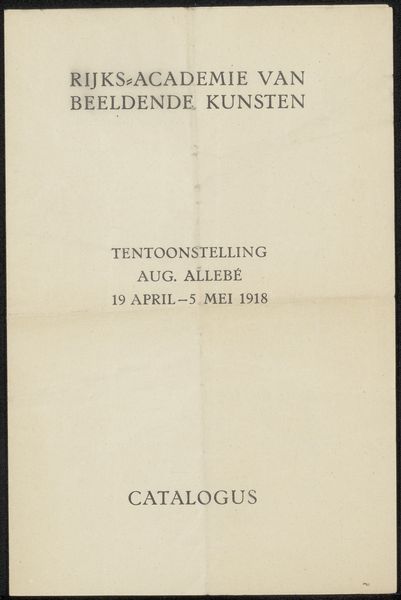
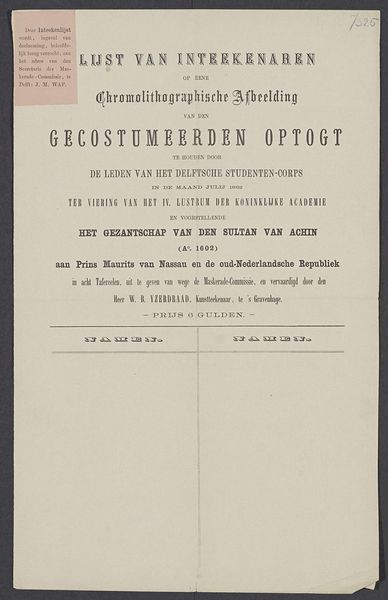
Curator: So, we’re looking at a printed poster, probably from 1918, announcing the Jubilee of Augustus Allebé at the Rijksacademie van Beeldende Kunsten. What's catching your eye? Editor: The immediate vibe is… austere, almost melancholic. I’m imagining a somber ceremony. It’s simple typography, like a telegram announcing bad news but with a slight Art Nouveau twist, particularly that ever so slightly curved line dividing the name. Does that fit the cultural mood, do you think? Curator: Definitely. The shadow of the First World War loomed large. Allebé, though a celebrated figure in the Dutch art world, was nearing the end of his life. This event wasn't just a celebration; it was a recognition of a lifetime's work against a backdrop of national and international anxiety. I think the design reflects a desire for dignified remembrance. Editor: "Dignified remembrance," I like that. The names listed at the bottom—the performers? And "Tekst der gezangen…" Hymns? It reinforces this sense of formal tribute. I wonder what Sem Dresden conducted. Something suitably gravitas-filled, I imagine. Curator: Yes, exactly. Sem Dresden was a very important composer and conductor; the list does indeed mention vocalists and performers for the occasion. And "Tekst der gezangen" suggests a very carefully chosen repertoire designed to honor Allebé's legacy within a specific cultural framework, right? Think about the significance of vocal music at that time, the power of collective voice... Editor: A collective lament, maybe? It makes you wonder about Allebé himself. Was he present? Did he approve the program? This poster becomes this tangible link to a moment where personal artistic achievement intersected with a nation facing enormous change and profound loss. Curator: Precisely. And that tension, between individual achievement and collective experience, is what makes it a really poignant historical artifact, I think. Editor: I'm going to remember this poster—not as a straightforward announcement, but as a quiet whisper from a fractured time, celebrating art in the face of it all. It's sad, really, but there’s resilience humming beneath it all too.
Comments
No comments
Be the first to comment and join the conversation on the ultimate creative platform.
 Collect
 React
React Comment
More like this